
Free Pre-Start Checklist (Seeder) Template
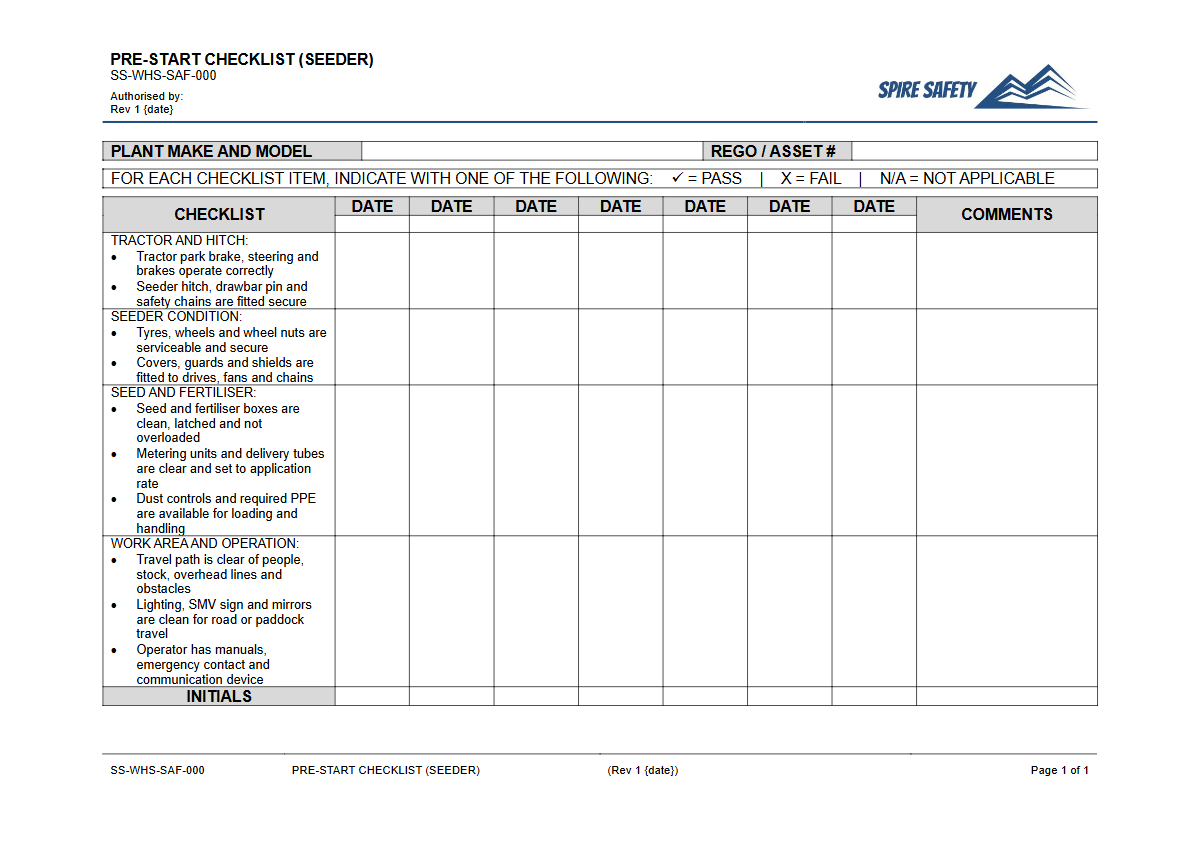
Download our free Pre-Start Checklist (Seeder) Template. This structured DOCX & PDF resource helps formalise safety checks for agricultural seeders.
Free Pre-Start Checklist (Seeder) Template
DOCX • 125 KB + PDF
Updated Oct 2026
No signup required
Purpose of the Free Pre-Start Checklist (Seeder) Template
Operating agricultural machinery like a seeder involves significant risk. This Free Pre-Start Checklist (Seeder) Template provides a structured framework for operators to conduct thorough safety inspections before commencing work.
Regular pre-start checks are a fundamental component of any effective safety program, helping to identify mechanical faults, fluid leaks, damaged guards, or other hazards before they can cause an incident. Formalising this process not only helps prevent injuries and equipment damage but also creates a verifiable record of due diligence, which is a key part of robust WHS management systems.
Using this template helps your organisation standardise its approach to equipment safety. It ensures that every operator checks the same critical components every time, promoting a consistent safety culture.
By identifying and rectifying potential issues early, you can improve equipment reliability, reduce costly downtime during critical sowing periods, and demonstrate a commitment to workplace health and safety.
Video walkthrough
How to use the Free Pre-Start Checklist (Seeder) Template
This template is designed for immediate, practical use. After downloading the DOCX or PDF file, it can be integrated into your daily operations.
The primary goal is to make the safety inspection process simple, repeatable, and easy to document.
Follow these steps for effective implementation:
- Download: Choose your preferred format, DOCX for easy customisation or PDF for straightforward printing.
- Customise: This is the most critical step. Adapt the checklist to include the specific components, controls, and safety features of your particular seeder model. Add your company branding and any site-specific requirements.
- Train: Ensure all operators are trained not just on how to operate the seeder, but on the importance and correct procedure for completing the pre-start check. Discussing the checklist's items can be an excellent topic, and our Pre-Start Checks and Plant Maintenance Toolbox Talk can help structure this training.
- Implement: Make the checklist a mandatory step before any seeder is used. Establish a clear process for what operators should do if they identify a fault, including who to report it to and how to tag the equipment as out-of-service.
- Review: Periodically review completed checklists to identify recurring faults, which may indicate a need for revised maintenance schedules or further operator training.
Please note: This document provides a foundational template. To be effective, you must customise it to reflect the specific machinery, tasks, and control measures relevant to your workplace. We provide this resource as a starting point, and its application should be managed by a competent person.
When to use a Seeder Pre-Start Checklist
A pre-start checklist for a seeder should be completed at the beginning of every shift or before each use, whichever comes first. This routine ensures that the equipment's condition has not changed since its last operation due to damage, tampering, or environmental factors.
It is a proactive safety measure, distinct from scheduled maintenance, that catches immediate hazards. The results of these checks can also serve as talking points in daily team meetings, which can be documented using a free Pre-Start Meeting Template to ensure all workers are aware of equipment status.
Who should use this Checklist
This checklist is designed primarily for use by competent and trained seeder operators. These are the individuals at the frontline who interact with the equipment daily and are best positioned to notice small changes or defects.
Supervisors also have a key role; they are responsible for ensuring operators are completing the checks correctly and for taking appropriate action when faults are reported. Maintenance personnel may also use the completed checklists to gain insight into recurring equipment issues, helping to inform preventative maintenance strategies. For other types of agricultural or landscaping plant, you may need a different checklist, such as our Free Pre-Start Checklist (Aerator) Template.
Integrating Pre-Start Checks into Your Safety System
A pre-start checklist is not a standalone document; it is one part of a comprehensive safety management system. The data gathered should feed into your broader risk management processes.
Regular analysis of checklist records can highlight trends, such as common failure points on a specific model or patterns of operator error, which can then be addressed through engineering controls, updated procedures, or targeted training. To ensure your processes remain effective and aligned with legal duties, consider periodic WHS compliance auditing of your plant and equipment procedures. For more useful documents, browse our complete free WHS resources library.
Common mistakes
Common mistakes to avoid
- Using a generic, non-customised checklist that doesn't match the specific seeder.
- Rushing or skipping checks to save time, especially during busy sowing seasons.
- Failing to report or take corrective action on defects found during the inspection.
- Poor record-keeping, such as losing forms or filing them incorrectly.
Legal references
Legal considerations
The following legal requirements may be relevant to this type of work.
- Work Health and Safety Act (Harmonised) — Provides the primary duties for protecting workers and other people from work health and safety risks.
- Work Health and Safety Regulations (Harmonised) — Sets out requirements supporting the management of workplace hazards and risks.
The following codes may be relevant to this type of work.
- Managing WHS Risks Code of Practice — Provides practical guidance on identifying hazards, assessing risks and applying effective controls.
- Work Health and Safety Consultation, Cooperation and Coordination Code of Practice — Provides practical guidance on consulting workers and coordinating with other duty holders.
- Managing the Work Environment and Facilities Code of Practice — Provides practical guidance on safe work environments, workplace facilities and related controls.
Did you know
Entanglement Hazard
The rotating shafts, augers, and moving parts on seeders present a major entanglement hazard. A thorough pre-start check ensures all guards and safety cut-offs are correctly fitted and functional.
Record Keeping
Completed pre-start checklists are a legal record under WHS law. They demonstrate proactive safety management and can be invaluable during incident investigations or maintenance planning.
FAQ
Frequently asked questions
01What should be included in a seeder pre-start checklist?
02How often do I need to do a pre-start check on a seeder?
03Is a digital pre-start checklist better than a paper one?
04Who is responsible for ensuring pre-start checks are completed?
Share this resource
Free Pre-Start Checklist (Seeder) Template
Browse Categories
How To Use It
- 1Download and open in Word or PDF.
- 2Replace the placeholders with your business details.
- 3Get it reviewed by a WHS specialist before rollout.
Need it customised?
Our WHS consultants can adapt this template to your site, run a gap analysis, or audit what you already have in place.
Book a Free Consultation WHS consulting servicesor call 1300 156 382