
Free Pre-Start Checklist (Scrub Tower) Template
Download our Free Pre-Start Checklist (Scrub Tower) Template to formalise your equipment inspections.
Free Pre-Start Checklist (Scrub Tower) Template
DOCX • 125 KB + PDF
Updated Oct 2026
No signup required
Purpose of the Free Pre-Start Checklist (Scrub Tower) Template
A scrub tower, or gas scrubber, is critical for controlling air pollution in many industrial settings. Ensuring it operates correctly is essential for both environmental compliance and worker safety.
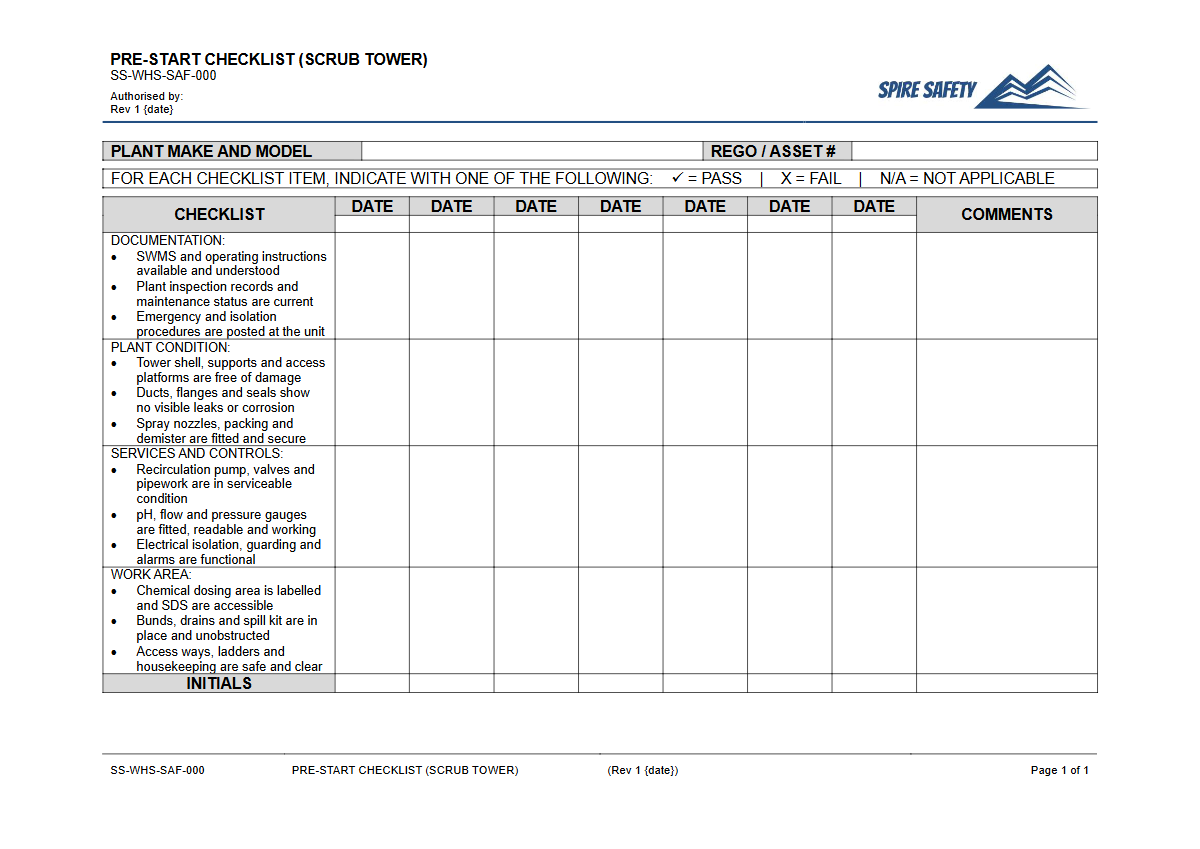
This Free Pre-Start Checklist (Scrub Tower) Template provides a structured starting point for organisations to formalise their daily equipment inspections. Using a checklist helps operators methodically verify that the equipment is safe to use, identify potential faults before they lead to costly breakdowns, and document due diligence in managing plant-related risks.
Regular pre-start inspections are a fundamental component of any plant safety program. They help a Person Conducting a Business or Undertaking (PCBU) meet their primary duty of care by taking reasonably practicable steps to eliminate or minimise risks.
Reinforcing the importance of these checks can be achieved with regular training, such as through our Pre-Start Checks and Plant Maintenance Toolbox Talk, which helps embed safe behaviour among operators and maintenance staff.
Video walkthrough
How to use the Free Pre-Start Checklist (Scrub Tower) Template
This resource is available as a fully editable DOCX file and a print-ready PDF. The checklist is designed to be comprehensive but also general in nature.
It includes sections for checking structural components, pumps, fans, instrumentation, safety guards, and fluid levels. The goal is to provide a solid foundation that you can adapt for your specific operational context.
Important: Before implementing this checklist, you must customise it to suit your specific workplace. We recommend a competent person reviews and amends the document to include items specific to your scrub tower's make and model, the chemicals used in your process, and any unique environmental or operational hazards.
Your safe work procedures and the manufacturer's operating manual should be the primary sources for customisation. This process is similar for any specific piece of plant, such as what would be required for our Free Pre-Start Checklist (Agitator) Template.
When to use it
A pre-start inspection should be conducted at the beginning of every shift or before the scrub tower is operated for the first time each day. It should also be completed after any maintenance, repair, or modification has occurred to ensure the equipment has been returned to a safe operational state.
Integrating this check into daily routines, perhaps alongside a daily team briefing using a Pre-Start Meeting Template, helps establish a consistent safety culture.
Who should use it
The pre-start checklist should be completed by the plant operator or another worker who is trained, competent, and authorised to operate the specific scrub tower. Supervisors should periodically review completed checklists to verify that inspections are being performed correctly and that any reported issues are being addressed promptly.
These records are a vital input for your broader WHS management systems, providing valuable data on equipment condition and operator behaviour.
Key Inspection Points for a Scrub Tower
While your customised checklist will be more detailed, it should cover several critical areas. A thorough inspection framework helps ensure no key system is overlooked. Consider including checks for:
- Structural Integrity: Look for signs of corrosion, cracks, or leaks in the tower body, ducting, and support structures.
- Mechanical Components: Check pumps, fans, and motors for unusual noises, vibrations, or heat. Ensure belts and couplings are in good condition and properly guarded.
- Fluid Systems: Verify the level and concentration of the scrubbing liquid. Check for leaks in pipes, valves, and seals.
- Instrumentation and Controls: Confirm that pressure gauges, flow meters, pH sensors, and temperature indicators are functioning and providing plausible readings.
- Safety Features: Test emergency stops, check that machine guarding is secure, and ensure warning labels and signage are legible and in place.
Many industrial systems share similar inspection principles. For instance, an air handling unit also requires checks on fans, motors, and structural integrity, as reflected in our Free Pre-Start Checklist (Air Handler) Template.
Beyond the Checklist: Reporting and Record Keeping
Completing the checklist is only the first step. The process must include clear procedures for what to do when a fault is found.
Any identified defect that poses a risk to health and safety means the equipment must not be used. It should be isolated, tagged out, and reported to a supervisor or the maintenance department immediately.
Completed checklists serve as important records that can be reviewed during incident investigations or safety audits, demonstrating a systematic approach to risk management. Regular reviews of these records can also highlight recurring issues, informing proactive maintenance schedules and potentially forming part of a WHS compliance auditing program to verify procedures are effective.
This document is just one of many tools designed to help you build a safer workplace. For more templates and guides, browse our complete free WHS resources library.
Common mistakes
Common mistakes to avoid
- Failing to customise the generic template for the specific make, model, and application of the scrub tower.
- Operators 'pencil-whipping' the checklist without physically verifying each item.
- Not immediately tagging out and reporting equipment when a safety-critical fault is discovered.
- Poor record-keeping or failing to review completed checklists to identify recurring faults and maintenance trends.
Legal references
Legal considerations
The following legal requirements may be relevant to this type of work.
- Work Health and Safety Act (Harmonised) — Provides the primary duties for protecting workers and other people from work health and safety risks.
- Work Health and Safety Regulations (Harmonised) — Sets out requirements supporting the management of workplace hazards and risks.
The following codes may be relevant to this type of work.
- Managing WHS Risks Code of Practice — Provides practical guidance on identifying hazards, assessing risks and applying effective controls.
- Work Health and Safety Consultation, Cooperation and Coordination Code of Practice — Provides practical guidance on consulting workers and coordinating with other duty holders.
- Managing the Work Environment and Facilities Code of Practice — Provides practical guidance on safe work environments, workplace facilities and related controls.
Did you know
Pollutant Removal
Wet scrubbers can remove pollutant particles by capturing them in liquid droplets. They can also be effective at removing gases by absorbing or chemically neutralising them with the scrubbing liquid.
Cost of Downtime
Unplanned equipment downtime is a major cost for industrial facilities. Proactive maintenance and daily inspections can reduce the risk of catastrophic failure by up to 75%.
FAQ
Frequently asked questions
01What is a scrub tower pre-start checklist?
02Why are daily checks on a scrub tower important?
03Who is responsible for completing the scrub tower pre-start?
04Can this template be used for any type of industrial scrubber?
Share this resource
Free Pre-Start Checklist (Scrub Tower) Template
Browse Categories
How To Use It
- 1Download and open in Word or PDF.
- 2Replace the placeholders with your business details.
- 3Get it reviewed by a WHS specialist before rollout.
Need it customised?
Our WHS consultants can adapt this template to your site, run a gap analysis, or audit what you already have in place.
Book a Free Consultation WHS consulting servicesor call 1300 156 382