
Free Pre-Start Checklist (Seed Drill) Template
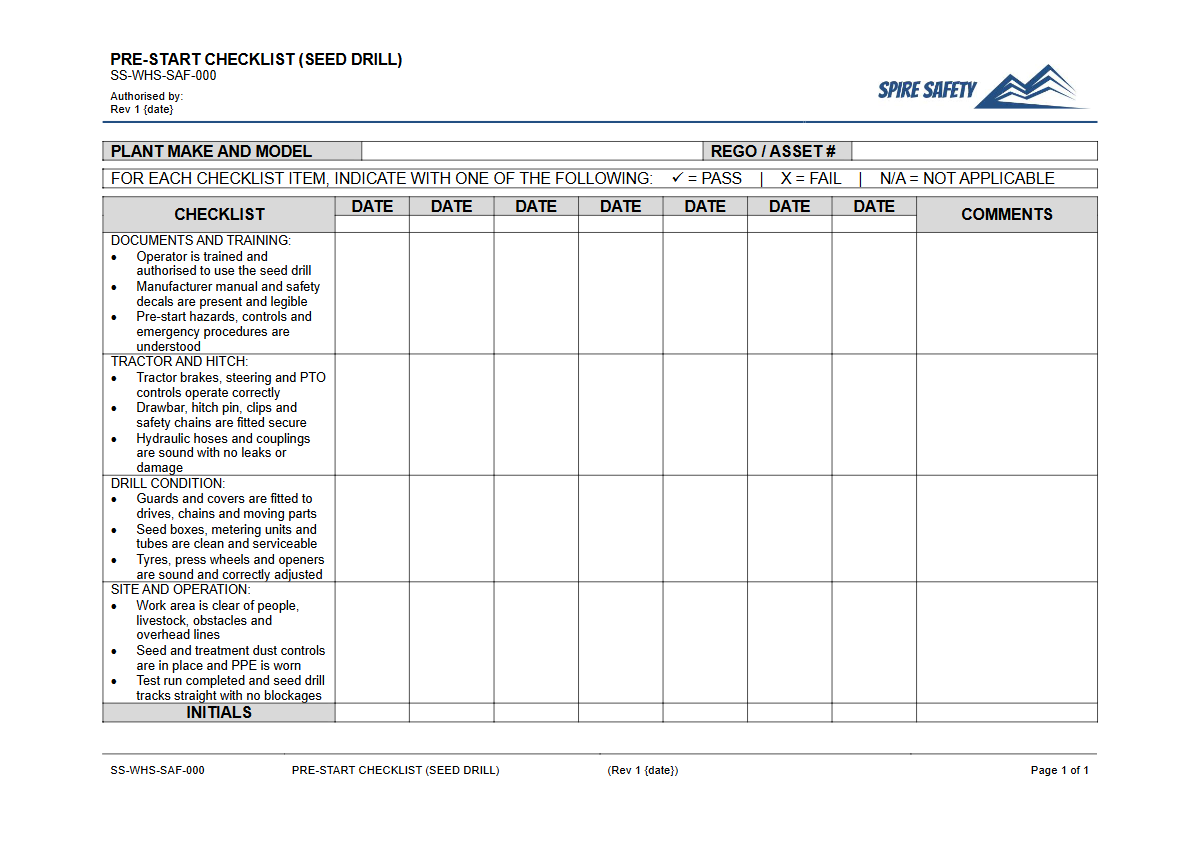
Download our Free Pre-Start Checklist (Seed Drill) Template (DOCX/PDF) to formalise your pre-operational safety inspections.
Free Pre-Start Checklist (Seed Drill) Template
DOCX • 125 KB + PDF
Updated Oct 2026
No signup required
Purpose of the Free Pre-Start Checklist (Seed Drill) Template
A seed drill, like all agricultural plant, presents significant risks if not properly maintained and inspected. This Free Pre-Start Checklist (Seed Drill) Template provides a structured framework for operators to conduct thorough pre-operational checks.
Using this checklist helps formalise the process of identifying and documenting potential hazards such as worn components, hydraulic leaks, or damaged guards before the machine is used. It serves as a critical first step in a safe system of work, complementing documents like a Seed Drill SOP (Safe Operating Procedure). Regular, documented checks are a fundamental part of managing risks associated with mobile plant in agriculture, helping to prevent incidents, minimise downtime, and demonstrate due diligence.
Video walkthrough
How to use the Free Pre-Start Checklist (Seed Drill) Template
Begin by downloading the template in your preferred format, either DOCX for easy editing or PDF for straightforward printing. The checklist is designed as a comprehensive starting point, aligned with Australian WHS principles, but it is not a one-size-fits-all solution.
It is essential that you adapt the content to the specific make and model of your seed drill, your unique site conditions, and any specific attachments or configurations you use.
Important: This is a template and must be customised to your workplace. We are not responsible for your safety outcomes.
You must consult with your operators and a competent safety professional to ensure the final document is suitable for your specific equipment and operational context.
When to use a Pre-Start Checklist
A pre-start checklist for a seed drill should be completed by the operator before the start of every shift or before the first use each day. This frequency ensures that any faults or damage that may have occurred overnight, during transport, or since the last use are identified before the equipment becomes operational.
It should also be used after significant maintenance or repair work to verify the machine is safe to return to service. Consistent use of these checks can be reinforced through regular team discussions, such as a Pre-Start Checks and Plant Maintenance Toolbox Talk.
Who should use it
The checklist should be completed by a person who is competent to operate the seed drill. This operator has the hands-on knowledge to effectively assess the machine's condition.
Supervisors or farm managers also have a role; they are responsible for ensuring the checks are being completed correctly and for implementing procedures to address any reported faults. This includes ensuring faulty equipment is tagged out and not used until it is repaired by a qualified person. This shared responsibility is a key component of effective WHS management systems.
Benefits of Consistent Pre-Start Checks
Implementing a routine of daily pre-start inspections offers numerous benefits beyond basic compliance. It fosters a proactive safety culture where operators take ownership of the condition of their equipment.
Early detection of minor issues like hydraulic fluid seeps or worn tines can prevent catastrophic failures, leading to significant cost savings by avoiding major repairs and unplanned downtime. Documented checks also provide a valuable maintenance history, allowing for better planning of servicing and parts procurement.
Standardising checks across different types of equipment, such as with our Free Pre-Start Checklist (Aerator) Template, creates consistency in your safety processes.
Integrating Checklists into Your Safety System
A pre-start checklist is most effective when it's integrated into a broader safety management framework. The information gathered should be reviewed to identify trends, such as recurring faults on a particular machine, which may indicate a need for a maintenance schedule review or operator retraining.
For businesses looking to formalise these processes but lacking in-house resources, engaging external expertise can be invaluable. Spire Safety offers WHS consulting to help agricultural businesses develop and implement practical safety systems that work.
You can also explore our entire free WHS resources library for more templates and guides.
Common mistakes
Common mistakes to avoid
- "Pencil-whipping" the checklist without physically inspecting the items.
- Ignoring seemingly minor issues like dirty windows or low-pressure tyres, which can contribute to incidents.
- Failing to adapt the generic template to the specific make, model, and configuration of the seed drill.
- Not immediately removing faulty equipment from service and clearly tagging it as "Out of Service".
Legal references
Legal considerations
The following legal requirements may be relevant to this type of work.
- Work Health and Safety Act (Harmonised) — Provides the primary duties for protecting workers and other people from work health and safety risks.
- Work Health and Safety Regulations (Harmonised) — Sets out requirements supporting the management of workplace hazards and risks.
The following codes may be relevant to this type of work.
- Managing WHS Risks Code of Practice — Provides practical guidance on identifying hazards, assessing risks and applying effective controls.
- Work Health and Safety Consultation, Cooperation and Coordination Code of Practice — Provides practical guidance on consulting workers and coordinating with other duty holders.
- Managing the Work Environment and Facilities Code of Practice — Provides practical guidance on safe work environments, workplace facilities and related controls.
Did you know
Agricultural Machinery Risks
According to Safe Work Australia, tractors and other mobile farm machinery are involved in a significant number of serious injuries and fatalities in the Australian agriculture industry each year, highlighting the importance of pre-operational checks.
FAQ
Frequently asked questions
01What is the difference between a pre-start checklist and a Safe Operating Procedure (SOP)?
02How often should a seed drill be inspected?
03Is this template suitable for all types of seed drills?
04Who is responsible for actioning faults found during a pre-start check?
Share this resource
Free Pre-Start Checklist (Seed Drill) Template
Browse Categories
How To Use It
- 1Download and open in Word or PDF.
- 2Replace the placeholders with your business details.
- 3Get it reviewed by a WHS specialist before rollout.
Need it customised?
Our WHS consultants can adapt this template to your site, run a gap analysis, or audit what you already have in place.
Book a Free Consultation WHS consulting servicesor call 1300 156 382