
Free Pre-Start Checklist (Screw Conveyor) Template
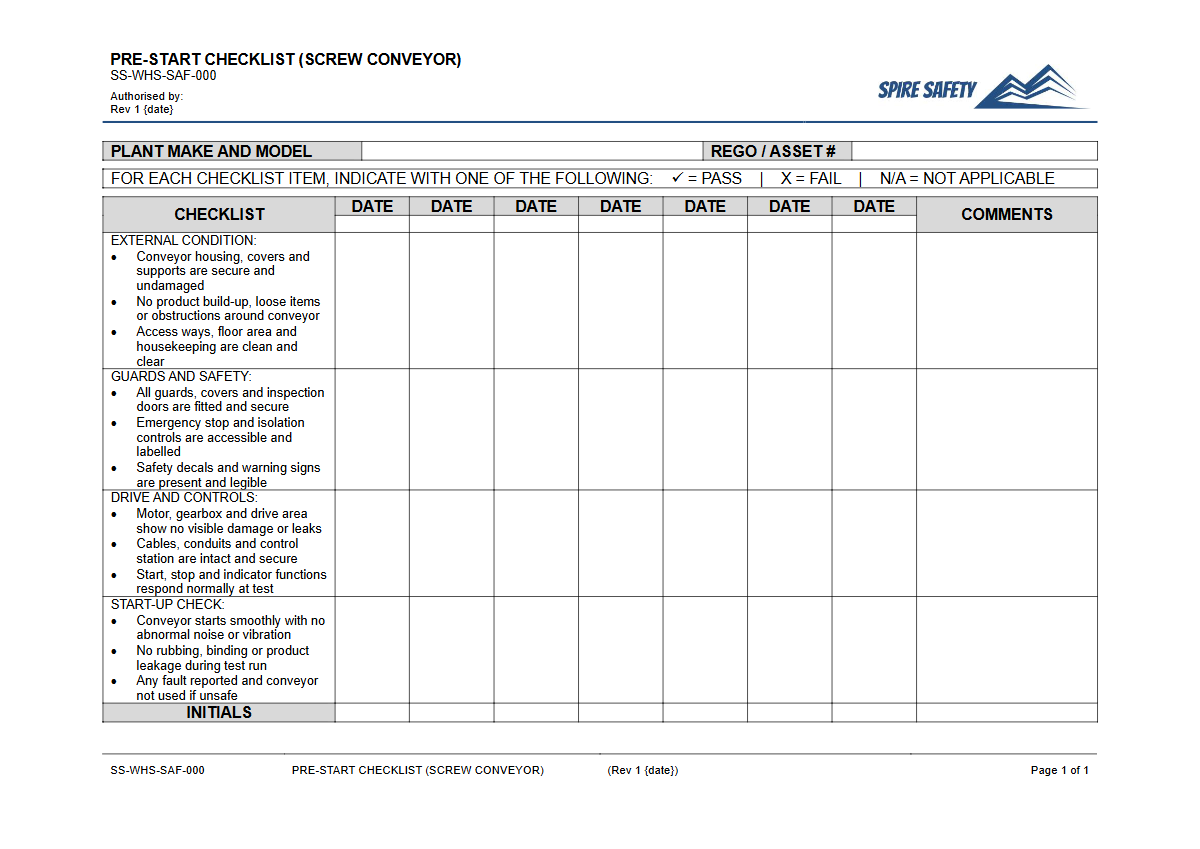
Formalise daily safety inspections for screw conveyors with our free Pre-Start Checklist. This DOCX & PDF template provides a structured starting point.
Free Pre-Start Checklist (Screw Conveyor) Template
DOCX • 125 KB + PDF
Updated Oct 2026
No signup required
Purpose of the Free Pre-Start Checklist (Screw Conveyor) Template
This free Pre-Start Checklist (Screw Conveyor) Template is designed to help your organisation formalise the daily safety inspections of screw conveyor systems. Screw conveyors present significant WHS risks, including entanglement, crushing, and shearing, primarily due to the rotating auger.
A consistent pre-start inspection process is a critical control measure to ensure the equipment is safe to operate before each shift begins.
Using a structured checklist helps operators systematically identify potential faults, damage, or missing safeguards that could lead to an incident. It provides a documented record of due diligence, demonstrating that steps are being taken to manage plant-related hazards.
Integrating such checks is a fundamental component of effective WHS management systems, helping to foster a proactive safety culture where equipment integrity is regularly verified.
Key objectives of this checklist include:
- Verifying that all guards, covers, and safety interlocks are in place and functioning correctly.
- Confirming that emergency stops are accessible and operational.
- Checking for signs of structural damage, wear, or material fatigue on the trough, auger, and drive components.
- Ensuring the work area around the conveyor is clear of obstructions and slip/trip hazards.
- Providing a clear, documented process for reporting and rectifying defects before operation.
Video walkthrough
How to use the Free Pre-Start Checklist (Screw Conveyor) Template
This template serves as a robust starting point, aligned with Australian WHS principles. To implement it effectively, you should download the DOCX file and adapt it to the specific context of your workplace.
Effective implementation involves more than just handing out a form; it requires a systematic approach to ensure it becomes an embedded part of your daily operations.
Important: This document is a template and must be customised to your specific workplace. We cannot guarantee its suitability for your specific circumstances.
You must adapt it to reflect the make and model of your equipment, the operational environment, and your organisation's specific risk controls. For expert assistance in tailoring safety documentation, consider engaging with WHS consulting professionals.
Steps for implementation:
- Customise: Add your company branding. Most importantly, review and modify the checklist items to match the specific features, controls, and risks of your screw conveyor(s). Different models will have unique inspection points.
- Train: Ensure all operators are trained not only on how to operate the conveyor safely but also on how to conduct a thorough pre-start inspection using the customised checklist. They must understand what each item means and what constitutes a 'pass' or 'fail'.
- Implement: Integrate the checklist into the daily workflow. The inspection must be completed before the conveyor is used for the first time on any given shift.
- Review: Supervisors should periodically review completed checklists to verify they are being filled out correctly and that reported faults are being addressed in a timely manner. This process can be reviewed during a formal WHS compliance auditing program.
While this checklist is for screw conveyors, the principles of pre-start inspections apply to other equipment. For related machinery, you might find our Free Pre-Start Checklist (Food Conveyor) Template useful for different operational contexts.
When to use it
A pre-start checklist for a screw conveyor should be completed at the beginning of every shift before the equipment is operated for the first time. This ensures that its condition has not changed since its last use and it remains safe.
Additionally, a pre-start check is advisable in the following situations:
- After any maintenance or repair work has been performed.
- If the conveyor has been idle for an extended period.
- Following any incident or near miss involving the equipment, to ensure no damage has occurred.
- When the conveyor is relocated or re-installed.
Who should use it
This checklist is intended for use by workers who are trained, competent, and authorised to operate the screw conveyor. The operator performing the check is directly responsible for confirming the equipment's safety before they use it.
They must have the knowledge to identify the hazards associated with the conveyor and understand the function of its safety features.
Supervisors and managers also have a role. They are responsible for ensuring that operators are completing the pre-start checks consistently and correctly.
They must also establish a clear process for what an operator should do if they identify a fault—typically involving tagging the equipment out of service and reporting the issue to maintenance personnel or a supervisor immediately. Our Free Pre-Start Checklist (Granulator) Template outlines a similar process for associated processing equipment.
For a wider range of safety documents covering various plant and equipment, explore our complete free WHS resources library.
Common mistakes
Common mistakes to avoid
- Failing to isolate and lock out the conveyor before clearing blockages or performing maintenance.
- Operating the conveyor with guards, grates, or safety interlocks removed, damaged, or bypassed.
- Using the template 'as-is' without customising it for the specific make, model, and operating environment.
- Treating the checklist as a 'tick-and-flick' exercise without conducting a genuine physical and visual inspection.
Legal references
Legal considerations
The following legal requirements may be relevant to this type of work.
- Work Health and Safety Act (Harmonised) — Provides the primary duties for protecting workers and other people from work health and safety risks.
- Work Health and Safety Regulations (Harmonised) — Sets out requirements supporting the management of workplace hazards and risks.
The following codes may be relevant to this type of work.
- Managing WHS Risks Code of Practice — Provides practical guidance on identifying hazards, assessing risks and applying effective controls.
- Work Health and Safety Consultation, Cooperation and Coordination Code of Practice — Provides practical guidance on consulting workers and coordinating with other duty holders.
- Managing the Work Environment and Facilities Code of Practice — Provides practical guidance on safe work environments, workplace facilities and related controls.
Did you know
The Archimedes' Screw
The basic principle of the screw conveyor dates back to the 3rd century BC. Attributed to Archimedes, the 'Archimedes' Screw' was originally invented to transfer water from a low-lying body of water into irrigation ditches.
Entanglement Risk
The rotating auger inside a screw conveyor is a major entanglement hazard. Most serious incidents occur during maintenance or when operators attempt to clear blockages without first isolating and locking out the equipment's power source.
FAQ
Frequently asked questions
01What are the main hazards of a screw conveyor?
02How often should a screw conveyor pre-start check be completed?
03Who is responsible for ensuring screw conveyor safety in the workplace?
04Can this template be used for other types of conveyors, like belt or roller conveyors?
Share this resource
Free Pre-Start Checklist (Screw Conveyor) Template
Browse Categories
How To Use It
- 1Download and open in Word or PDF.
- 2Replace the placeholders with your business details.
- 3Get it reviewed by a WHS specialist before rollout.
Need it customised?
Our WHS consultants can adapt this template to your site, run a gap analysis, or audit what you already have in place.
Book a Free Consultation WHS consulting servicesor call 1300 156 382