
Free Pre-Start Checklist (Scissor Lift) Template
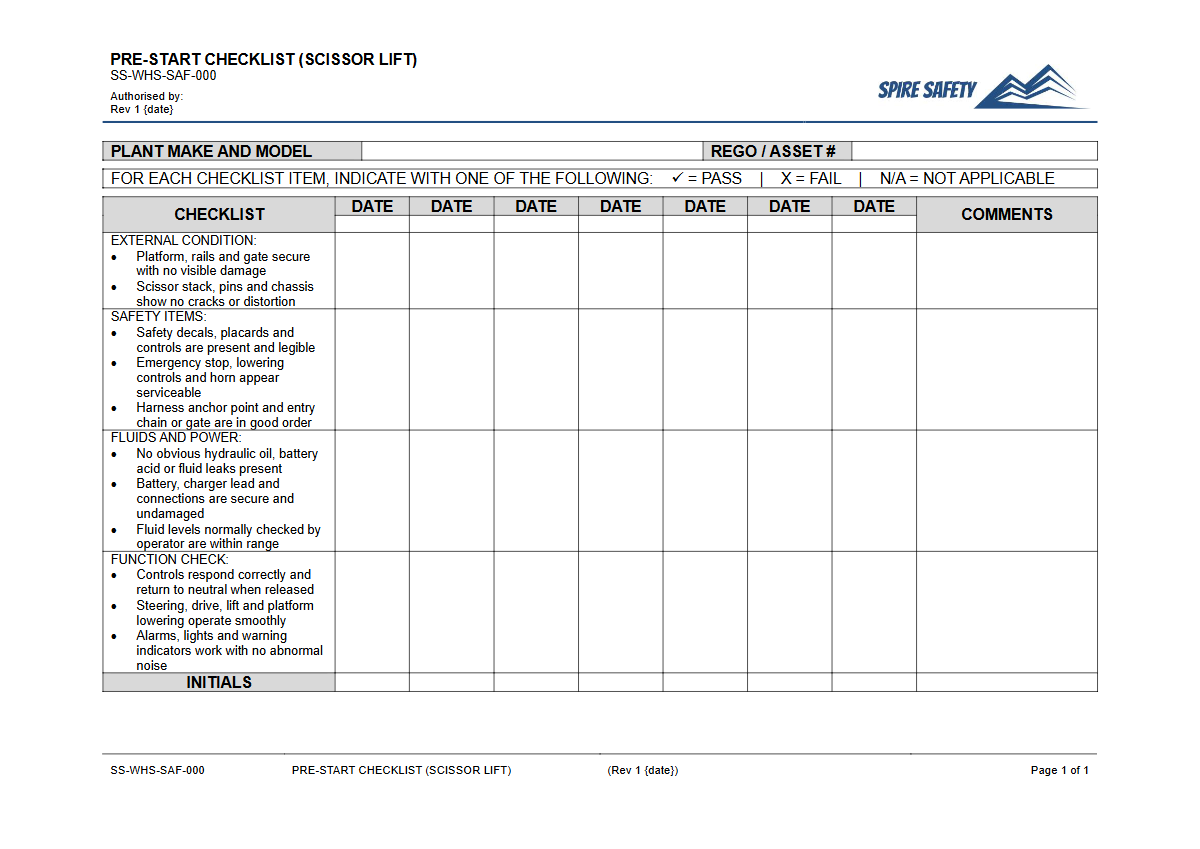
Download our Free Pre-Start Checklist (Scissor Lift) Template. This structured DOCX & PDF document helps formalise daily equipment safety inspections.
Free Pre-Start Checklist (Scissor Lift) Template
DOCX • 125 KB + PDF
Updated Oct 2026
No signup required
Purpose of the Free Pre-Start Checklist (Scissor Lift) Template
Operating a scissor lift safely begins long before the platform is raised. A critical step is the daily pre-start inspection, a fundamental practice for any organisation using mobile elevating work platforms (MEWPs).
This free Pre-Start Checklist (Scissor Lift) Template provides a structured starting point for operators to systematically check their equipment, identify potential hazards, and ensure the machine is fit for use. Regular, documented inspections are a key component of a proactive safety culture and help a Person Conducting a Business or Undertaking (PCBU) meet their primary duty of care under WHS legislation.
Using this checklist helps formalise the inspection process, creating a consistent record that can be reviewed and audited. It encourages operators to be methodical, reducing the chance of overlooking faults in critical systems like hydraulics, emergency controls, or guardrails.
Integrating such procedures into your daily operations is a core element of effective WHS management systems, demonstrating a commitment to preventing incidents before they occur.
Video walkthrough
How to use the Free Pre-Start Checklist (Scissor Lift) Template
This template is provided as a downloadable DOCX and PDF file. The DOCX version is fully editable, allowing you to tailor it to the specific makes and models of scissor lifts used in your workplace, as well as your site-specific risks and operational procedures. Effective implementation involves a few key steps:
- Download: Select the DOCX format for customisation or the PDF for immediate use.
- Customise: Add your company branding. Most importantly, review and adapt the checklist items to match the specific features and potential hazards of your scissor lifts. Different models have unique controls, safety mechanisms, and inspection points.
- Train: Ensure all licensed operators are trained on how to use the checklist correctly. This includes understanding what each item means, how to identify a fault, and the process for reporting defects.
- Implement: Integrate the checklist into your daily workflow. Make it a non-negotiable step before any scissor lift is used for the first time on a shift.
Note: This document is a template only. It is not a complete or finished safety document.
It is essential that you customise it to reflect the specific equipment, tasks, and environment of your workplace. We recommend seeking professional advice to ensure your final document is fit for purpose; our WHS consulting team can assist with this process.
What to Inspect on a Scissor Lift
A thorough pre-start inspection covers all key aspects of the machine, from the ground up. The checklist guides the operator through a logical sequence, typically including:
- Visual & Structural Checks: Inspecting for damage to the chassis, wheels, tyres, and platform. This includes checking for cracks in welds, loose components, and the condition of the guardrails and entry gate.
- Fluid Levels: Checking hydraulic oil, fuel (if applicable), and battery fluid levels to ensure they are within the manufacturer's recommended operating range.
- Controls & Functions: Testing all operating controls, both at ground level and on the platform, to ensure they function smoothly. This includes emergency stop buttons and the emergency lowering system.
- Safety Devices: Verifying that all safety features are in place and functional. This includes pothole protectors, tilt alarms, safety decals, and the operator's manual being present and legible.
While this template is for a scissor lift, the principle of pre-start inspections applies to all types of plant and equipment. For example, similar checks are required for heavy vehicles, as outlined in our Pre-Start Checklist (Forwarder) Template.
When to Use This Pre-Start Checklist
The pre-start checklist should be completed at the beginning of each day or shift before the scissor lift is first operated. It should also be completed after any significant event that may have affected the machine's condition, such as a repair, a period of inactivity, or if it has been transported to a new location.
Consistent use ensures that any defects that may have developed overnight or between shifts are identified before the equipment is put into service, minimising risk to the operator and others in the vicinity.
Who Should Use This Scissor Lift Checklist
The pre-start inspection must be carried out by a person who is competent to operate the scissor lift. This means they must hold the relevant High Risk Work Licence (if applicable, for boom-type EWPs over 11m) or have completed appropriate training and been deemed competent by the PCBU for scissor lifts.
The operator is responsible for performing the checks thoroughly and accurately.
Supervisors and managers also have a role. They are responsible for ensuring that operators are completing the checklists as required and for actioning any reported faults.
Completed checklists become important safety records, providing evidence that safety procedures are being followed. These records are often reviewed during a WHS compliance audit to verify that the organisation's safety systems are being implemented effectively. This process isn't limited to MEWPs; even simpler equipment requires diligent checks, as seen in our Pre-Start Checklist (Bench Grinder) Template. For more tools to help manage workplace safety, browse our complete free WHS resources library.
Common mistakes
Common mistakes to avoid
- Signing off the checklist without physically inspecting each item ('pencil-whipping').
- Failing to remove a faulty machine from service, hoping the issue will 'fix itself'.
- Using a generic checklist that doesn't cover the specific features of the scissor lift model.
- Ignoring seemingly 'minor' faults like worn tyres or low hydraulic fluid, which can lead to major incidents.
Legal references
Legal considerations
The following legal requirements may be relevant to this type of work.
- Work Health and Safety Act (Harmonised) — Provides the primary duties for protecting workers and other people from work health and safety risks.
- Work Health and Safety Regulations (Harmonised) — Sets out requirements supporting the management of workplace hazards and risks.
The following codes may be relevant to this type of work.
- Managing WHS Risks Code of Practice — Provides practical guidance on identifying hazards, assessing risks and applying effective controls.
- Work Health and Safety Consultation, Cooperation and Coordination Code of Practice — Provides practical guidance on consulting workers and coordinating with other duty holders.
- Managing the Work Environment and Facilities Code of Practice — Provides practical guidance on safe work environments, workplace facilities and related controls.
Did you know
MEWP Classification
Scissor lifts are a type of Mobile Elevating Work Platform (MEWP). Other common MEWPs include boom lifts (or 'cherry pickers'), which have different risk profiles and operating requirements.
Tip-Over Risk
According to Safe Work Australia data, tip-overs are the most common cause of fatalities involving MEWPs. The leading causes of tip-overs are driving on uneven ground and over-extending the platform.
FAQ
Frequently asked questions
01What should be checked on a scissor lift before use?
02How often should a scissor lift pre-start check be done?
03Who is responsible for completing the scissor lift pre-start checklist?
04What happens if a fault is found during a scissor lift inspection?
Share this resource
Free Pre-Start Checklist (Scissor Lift) Template
Browse Categories
How To Use It
- 1Download and open in Word or PDF.
- 2Replace the placeholders with your business details.
- 3Get it reviewed by a WHS specialist before rollout.
Need it customised?
Our WHS consultants can adapt this template to your site, run a gap analysis, or audit what you already have in place.
Book a Free Consultation WHS consulting servicesor call 1300 156 382