
Free Pre-Start Checklist (Scissor Table) Template
Download our free Pre-Start Checklist (Scissor Table) Template. This structured DOCX & PDF helps formalise equipment checks and manage WHS risks. Get yours now.
Free Pre-Start Checklist (Scissor Table) Template
DOCX • 125 KB + PDF
Updated Oct 2026
No signup required
Purpose of the Free Pre-Start Checklist (Scissor Table) Template
A scissor table, or lift table, is essential in many industrial settings for lifting and positioning heavy loads. However, it also introduces significant hazards like crushing, shearing, and uncontrolled movement.
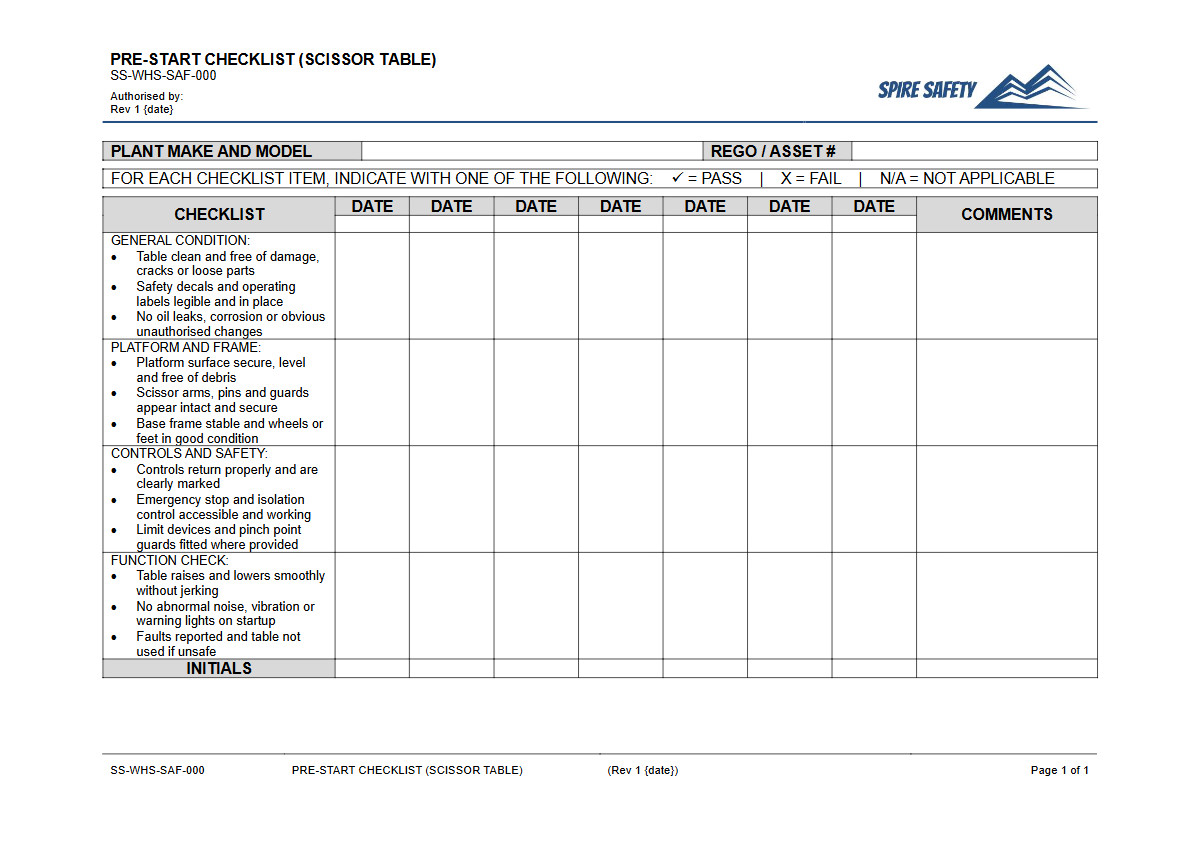
This Free Pre-Start Checklist (Scissor Table) Template provides a structured framework for operators to conduct thorough inspections before use. The primary purpose is to systematically identify any damage, wear, or malfunction that could lead to an incident.
Using this Pre-Start Checklist helps your organisation:
- Proactively identify and report equipment faults before they cause injury or failure.
- Provide a consistent inspection routine for all operators.
- Create a documented record of safety checks, demonstrating due diligence.
- Reinforce safe work practices and operator responsibility.
Integrating regular equipment inspections into your broader WHS management systems is a critical step in managing plant-related risks and meeting your duties under Australian WHS law.
Video walkthrough
How to use the Free Pre-Start Checklist (Scissor Table) Template
This resource is provided in both DOCX and PDF formats for your convenience. Download the DOCX file to customise it with your company branding and add or remove checks specific to your equipment and operating environment.
The PDF version is ready for immediate printing and use.
Important Note: This document is a template designed as a starting point. To be effective, you must customise it to reflect the specific make, model, power source (hydraulic, pneumatic, mechanical), and safety features of the scissor tables in your workplace.
We cannot guarantee it covers every potential hazard for your specific circumstances. If you require help adapting this template, our WHS consulting team can provide expert support.
When to use it
The scissor table Pre-Start Checklist should be completed at the beginning of each shift or before the equipment is used for the first time on a given day. If different operators use the same table during a 24-hour period, each operator should conduct their own check before starting their work.
This frequency ensures that any faults that may have developed—either during operation or overnight—are identified before the equipment is put back into service.
Who should use it
This checklist should be completed by workers who are trained, competent, and authorised to operate the specific scissor table. The operator is in the best position to notice subtle changes in the equipment's performance or condition.
Supervisors also have a role; they must ensure operators are completing the checks correctly and that a clear process is in place for reporting and rectifying any faults found. A periodic review of completed checklists as part of a WHS compliance auditing process can help verify that your safety procedures are being followed effectively.
The principles of pre-start inspections are fundamental to workshop safety and apply to many types of machinery. For example, similar documented checks are vital for equipment covered in our Free Pre-Start Checklist (Bench Grinder) Template.
Keeping accurate records is a key part of the process. Completed checklists should be filed and retained according to your organisation's record-keeping policy.
These records can be invaluable for tracking equipment reliability, identifying recurring problems, and demonstrating a history of safety compliance. The methodology is transferable to other industrial tools, as seen in our Free Pre-Start Checklist (Floor Saw) Template. For a wider range of safety documents, browse our free WHS resources library.
Common mistakes
Common mistakes to avoid
- Overlooking small hydraulic fluid leaks, which can indicate a developing system failure.
- Using the checklist without proper operator training on what to look for.
- Failing to immediately lock out and tag out a scissor table that has a reported fault.
- "Pencil-whipping" the checklist — ticking boxes without physically performing the checks.
Legal references
Legal considerations
The following legal requirements may be relevant to this type of work.
- Work Health and Safety Act (Harmonised) — Provides the primary duties for protecting workers and other people from work health and safety risks.
- Work Health and Safety Regulations (Harmonised) — Sets out requirements supporting the management of workplace hazards and risks.
The following codes may be relevant to this type of work.
- Managing WHS Risks Code of Practice — Provides practical guidance on identifying hazards, assessing risks and applying effective controls.
- Work Health and Safety Consultation, Cooperation and Coordination Code of Practice — Provides practical guidance on consulting workers and coordinating with other duty holders.
- Managing the Work Environment and Facilities Code of Practice — Provides practical guidance on safe work environments, workplace facilities and related controls.
Did you know
Pinch Points
The most significant hazard associated with scissor tables is crushing, caused by being caught between the moving parts of the lift mechanism or between the table platform and a fixed structure.
Capacity is Key
Exceeding the rated load capacity of a scissor table is a primary cause of mechanical and hydraulic failure. The capacity often decreases if the load is not distributed evenly across the platform.
FAQ
Frequently asked questions
01What is a scissor table pre-start checklist?
02Why is a pre-start check important for a scissor table?
03How often should a scissor table inspection be performed?
04Is a digital pre-start checklist better than a paper one?
Share this resource
Free Pre-Start Checklist (Scissor Table) Template
Browse Categories
How To Use It
- 1Download and open in Word or PDF.
- 2Replace the placeholders with your business details.
- 3Get it reviewed by a WHS specialist before rollout.
Need it customised?
Our WHS consultants can adapt this template to your site, run a gap analysis, or audit what you already have in place.
Book a Free Consultation WHS consulting servicesor call 1300 156 382