
Free Pre-Start Checklist (Scarifier) Template
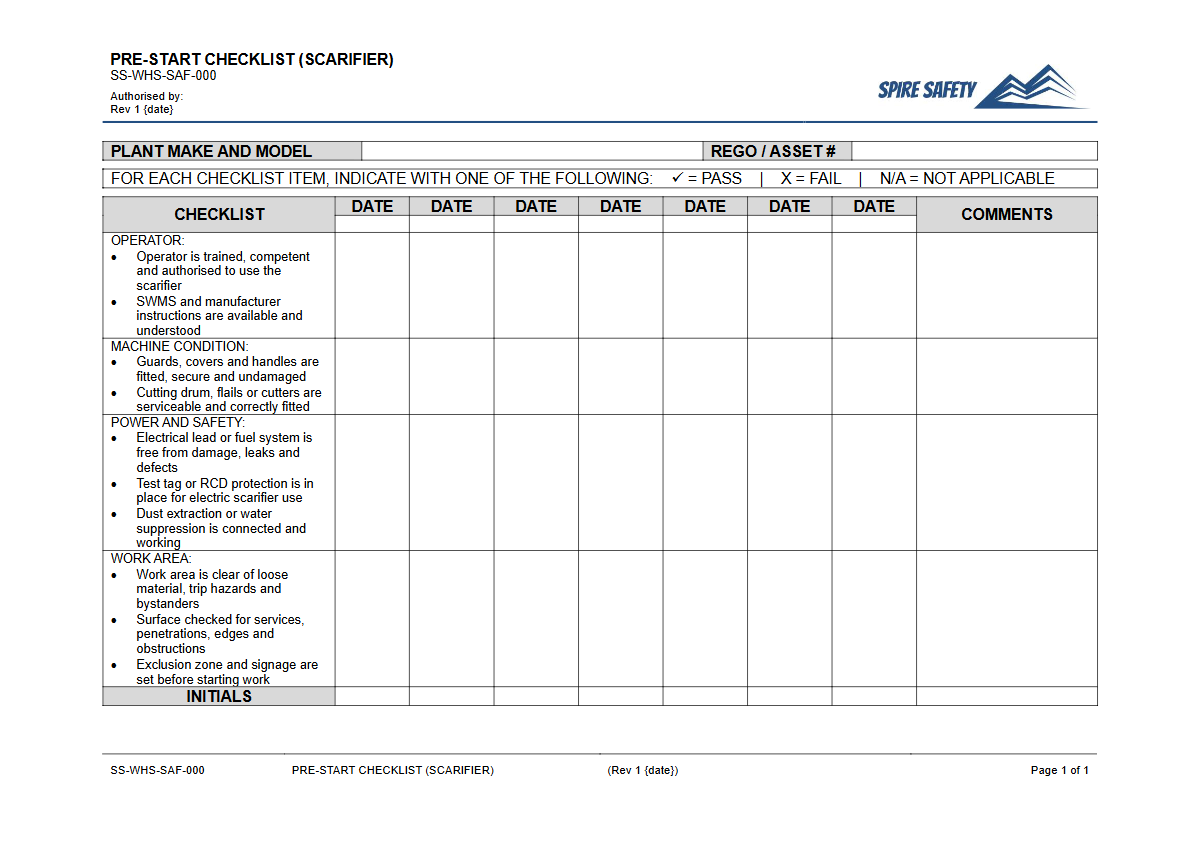
Download our Free Pre-Start Checklist (Scarifier) Template. This DOCX & PDF resource helps formalise equipment safety inspections and manage WHS risks.
Free Pre-Start Checklist (Scarifier) Template
DOCX • 125 KB + PDF
Updated Oct 2026
No signup required
Purpose of the Free Pre-Start Checklist (Scarifier) Template
Using a scarifier, whether for turf renovation or surface preparation, involves significant mechanical hazards. Implementing a routine inspection before each use is a critical control measure to ensure the equipment is safe to operate.
Our Free Pre-Start Checklist (Scarifier) Template provides a structured framework for operators to conduct these vital safety checks.
This template helps your organisation formalise the inspection process, creating a record that a check has been completed. It prompts operators to systematically inspect key components like blades or tines, guards, controls, and fluid levels.
By identifying potential faults or damage before operation begins, you can prevent equipment failure, reduce the risk of serious injury, and minimise costly downtime. Integrating such checks is a fundamental part of a proactive WHS management system, demonstrating a commitment to plant safety.
Video walkthrough
How to use the Free Pre-Start Checklist (Scarifier) Template
This document is designed as a starting point. After downloading the DOCX or PDF file, you should review and adapt the checklist to suit the specific models of scarifiers used at your workplace, your site conditions, and your operational procedures.
It is crucial to engage with operators and maintenance staff during this customisation process.
Things to consider adding or modifying include:
- Specific checks for petrol, diesel, or electric power sources.
- Checks relevant to pedestrian-operated or ride-on models.
- Inspection points for unique attachments or features.
- Site-specific considerations, such as the type of terrain or environment.
Important Note: This is a generic template. For it to be effective, we strongly recommend you customise it by consulting with your team to ensure it covers all relevant hazards for your specific equipment and work environment.
Training on how to complete the checklist properly can be supported by delivering a Pre-Start Checks and Plant Maintenance Toolbox Talk to all relevant workers.
When to use it
A pre-start check should be conducted before every use or at the beginning of each shift where the scarifier will be operated. It is a non-negotiable step for the first operator of the day.
Additionally, a full pre-start inspection is recommended if the equipment has been returned from off-site maintenance, has been idle for an extended period, or if a different operator takes over mid-shift.
Who should use it
The primary person responsible for completing the scarifier pre-start checklist is the competent person assigned to operate the equipment. They have the most immediate interaction with the machine and are best placed to notice any changes or defects.
Supervisors also have a responsibility to ensure these checks are being completed correctly and consistently. They must review the completed checklists to identify recurring faults and schedule necessary maintenance.
The data from these checks is invaluable for internal WHS compliance auditing activities, helping to spot trends in equipment condition or operator behaviour.
The process is similar to checks for other turf equipment outlined in our Free Pre-Start Checklist (Aerator) Template. While the operator performs the check, the Person Conducting a Business or Undertaking (PCBU) holds the ultimate responsibility for ensuring a system for plant inspection is in place and effective. A pre-start check is just one element of a comprehensive approach to managing plant safety.
For certain high-risk tasks, this may also involve developing a specific procedure, much like the process for creating a Safe Work Method Statement (Concrete Truck Operation) Template for other types of mobile plant.
By embedding this simple habit into your daily operations, you build a stronger safety culture where everyone is accountable for their own safety and the safety of those around them. To discover more ways to improve your safety documentation, explore our complete free WHS resources library.
Common mistakes
Common mistakes to avoid
- Failing to check the security, sharpness, and condition of blades or tines.
- Ignoring safety guards, dead man's levers, or emergency stops that have been bypassed or are faulty.
- Completing the form without physically checking each item ('tick and flick' behaviour).
- Not immediately removing faulty equipment from service and reporting the defect.
Legal references
Legal considerations
The following legal requirements may be relevant to this type of work.
- Work Health and Safety Act (Harmonised) — Provides the primary duties for protecting workers and other people from work health and safety risks.
- Work Health and Safety Regulations (Harmonised) — Sets out requirements supporting the management of workplace hazards and risks.
The following codes may be relevant to this type of work.
- Managing WHS Risks Code of Practice — Provides practical guidance on identifying hazards, assessing risks and applying effective controls.
- Work Health and Safety Consultation, Cooperation and Coordination Code of Practice — Provides practical guidance on consulting workers and coordinating with other duty holders.
- Managing the Work Environment and Facilities Code of Practice — Provides practical guidance on safe work environments, workplace facilities and related controls.
Did you know
Blade Wear is Critical
Scarifier blades, also known as flails or tines, wear down quickly, especially in abrasive soils. A worn or unbalanced set of blades can cause excessive vibration, leading to operator fatigue and premature failure of machine bearings and components.
Hidden Hazards
Underground services like irrigation pipes, gas lines, and electrical cables are a major hazard when scarifying. Always conduct a site assessment and consult site plans or use a service locator before starting work in a new area.
FAQ
Frequently asked questions
01What is a scarifier pre-start checklist for?
02Is this scarifier checklist a legal document?
03Who is responsible for completing the scarifier checklist?
04What happens if a fault is found during a pre-start check?
Share this resource
Free Pre-Start Checklist (Scarifier) Template
Browse Categories
How To Use It
- 1Download and open in Word or PDF.
- 2Replace the placeholders with your business details.
- 3Get it reviewed by a WHS specialist before rollout.
Need it customised?
Our WHS consultants can adapt this template to your site, run a gap analysis, or audit what you already have in place.
Book a Free Consultation WHS consulting servicesor call 1300 156 382