
Free Pre-Start Checklist (Sand Blaster) Template
Download our Free Pre-Start Checklist for Sand Blasters. This DOCX & PDF template helps formalise daily equipment checks and manage WHS risks in Australia.
Free Pre-Start Checklist (Sand Blaster) Template
DOCX • 125 KB + PDF
Updated Oct 2026
No signup required
Purpose of the Free Pre-Start Checklist (Sand Blaster) Template
Abrasive blasting, commonly known as sand blasting, is a high-risk activity that exposes operators and nearby workers to significant hazards. Using this Free Pre-Start Checklist (Sand Blaster) Template helps formalise the process of inspecting equipment before use, providing a systematic way to identify potential faults that could lead to injury.
Regular checks are a critical control measure for managing risks associated with high-pressure air systems, abrasive material exposure, equipment failure, and electrical hazards. This structured approach helps demonstrate due diligence and supports a proactive safety culture within your organisation.
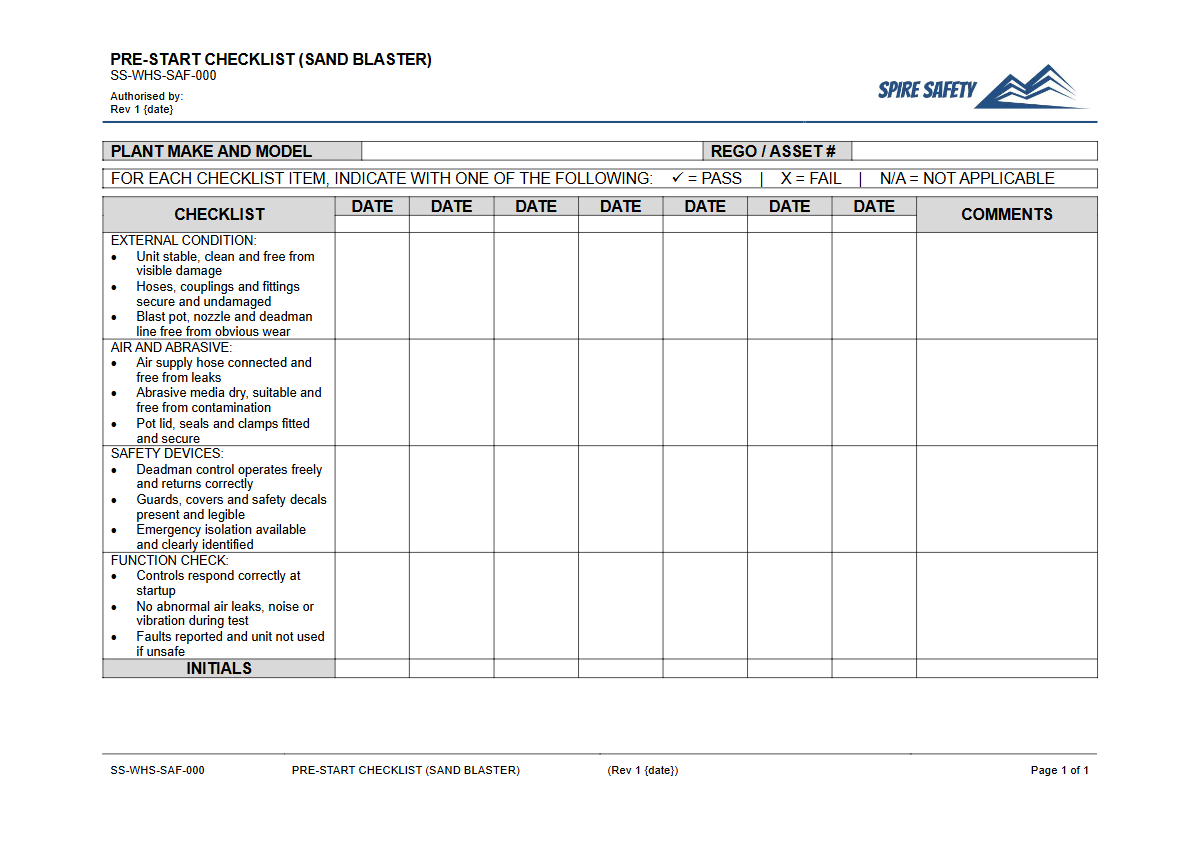
The checklist prompts operators to examine critical components like hoses, couplings, nozzles, the deadman switch, and the blast pot. Identifying wear, damage, or malfunction before starting work is essential for preventing catastrophic failures, such as hose blowouts or accidental equipment activation.
Documenting these checks creates a record of the equipment's condition over time, which can inform maintenance schedules and be integrated into your broader WHS management system to ensure a holistic approach to workplace safety.
Video walkthrough
How to Use the Free Pre-Start Checklist (Sand Blaster) Template
This template is designed for simplicity and practical application on the worksite. First, download the document in your preferred format (DOCX for easy editing or PDF for straightforward printing).
The next step is the most important: customisation. You must adapt the checklist to suit the specific make and model of your sand blasting equipment, the types of abrasive media used, and the unique conditions of your work environment.
A generic checklist cannot account for all variables.
Important: This document serves as a structured starting point. We strongly advise that you customise it to reflect your specific sand blasting equipment, work environment, and organisational procedures.
Once customised, ensure all operators are trained on how to properly complete the checklist, what each item means, and the procedure for reporting faults or taking faulty equipment out of service. This process is similar to implementing pre-start checks for equipment like bench grinders, where specific component checks are vital.
When to Use This Checklist
The pre-start checklist should be completed by the operator before the start of each shift or before the first use of the sand blaster on any given day. It is a brief, focused inspection designed to catch obvious faults that may have developed since the last use or during transport.
This routine check is not a replacement for scheduled, in-depth maintenance and servicing performed by a competent person. It is a frontline defence against equipment-related incidents and should be an ingrained part of the safe work procedure for any abrasive blasting task.
By making these checks a non-negotiable daily habit, organisations can foster a consistent safety mindset. A documented and consistent approach, similar to what is promoted in our free pre-start checklist for floor saws, helps ensure high-risk plant is always verified as safe for operation before work commences.
Who Should Use This Checklist
This checklist is intended for use by trained and competent operators who are authorised to use the sand blasting equipment. The person performing the check must have sufficient knowledge to understand what they are looking for, such as signs of wear on a blast hose or the correct function of a deadman switch.
Supervisors also play a key role in ensuring the checks are being completed correctly and that any identified issues are addressed promptly. They are responsible for taking faulty equipment out of service and arranging for repair.
The effectiveness of your pre-start inspection program can be periodically verified through regular WHS compliance auditing. This helps confirm that procedures are being followed correctly and are effective in managing risks. It also provides an opportunity to identify areas for improvement in your safety processes.
Key Inspection Areas for Sand Blasters
- Air Supply and Hoses: Check for any cuts, abrasions, or soft spots on the blast hose and air supply lines. Ensure all couplings are secure and fitted with safety locking pins.
- Deadman Switch: Test the functionality of the deadman switch. It must immediately stop the flow of abrasive material when released. This is arguably the most critical safety feature.
- Nozzle: Inspect the nozzle for excessive wear or damage. A worn nozzle can decrease efficiency and create an unpredictable blast pattern.
- Blast Pot: Check the structural integrity of the blast pot, ensuring there are no cracks or significant corrosion. Verify that the pressure vessel certification is current.
- Personal Protective Equipment (PPE): Ensure the operator's supplied-air respirator, helmet, gloves, and protective suit are in good condition and functioning correctly. This includes checking the breathing air supply lines, a process not unlike safety inspections for safety equipment like a fume cabinet.
If your team requires expert guidance on establishing safe work methods for high-risk plant like abrasive blasters, seeking assistance from a WHS consulting professional can provide clarity and ensure your procedures are robust and aligned with industry best practice.
Common mistakes
Common mistakes to avoid
- Neglecting to physically test the deadman switch functionality before starting.
- Using kinked, worn, or visibly damaged blast hoses that are at risk of bursting.
- Failing to thoroughly inspect personal protective equipment (PPE), especially the supplied-air respirator and air lines.
- Treating the checklist as a 'tick-and-flick' exercise without performing a genuine, hands-on inspection of each item.
Legal references
Legal considerations
The following legal requirements may be relevant to this type of work.
- Work Health and Safety Act (Harmonised) — Provides the primary duties for protecting workers and other people from work health and safety risks.
- Work Health and Safety Regulations (Harmonised) — Sets out requirements supporting the management of workplace hazards and risks.
The following codes may be relevant to this type of work.
- Managing WHS Risks Code of Practice — Provides practical guidance on identifying hazards, assessing risks and applying effective controls.
- Work Health and Safety Consultation, Cooperation and Coordination Code of Practice — Provides practical guidance on consulting workers and coordinating with other duty holders.
- Managing the Work Environment and Facilities Code of Practice — Provides practical guidance on safe work environments, workplace facilities and related controls.
Did you know
The Danger of 'Sand'
Many modern 'sandblasting' operations have banned silica sand due to the risk of silicosis, a severe and incurable lung disease. Alternative abrasive media like garnet, steel grit, or sodium bicarbonate are now commonly used to protect worker health.
FAQ
Frequently asked questions
01What is a sand blaster pre-start checklist?
02Why is a pre-start check so important for abrasive blasting?
03Who is responsible for completing the sand blaster checklist?
04How often should a sand blaster be inspected?
Share this resource
Free Pre-Start Checklist (Sand Blaster) Template
Browse Categories
How To Use It
- 1Download and open in Word or PDF.
- 2Replace the placeholders with your business details.
- 3Get it reviewed by a WHS specialist before rollout.
Need it customised?
Our WHS consultants can adapt this template to your site, run a gap analysis, or audit what you already have in place.
Book a Free Consultation WHS consulting servicesor call 1300 156 382