
Free Pre-Start Checklist (Root Cutter) Template
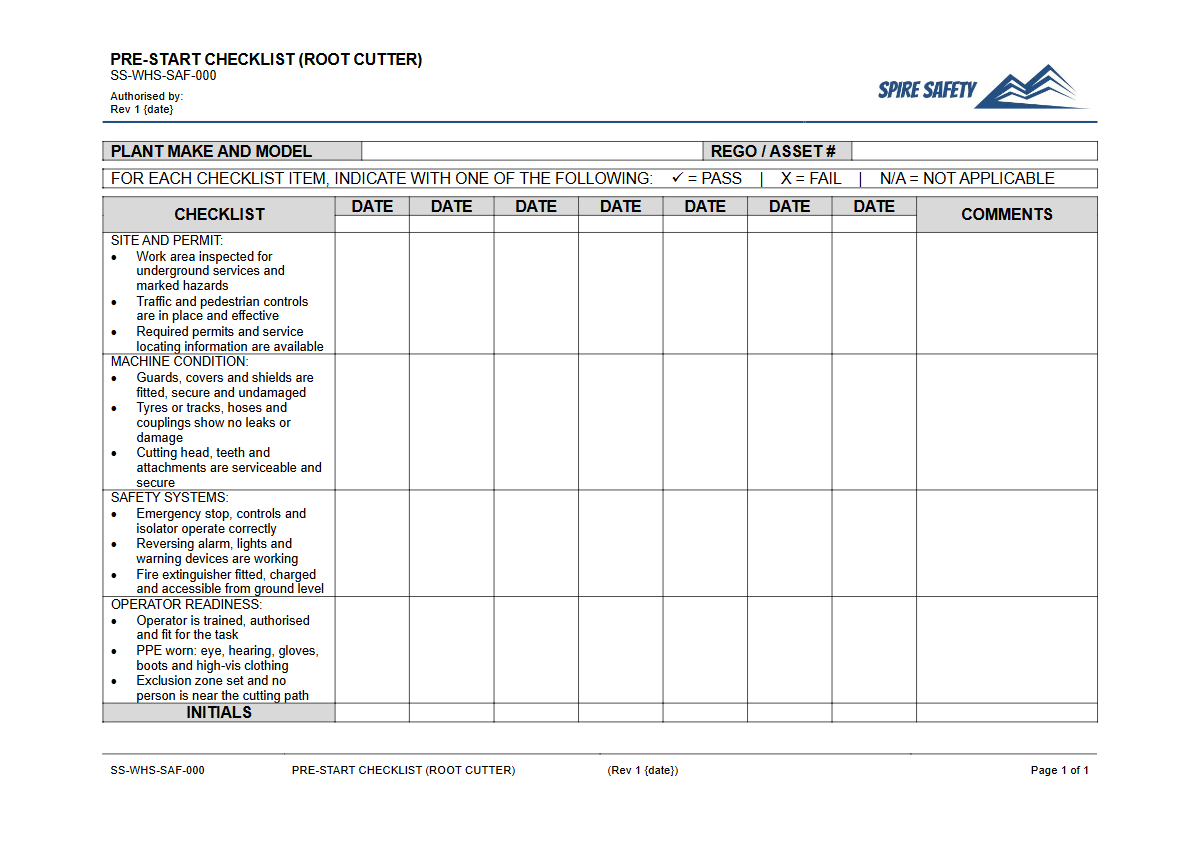
Download our free Pre-Start Checklist (Root Cutter) Template. This structured Word & PDF document helps formalise equipment safety inspections. Get your copy.
Free Pre-Start Checklist (Root Cutter) Template
DOCX • 125 KB + PDF
Updated Oct 2026
No signup required
Purpose of the Free Pre-Start Checklist (Root Cutter) Template
The primary purpose of the free Pre-Start Checklist (Root Cutter) Template is to formalise the process of identifying and controlling hazards associated with the equipment. Operating a root cutter, whether a mechanical auger or a high-pressure water jetter, involves significant risks from rotating parts, ejected debris, electrical faults, or high-pressure water injection.
A consistent pre-start inspection helps ensure that all safety guards, emergency stops, hoses, nozzles, and power systems are in good working order before operation begins. Documenting these checks also creates a clear record of due diligence, which is a key component of any robust safety system. This practice is a critical part of a proactive maintenance culture, which can be reinforced with regular safety discussions like those in our Pre-Start Checks and Plant Maintenance Toolbox Talk Template.
Video walkthrough
How to use the Free Pre-Start Checklist (Root Cutter) Template
To get started, download the file in your preferred format (DOCX for easy editing or PDF). Before deploying it in your workplace, you must review and adapt its contents.
This involves adding, removing, or modifying checklist items to align with the specific make and model of your root cutter, as well as the unique conditions of your work sites (e.g., confined spaces, public areas, terrain). Once tailored, this document becomes a core part of your safe work procedure, much like how a FREE Waterjet Cutter SOP Template outlines the entire task from start to finish.
Important: It's crucial to remember that this is a template. We strongly recommend you customise it to reflect your specific equipment, operational context, and the unique risks present in your workplace.
A generic checklist can easily miss critical, model-specific safety features or hazards.
When to use it
This checklist should be completed before every use or at the beginning of each shift where the root cutter will be operated. Consistency is vital.
Making the pre-start check a non-negotiable first step ensures that the equipment's condition is verified before it is energised or put under load. Skipping this check, even once, can lead to equipment failure and serious incidents.
These daily checks should form one part of your broader WHS management systems, which encompass all aspects of workplace safety from procedures to incident reporting and training.
Who should use it
The pre-start check should be conducted by a competent person who will be operating the root cutter. They are best placed to notice any changes, wear, or defects in the equipment they use daily.
Ensuring a worker is competent to both operate the machine and conduct a thorough inspection is a separate but related duty for a PCBU (Person Conducting a Business or Undertaking). You can formalise this process using a resource like our Verification of Competency (Pipe Cutter) Template to assess and document operator skills.
Supervisors also have a role in periodically reviewing completed checklists to ensure they are being filled out correctly and that any reported faults are being addressed promptly and effectively.
By diligently using and customising this checklist, your organisation can improve its safety outcomes and demonstrate a commitment to risk management. Regular reviews of your safety processes, including how checklists are used and actioned, are also recommended.
A formal WHS compliance auditing program can help identify gaps and opportunities for improvement across all your safety procedures. For more useful documents to support your safety framework, explore our complete free WHS resources library.
Common mistakes
Common mistakes to avoid
- Treating the checklist as a "tick and flick" exercise without physically inspecting each item.
- Using the generic template without customising it for the specific machine model and work environment.
- Continuing to use equipment after identifying a fault, instead of immediately tagging it out of service for repair.
- Failing to file and retain completed checklists, which are important records for maintenance tracking and safety audits.
Legal references
Legal considerations
The following legal requirements may be relevant to this type of work.
- Work Health and Safety Act (Harmonised) — Provides the primary duties for protecting workers and other people from work health and safety risks.
- Work Health and Safety Regulations (Harmonised) — Sets out requirements supporting the management of workplace hazards and risks.
The following codes may be relevant to this type of work.
- Managing WHS Risks Code of Practice — Provides practical guidance on identifying hazards, assessing risks and applying effective controls.
- Work Health and Safety Consultation, Cooperation and Coordination Code of Practice — Provides practical guidance on consulting workers and coordinating with other duty holders.
- Managing the Work Environment and Facilities Code of Practice — Provides practical guidance on safe work environments, workplace facilities and related controls.
Did you know
High-Pressure Hazards
High-pressure water jetters used for root cutting can operate at pressures exceeding 4,000 PSI. Accidental injection of water at this pressure can cause severe, limb-threatening injuries that require immediate specialist medical attention.
Plant-Related Incidents
According to Safe Work Australia, a significant percentage of workplace fatalities and serious injuries involve the use of plant and equipment, with inadequate inspection and maintenance being a common contributing factor.
FAQ
Frequently asked questions
01What is the main purpose of a root cutter pre-start checklist?
02Can I use this template for any brand of root cutter?
03How often should a root cutter pre-start check be completed?
04Who is responsible for signing off on a completed checklist?
Share this resource
Free Pre-Start Checklist (Root Cutter) Template
Browse Categories
How To Use It
- 1Download and open in Word or PDF.
- 2Replace the placeholders with your business details.
- 3Get it reviewed by a WHS specialist before rollout.
Need it customised?
Our WHS consultants can adapt this template to your site, run a gap analysis, or audit what you already have in place.
Book a Free Consultation WHS consulting servicesor call 1300 156 382