
Free Pre-Start Checklist (Roller Mill) Template
Download our free Pre-Start Checklist (Roller Mill) Template to formalise daily equipment checks.
Free Pre-Start Checklist (Roller Mill) Template
DOCX • 125 KB + PDF
Updated Oct 2026
No signup required
Purpose of the Free Pre-Start Checklist (Roller Mill) Template
A roller mill uses rotating cylindrical rollers to crush, grind, or mill materials. Due to the high-powered rotating parts, it presents significant risks, including entanglement, crushing, and mechanical failure.
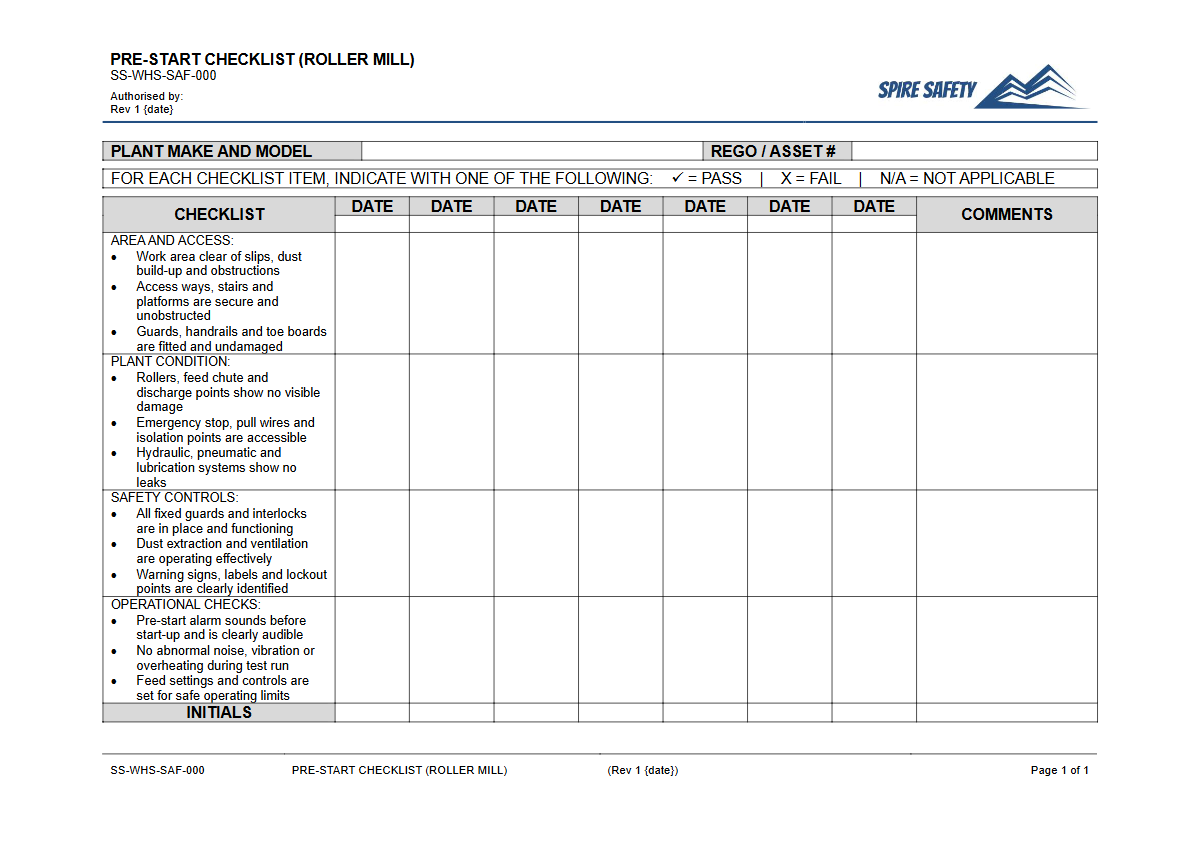
This free Pre-Start Checklist (Roller Mill) Template provides a structured framework for operators to conduct thorough inspections before use. Its primary purpose is to systematically identify potential defects, damage, or operational issues that could lead to an incident, injury, or costly downtime.
Formalising this process helps create a consistent safety standard across all shifts and operators.
Regularly completing these checks serves as a critical component of your plant and equipment maintenance program. It creates a documented record of the machine's condition over time, which can inform maintenance schedules and demonstrate due diligence.
For broader discussions on equipment safety, our Pre-Start Checks and Plant Maintenance Toolbox Talk can help reinforce these principles with your team.
Video walkthrough
How to use the Free Pre-Start Checklist (Roller Mill) Template
This resource is available for download as a DOCX file for easy editing in Microsoft Word, or as a PDF for straightforward printing and use. The template is designed as a starting point, covering common inspection items relevant to many types of roller mills.
It guides the operator through a logical sequence of checks, from emergency stops and guarding to the condition of the rollers and feed mechanisms.
Important: This document is a template and must be customised to suit the specific make, model, and configuration of the roller mill at your workplace, as well as your operational context and site-specific risks. We cannot guarantee its suitability for your specific circumstances.
You should review the manufacturer’s instructions and consult with operators and maintenance personnel to add, remove, or modify checklist items to ensure it is comprehensive for your equipment. A robust checklist should be developed alongside other key safety documents, like our free Roller SOP (Safe Operating Procedure) Template, to ensure all aspects of safe operation are covered.
Key Inspection Areas
While your customised checklist will be specific to your machinery, it should generally cover the following areas:
- Guarding: Ensure all guards and safety covers are in place, secure, and not damaged. Check that interlock switches are functional.
- Emergency Stops: Test all E-stop buttons and pull-cords to confirm they function correctly and are easily accessible.
- Rollers & Bearings: Visually inspect rollers for wear, damage, or foreign objects. Listen for unusual noises from bearings that could indicate failure.
- Frame & Mounts: Check the structural integrity of the machine, looking for cracks, loose bolts, or signs of stress.
- Drive System: Inspect belts, chains, and gears for correct tension, wear, and proper lubrication.
- Feed & Discharge Chutes: Ensure chutes are clear of blockages and are structurally sound.
- General Housekeeping: Check that the area around the mill is clean, dry, and free from slip or trip hazards.
This structured approach to inspection is not limited to roller mills and can be adapted for various types of industrial mixing and processing equipment. For example, similar principles apply when inspecting machinery like in our Free Pre-Start Checklist (Agitator) Template.
When to use a Roller Mill Pre-Start Checklist
A pre-start inspection should be completed at the beginning of every shift before the roller mill is operated. It should also be conducted any time a new operator takes over the machine during a shift.
Additionally, a check is recommended after the equipment has undergone maintenance or repair to verify it has been returned to a safe operational state. Integrating these checks into your daily routine is a fundamental part of effective WHS management systems, embedding safety as a proactive, non-negotiable activity.
Who Should Complete the Pre-Start Checklist
The pre-start checklist must be completed by a person who is trained, competent, and authorised to operate the specific roller mill. This operator should have a thorough understanding of the machine’s functions, potential hazards, and the safety features being inspected.
The process of verifying an individual's skill is crucial, a principle that applies to all high-risk plant. This is often documented in other procedures, such as a Safe Work Method Statement for padfoot roller operation, which outlines requirements for operator competency.
Integrating the Checklist into Your Safety System
A pre-start checklist is most effective when it is part of a broader safety ecosystem. Your procedures should clearly state what an operator must do if they identify a fault.
This typically involves stopping work, immediately notifying a supervisor, and applying a lock and tag to the equipment to prevent its use until it is repaired. Records of completed checklists, identified faults, and corrective actions should be retained.
Periodically reviewing these records during WHS compliance auditing can help identify recurring equipment issues or gaps in your safety processes.
By implementing and consistently using this Roller Mill Pre-Start Checklist, your organisation can take a significant step towards preventing incidents and fostering a stronger safety culture. Explore our free WHS resources library for more templates to support your safety management system.
Common mistakes
Common mistakes to avoid
- Using a generic checklist without customising it for the specific machine.
- "Pencil-whipping" the form — ticking boxes without performing the physical checks.
- Failing to immediately report and tag out faulty or unsafe equipment.
- Not retaining completed checklists as part of the organisation's safety records.
Legal references
Legal considerations
The following legal requirements may be relevant to this type of work.
- Work Health and Safety Act (Harmonised) — Provides the primary duties for protecting workers and other people from work health and safety risks.
- Work Health and Safety Regulations (Harmonised) — Sets out requirements supporting the management of workplace hazards and risks.
The following codes may be relevant to this type of work.
- Managing WHS Risks Code of Practice — Provides practical guidance on identifying hazards, assessing risks and applying effective controls.
- Work Health and Safety Consultation, Cooperation and Coordination Code of Practice — Provides practical guidance on consulting workers and coordinating with other duty holders.
- Managing the Work Environment and Facilities Code of Practice — Provides practical guidance on safe work environments, workplace facilities and related controls.
Did you know
Entanglement Hazard
Entanglement in moving machinery parts, such as rollers, is one of the most severe industrial hazards. A rotating shaft only needs a fraction of a second to catch clothing, hair, or jewellery, often resulting in serious or fatal injuries.
Ancient Origins
The concept of milling with rollers dates back centuries. The first mechanised roller mill, which revolutionised the flour industry, was invented in Hungary in the late 1800s, replacing traditional stone grinding.
FAQ
Frequently asked questions
01What is the difference between a pre-start checklist and a SWMS?
02How often should a roller mill be inspected?
03Is this roller mill checklist suitable for all types of mills?
04Who is responsible for ensuring pre-start checks are done?
Share this resource
Free Pre-Start Checklist (Roller Mill) Template
Browse Categories
How To Use It
- 1Download and open in Word or PDF.
- 2Replace the placeholders with your business details.
- 3Get it reviewed by a WHS specialist before rollout.
Need it customised?
Our WHS consultants can adapt this template to your site, run a gap analysis, or audit what you already have in place.
Book a Free Consultation WHS consulting servicesor call 1300 156 382