
Free Pre-Start Checklist (Rock Drill) Template
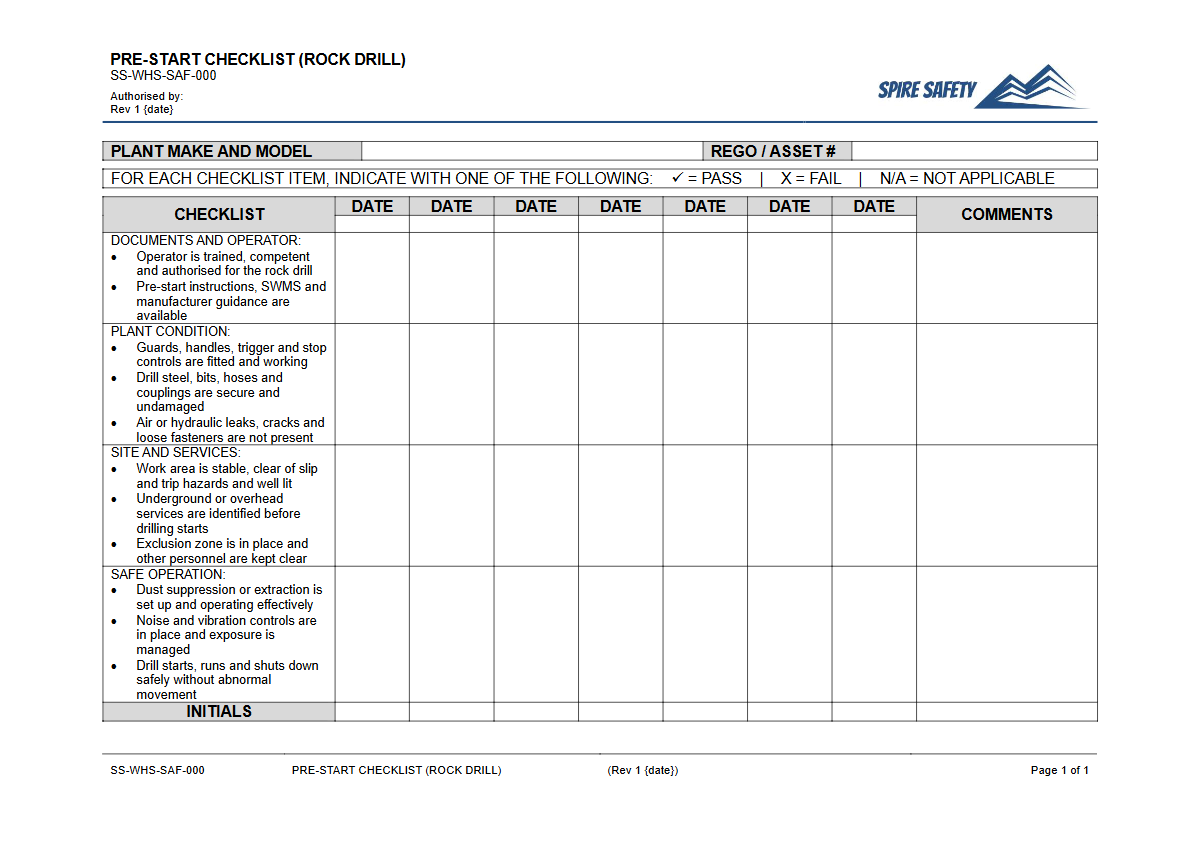
Download our free Pre-Start Checklist (Rock Drill) Template to formalise daily equipment inspections.
Free Pre-Start Checklist (Rock Drill) Template
DOCX • 125 KB + PDF
Updated Oct 2026
No signup required
Purpose of the Free Pre-Start Checklist (Rock Drill) Template
A rock drill is a high-risk piece of plant that exposes operators to significant hazards, including extreme vibration, hazardous dust, high noise levels, and powerful mechanical force. Conducting a thorough pre-start inspection before each use is a fundamental safety requirement.
This Free Pre-Start Checklist (Rock Drill) Template provides a structured framework for operators to systematically inspect the equipment, identify potential faults, and verify that safety controls are in place and functioning correctly. Formalising this process helps organisations meet their duty of care and reduces the risk of equipment failure, incidents, and operator injury.
Using a documented checklist ensures consistency and accountability in daily equipment checks. It moves the process beyond a simple visual glance, prompting a detailed review of critical safety components.
Integrating these checks into daily operations is a key part of preventative maintenance and reinforces a positive safety culture. For further guidance on integrating these checks, consider our Pre-Start Checks and Plant Maintenance Toolbox Talk to train your team effectively.
Video walkthrough
How to use the Free Pre-Start Checklist (Rock Drill) Template
This template is provided in both DOCX and PDF formats for your convenience. The DOCX file is fully editable, allowing you to tailor it to your specific operational needs.
While this template is aligned with Australian WHS principles, it is a generic starting point. For it to be effective, you must adapt it to your specific circumstances.
Important: We recommend you customise this template to reflect the specific make and model of the rock drill(s) used in your workplace. Always consult the manufacturer’s operating manual and add any model-specific checks, such as unique safety features or maintenance points, to your final checklist.
This ensures all critical components are covered. Once customised, this document becomes a vital record within your overall WHS management systems.
Key Inspection Points for a Rock Drill
Your customised checklist should cover several key areas to be effective. These include, but are not limited to:
- General Condition: Check for any cracks, leaks, or damage to the main body, handles, and casing.
- Drill Steel & Bit: Inspect for excessive wear, cracks, or damage. Ensure it is securely attached.
- Hoses & Connections: Check air and water hoses for splits, leaks, or abrasion. Ensure all couplings are secure and fitted with retaining clips or whip checks.
- Controls: Test the throttle/trigger for smooth operation and ensure it does not stick. Verify that any emergency stop functions work correctly.
- Safety Features: Confirm that vibration-dampening handles are secure and in good condition. Check that any guards or deflectors are properly fitted.
- Dust Suppression: Ensure the water delivery system or other dust suppression mechanism is functional and has an adequate supply. This is critical for controlling silica dust.
For a detailed breakdown of procedural steps, you can also reference our Hammer Drill SOP, which outlines a safe system of work for similar high-vibration drilling tasks.
When to use it
A rock drill pre-start checklist must be completed before the first use of the equipment on every shift. If operators change mid-shift, the new operator should conduct their own pre-start inspection before commencing work.
The harsh conditions in which rock drills operate, combined with the high levels of vibration, mean that components can loosen or fail without warning. A 'before every use' approach is the best practice for mitigating these risks. This simple check is a core component of a safe system of work, as outlined in documents like a Hammer Drill SWMS.
Who should use it
The primary user of the checklist is the rock drill operator. They are the person most at risk and have the immediate responsibility to ensure the equipment is safe before they use it. However, other personnel have a role:
- Operators: Conduct the physical inspection and complete the checklist, signing off that the equipment is fit for use.
- Supervisors / Line Managers: Periodically review completed checklists to ensure they are being done correctly and diligently. They are also responsible for ensuring that any identified faults are actioned and that faulty equipment is tagged out and removed from service until repaired.
- Maintenance Personnel: Use the information from completed checklists to identify recurring faults and inform preventative maintenance schedules.
Ensuring operators are competent to both use the equipment and perform the pre-start check is crucial. You can use a document like our Drill Press VOC (Verification of Competency) as a model for verifying these skills.
Regular reviews of this process during WHS compliance auditing can confirm that procedures are being followed effectively across the organisation.
Common mistakes
Common mistakes to avoid
- Treating the check as a 'tick-and-flick' exercise without physically inspecting each item.
- Failing to remove a faulty rock drill from service immediately, creating risk for the next user.
- Using a generic plant checklist that misses rock drill-specific items like drill bit condition or vibration dampeners.
- Not reporting recurring minor faults, which could indicate a more serious underlying maintenance issue.
Legal references
Legal considerations
The following legal requirements may be relevant to this type of work.
- Work Health and Safety Act (Harmonised) — Provides the primary duties for protecting workers and other people from work health and safety risks.
- Work Health and Safety Regulations (Harmonised) — Sets out requirements supporting the management of workplace hazards and risks.
The following codes may be relevant to this type of work.
- Managing WHS Risks Code of Practice — Provides practical guidance on identifying hazards, assessing risks and applying effective controls.
- Work Health and Safety Consultation, Cooperation and Coordination Code of Practice — Provides practical guidance on consulting workers and coordinating with other duty holders.
- Managing the Work Environment and Facilities Code of Practice — Provides practical guidance on safe work environments, workplace facilities and related controls.
Did you know
Vibration White Finger
Prolonged exposure to vibration from tools like rock drills can lead to Hand-Arm Vibration Syndrome (HAVS), also known as 'Vibration White Finger'. This condition damages nerves and blood vessels, causing pain, numbness, and loss of grip strength.
Silica Dust Hazard
Drilling into rock, concrete, or masonry can generate respirable crystalline silica dust. Inhaling this dust can lead to silicosis, a serious and incurable lung disease, making dust suppression systems a critical safety feature to inspect.
FAQ
Frequently asked questions
01What are the primary hazards of using a rock drill?
02Why is a pre-start check vital for a high-vibration tool like a rock drill?
03Can I use this template for any brand or model of rock drill?
04How often should rock drill pre-start checks be completed?
Share this resource
Free Pre-Start Checklist (Rock Drill) Template
Browse Categories
How To Use It
- 1Download and open in Word or PDF.
- 2Replace the placeholders with your business details.
- 3Get it reviewed by a WHS specialist before rollout.
Need it customised?
Our WHS consultants can adapt this template to your site, run a gap analysis, or audit what you already have in place.
Book a Free Consultation WHS consulting servicesor call 1300 156 382