
Free Pre-Start Checklist (Road Train) Template
Formalise daily safety inspections for your heavy vehicle fleet with our free Pre-Start Checklist (Road Train) Template. Download now to improve WHS processes.
Free Pre-Start Checklist (Road Train) Template
DOCX • 125 KB + PDF
Updated Oct 2026
No signup required
Purpose of the Free Pre-Start Checklist (Road Train) Template
Operating a road train involves significant WHS risks, not only to the driver but to other road users. A systematic pre-start inspection is a fundamental control measure to ensure the vehicle is safe for operation before it begins its journey.
This free Pre-Start Checklist (Road Train) Template provides a structured format for drivers to conduct and record thorough daily checks, helping your organisation meet its safety obligations and maintain a reliable fleet.
Using this template helps to formalise the process of identifying mechanical faults, fluid leaks, tyre damage, and other defects that could lead to an incident. Regular, documented checks serve as evidence of due diligence, support a preventative maintenance program, and foster a stronger safety culture among operators.
It is a critical tool for managing risks associated with heavy vehicle transport and logistics.
Video walkthrough
How to use the Free Pre-Start Checklist (Road Train) Template
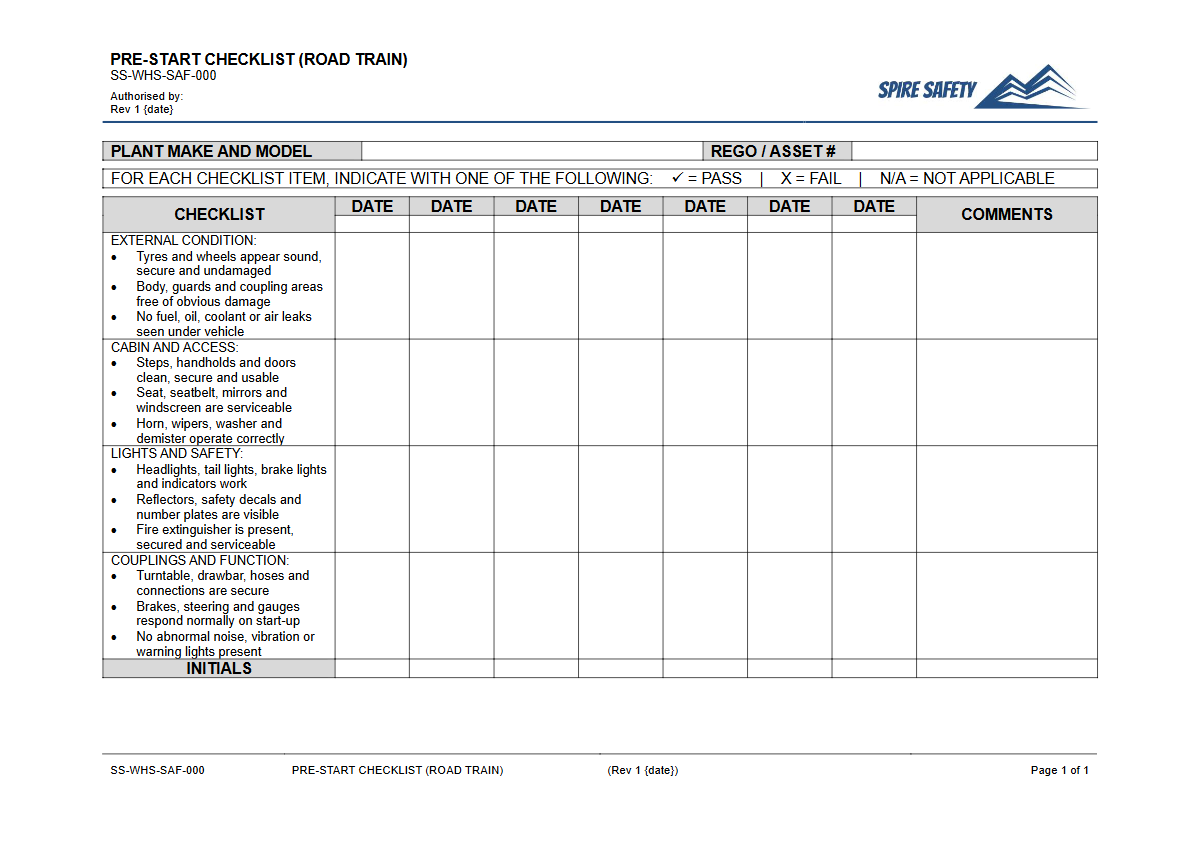
This checklist is provided as a user-friendly DOCX file that you can download and customise, along with a print-ready PDF version. The document outlines key inspection points for a generic road train configuration, covering the prime mover and its trailers.
Operators should be trained to follow the checklist systematically, marking each item as satisfactory or noting any defects found.
Important: This template is a starting point. We strongly advise that you customise it to reflect the specific hazards, controls, and operational procedures of your workplace and the exact make, model, and configuration of your road trains.
Integrating this process into your broader WHS management systems ensures that identified faults are reported, tracked, and rectified according to established procedures.
What to Check on a Road Train
A comprehensive road train pre-start inspection should cover all critical components of the entire combination. Our template prompts the user to check areas such as:
- Prime Mover (Engine and Cabin): Engine oil, coolant, hydraulic fluid levels, belts, hoses, and checks for leaks. In the cabin, verify gauges, horn, windscreen wipers/washers, mirrors, and emergency equipment.
- Braking and Air Systems: Inspect air lines for damage or leaks, check brake adjustment, and test the parking and service brakes.
- Wheels, Tyres, and Suspension: Check for correct tyre inflation, cuts or damage to sidewalls and tread, and look for loose or missing wheel nuts. Inspect suspension components for signs of wear or failure.
- Couplings and Connections: This is a critical area for road trains. Check turntables, kingpins, and all couplings between trailers for security, damage, and proper lubrication. Also inspect safety chains and electrical/air connections. While a road train is complex, the principle of pre-start checks applies to other mobile plant, as shown in our Pre-Start Checklist for a Forwarder.
- Lights and Electrical Systems: Test all lights, including headlights, brake lights, tail lights, indicators, and clearance lights on all trailers.
- Trailers: Inspect the chassis, body, and landing gear of each trailer. Ensure load restraints and tarps are secure and in good condition. The systematic checking of equipment is also vital for smaller machinery, as detailed in our Pre-Start Checklist (Bin Lifter) Template.
When to Use It
A pre-start checklist for a road train should be completed at the beginning of every shift or day of operation, before the vehicle is used for the first time. It should also be conducted if there is a change of operator during a shift.
An additional post-trip inspection is also considered best practice, as it can identify faults that occurred during operation, allowing for repairs to be scheduled before the next shift.
Formal records of these checks are essential. Conducting regular reviews of completed checklists is a key activity in any safety assurance program.
This process can be verified through a systematic WHS compliance auditing program to ensure procedures are being followed correctly and are effective in managing risk.
Who Should Use It
The pre-start checklist must be completed by a person competent to operate a road train. This is typically the licensed and experienced driver assigned to the vehicle for that shift.
They have the most immediate responsibility for ensuring the vehicle is safe to drive. Supervisors and fleet managers also have a role in reviewing the completed checklists, ensuring any reported defects are addressed promptly, and verifying that the checks are being completed thoroughly and not just as a paper-filling exercise.
While this template is for heavy transport, the same principles apply to other equipment. For example, our Pre-Start Checklist for a Lawn Tractor follows a similar structure for ensuring operator safety. You can explore hundreds of similar documents in our complete free WHS resources library.
Common mistakes
Common mistakes to avoid
- "Pencil-whipping" the form without physically inspecting the items.
- Ignoring minor defects like weeping hoses or worn tyres that can escalate into major failures.
- Failing to properly check the security and condition of all couplings between trailers.
- Neglecting to check tyre pressures, a leading cause of blowouts and stability issues.
Legal references
Legal considerations
The following legal requirements may be relevant to this type of work.
- Work Health and Safety Act (Harmonised) — Provides the primary duties for protecting workers and other people from work health and safety risks.
- Work Health and Safety Regulations (Harmonised) — Sets out requirements supporting the management of workplace hazards and risks.
The following codes may be relevant to this type of work.
- Managing WHS Risks Code of Practice — Provides practical guidance on identifying hazards, assessing risks and applying effective controls.
- Work Health and Safety Consultation, Cooperation and Coordination Code of Practice — Provides practical guidance on consulting workers and coordinating with other duty holders.
- Managing the Work Environment and Facilities Code of Practice — Provides practical guidance on safe work environments, workplace facilities and related controls.
Did you know
Vehicle Length
The maximum allowable length for a road train in Australia can be up to 53.5 metres, making thorough checks of all couplings and trailers absolutely critical for road safety.
Braking Distance
A fully loaded road train travelling at 100 km/h can take up to 40% longer to stop than a standard car, highlighting the importance of ensuring the braking system is in perfect working order before every trip.
FAQ
Frequently asked questions
01What is the Chain of Responsibility (CoR) for road train pre-starts?
02What happens if a defect is found during a pre-start check?
03Can this pre-start checklist be completed digitally?
04How often should a road train pre-start check be performed?
Share this resource
Free Pre-Start Checklist (Road Train) Template
Browse Categories
How To Use It
- 1Download and open in Word or PDF.
- 2Replace the placeholders with your business details.
- 3Get it reviewed by a WHS specialist before rollout.
Need it customised?
Our WHS consultants can adapt this template to your site, run a gap analysis, or audit what you already have in place.
Book a Free Consultation WHS consulting servicesor call 1300 156 382