
Free Pre-Start Checklist (Rock Breaker) Template
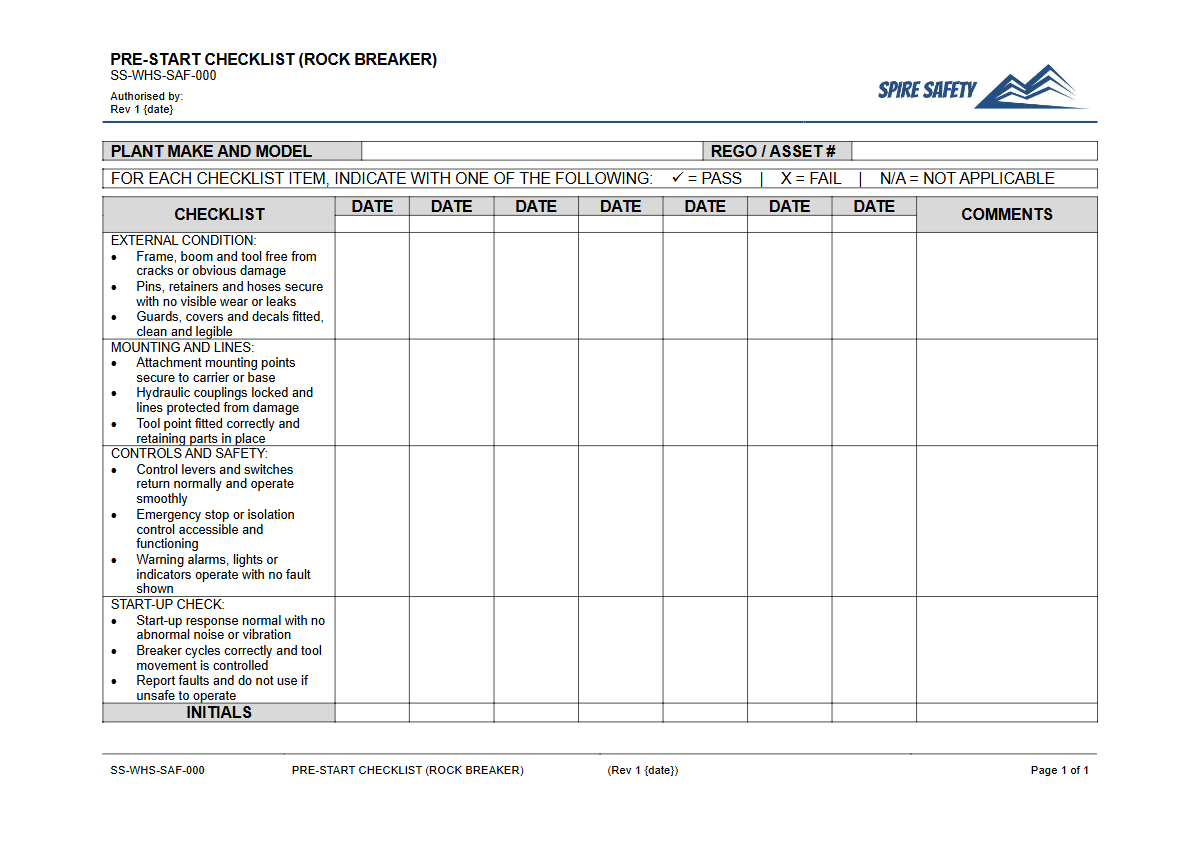
Download our free Pre-Start Checklist (Rock Breaker) Template to formalise equipment checks and manage WHS risks. Get your DOCX and PDF template now.
Free Pre-Start Checklist (Rock Breaker) Template
DOCX • 125 KB + PDF
Updated Oct 2026
No signup required
Purpose of the Free Pre-Start Checklist (Rock Breaker) Template
Using powerful equipment like a hydraulic rock breaker requires strict safety protocols to manage significant risks. Our free Pre-Start Checklist (Rock Breaker) Template provides a structured starting point for operators to conduct thorough inspections before each use.
Systematically checking for potential faults helps identify mechanical, hydraulic, or structural defects before they lead to equipment failure, property damage, or serious injury. This documented process is a critical component of any robust safety framework.
Integrating regular, documented checks is a practical way for a Person Conducting a Business or Undertaking (PCBU) to meet their primary duty of care. This template helps formalise the inspection process, ensuring that no critical checks are overlooked.
Consistent use of such checklists demonstrates a commitment to proactive risk management and forms a key part of effective WHS management systems, creating a safer work environment for everyone on site.
Video walkthrough
How to use the Free Pre-Start Checklist (Rock Breaker) Template
This checklist is designed as a foundational tool. Download the template in your preferred format—DOCX for easy editing or PDF for straightforward printing.
The operator should use the checklist to physically inspect the rock breaker and its host machine (e.g., excavator) before starting work, marking each item as satisfactory or identifying any faults. Any issues noted must be reported immediately according to your organisation's procedures, and the equipment should be taken out of service until it is deemed safe.
Important: This is a generic template and must be customised to your specific workplace. We have provided a comprehensive starting point, but you must adapt it to reflect the particular make and model of your rock breaker, the host machine, your site-specific hazards, and your internal procedures.
We recommend a competent person reviews and amends the DOCX version to ensure it is fit for purpose at your operation.
When to use it
A pre-start checklist for a rock breaker should be completed before the start of every shift or before the first use of the equipment each day. It is a preventative measure designed to catch issues early.
If the equipment is used by multiple operators in one shift, a new check should be considered at handover to ensure continuity of safety. This routine aligns with the safety inspection principles for other high-risk plant, such as those covered in our free Pre-Start Checklist for Floor Saws.
Who should use it
The pre-start check must be conducted by a person who is competent to operate the rock breaker and its host machine. This means they have received the necessary information, training, instruction, and supervision to identify potential faults and understand the associated risks.
Supervisors should also be familiar with the checklist to ensure that operators are completing the checks diligently and that proper follow-up actions are taken when faults are identified. The process is similar for other workshop and site equipment, as shown in our Pre-Start Checklist (Bench Grinder) Template.
Record Keeping and Follow-Up
Completed checklists are important safety records. They provide a documented history of the equipment's condition and the inspections performed.
These records are invaluable during maintenance planning, incident investigations, or safety audits. Storing these documents (whether digitally or in hard copy) in an organised manner is essential for demonstrating compliance and continuous improvement.
Regular reviews of these records can help identify recurring issues, indicating a need for more comprehensive maintenance or operator retraining.
Maintaining a clear and accessible paper trail of inspections, faults, and corrective actions is fundamental to safety governance. This documentation is a key piece of evidence examined during a WHS compliance auditing process, verifying that safety procedures are not just written down, but are actively implemented and monitored. This proactive approach helps in managing risks associated with all types of mechanised plant, from rock breakers to the equipment detailed in our free Pre-Start Checklist (Bin Lifter) Template.
If this resource is helpful, you may find more useful documents in our complete free WHS resources library, which includes a wide range of checklists, policies, and templates.
Common mistakes
Common mistakes to avoid
- Ignoring small hydraulic fluid weeps or leaks, which can escalate into major failures.
- Using a blunt, cracked, or incorrect tool bit, leading to poor performance and potential tool fracture.
- Neglecting to check the security and condition of mounting pins and bushings, risking attachment detachment.
- Failing to properly document and report identified faults, allowing unsafe equipment to remain in service.
Legal references
Legal considerations
The following legal requirements may be relevant to this type of work.
- Work Health and Safety Act (Harmonised) — Provides the primary duties for protecting workers and other people from work health and safety risks.
- Work Health and Safety Regulations (Harmonised) — Sets out requirements supporting the management of workplace hazards and risks.
The following codes may be relevant to this type of work.
- Managing WHS Risks Code of Practice — Provides practical guidance on identifying hazards, assessing risks and applying effective controls.
- Work Health and Safety Consultation, Cooperation and Coordination Code of Practice — Provides practical guidance on consulting workers and coordinating with other duty holders.
- Managing the Work Environment and Facilities Code of Practice — Provides practical guidance on safe work environments, workplace facilities and related controls.
Did you know
Extreme Force
Hydraulic rock breakers generate immense power, with impact energy often measured in thousands of joules. A seemingly minor hydraulic leak can not only reduce this force but can also lead to catastrophic failure under pressure.
Attachment Incidents
A significant number of incidents involving excavators are related to the failure of attachments or quick-hitch couplers. This makes the pre-start inspection of pins, locks, and hydraulic connections a life-critical task.
FAQ
Frequently asked questions
01What key items should be checked on a rock breaker before use?
02How often should a rock breaker pre-start check be performed?
03Who is responsible for completing a rock breaker pre-start checklist?
04Is this template suitable for all types of hydraulic rock breakers?
Share this resource
Free Pre-Start Checklist (Rock Breaker) Template
Browse Categories
How To Use It
- 1Download and open in Word or PDF.
- 2Replace the placeholders with your business details.
- 3Get it reviewed by a WHS specialist before rollout.
Need it customised?
Our WHS consultants can adapt this template to your site, run a gap analysis, or audit what you already have in place.
Book a Free Consultation WHS consulting servicesor call 1300 156 382