
Free Pre-Start Checklist (Road Roller) Template
Download our free Pre-Start Checklist (Road Roller) Template. This structured DOCX & PDF document helps formalise daily equipment checks. Improve WHS now.
Free Pre-Start Checklist (Road Roller) Template
DOCX • 125 KB + PDF
Updated Oct 2026
No signup required
Purpose of the Free Pre-Start Checklist (Road Roller) Template
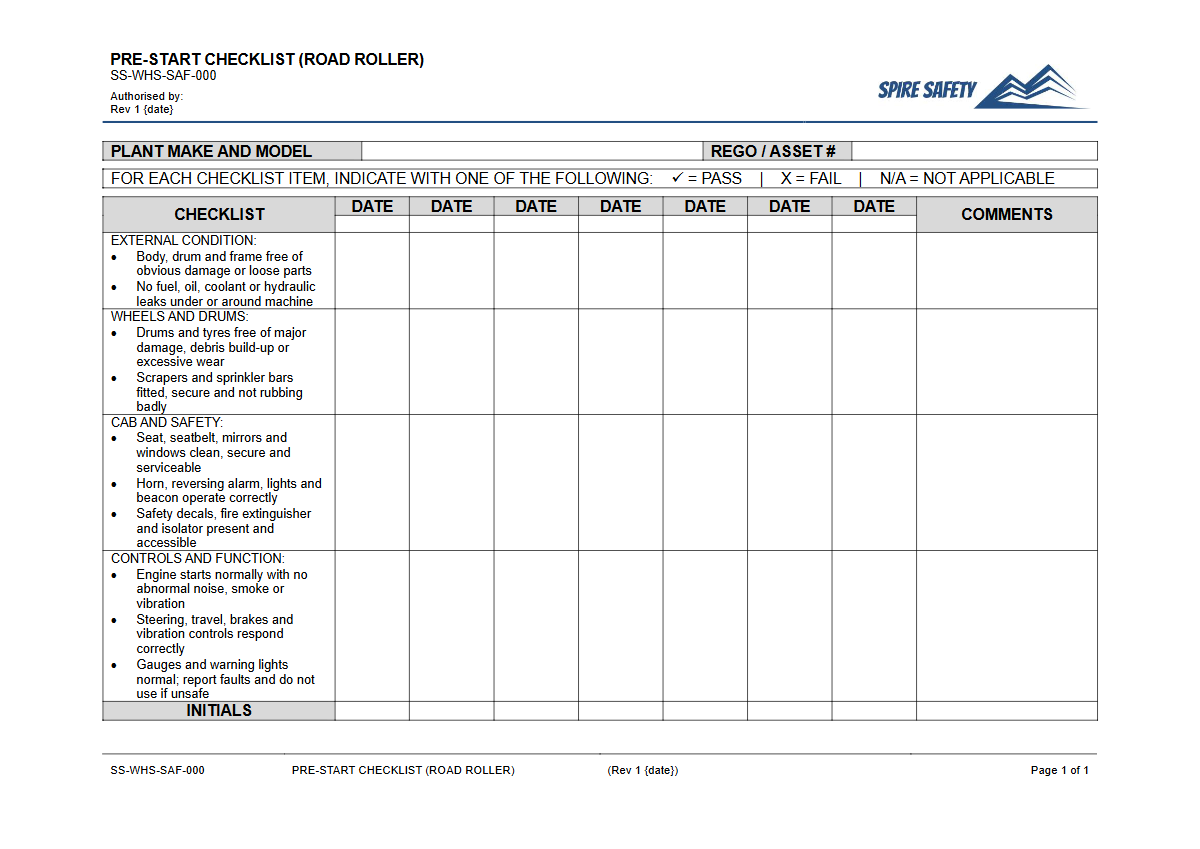
Operating a road roller involves significant risks, from rollovers to collisions and mechanical failures. This free Pre-Start Checklist (Road Roller) Template provides a structured framework for operators to conduct thorough, documented inspections before each use.
Implementing a consistent pre-start process helps identify potential faults or damage early, preventing incidents, minimising costly downtime, and demonstrating a commitment to workplace health and safety. It serves as a critical record-keeping tool, forming an essential part of your broader WHS management system and helping meet due diligence requirements.
Video walkthrough
How to use the Free Pre-Start Checklist (Road Roller) Template
This template is a comprehensive starting point designed for easy implementation. Begin by downloading the DOCX or PDF file and adapting it to the specific models of road rollers used in your workplace.
Different rollers have unique features and potential hazards, so customisation is crucial for effectiveness.
- Customise: Add or remove checkpoints to match the specific make, model, and configuration of your equipment. Include brand-specific safety features or known problem areas.
- Integrate: Incorporate the checklist into your daily operational procedures and Safe Work Method Statements (SWMS).
- Train: Ensure all operators are trained on how to properly complete the checklist, what each item means, and the procedure for reporting faults.
- Implement: Make the checklist mandatory before the first operation of each shift. Store completed forms securely for auditing and review.
Important: This is a template, not a finished document. We have no way of knowing your specific equipment, operational context, or local risks.
You must customise this document to ensure it is fit for purpose in your workplace. For other heavy mobile plant, you might review our free Pre-Start Checklist for a forwarder as another example of a customisable template.
When to use it
A pre-start inspection should be conducted at the beginning of every shift or before the roller is used for the first time on any given day. It should also be performed after any significant break in operation or following maintenance or repair work to verify the equipment is safe to return to service.
This regular cadence ensures that any deterioration or damage that occurred overnight or during a previous shift is captured before the plant becomes operational. Regular WHS compliance auditing can verify that these checks are being completed consistently and correctly.
Who should use it
The pre-start check should be completed by a competent person, which is typically the trained and authorised operator assigned to the road roller for that shift. They have the most hands-on familiarity with the equipment and are best placed to notice subtle changes in its condition or performance.
Supervisors and managers also have a responsibility to ensure these checks are being performed correctly and that any identified faults are addressed promptly. The process reinforces the operator's responsibility for their own safety and the safety of those around them. Similar operator-led checks are crucial for all mobile plant, such as those detailed in our lawn tractor pre-start checklist.
Key Areas for Inspection
While the template provides a detailed list, key areas of focus for any road roller inspection include:
- General Condition: Check for leaks (oil, hydraulic fluid, coolant), structural damage, and cleanliness of the operator's cabin and windows.
- Safety Features: Verify the functionality of the Rollover Protective Structure (ROPS), seatbelt, horn, lights, alarms (including reversing beeper), and emergency stop controls.
- Operator Controls: Ensure steering, brakes (including the park brake), and hydraulic controls are responsive and functioning as expected.
- Drum and Wheels: Inspect the drum surface for damage, check scraper bars are correctly adjusted, and examine tyres for correct inflation and wear. Checks for hydraulic systems are also found on other equipment, like the items in our bin lifter pre-start checklist.
- Fluid Levels: Check engine oil, hydraulic fluid, coolant, and fuel levels before starting the engine.
By formalising these checks, you create a safer working environment and a clear, auditable trail of safety management. Explore our complete free WHS resources library for more tools to support your safety processes.
Common mistakes
Common mistakes to avoid
- Ticking all boxes without physically inspecting the corresponding components ('pencil-whipping').
- Failing to immediately report a discovered fault and tag the equipment as 'Out of Service'.
- Using a generic checklist that doesn't match the specific model of the road roller being inspected.
- Not retaining completed checklists as a record for safety audits or incident investigations.
Legal references
Legal considerations
The following legal requirements may be relevant to this type of work.
- Work Health and Safety Act (Harmonised) — Provides the primary duties for protecting workers and other people from work health and safety risks.
- Work Health and Safety Regulations (Harmonised) — Sets out requirements supporting the management of workplace hazards and risks.
The following codes may be relevant to this type of work.
- Managing WHS Risks Code of Practice — Provides practical guidance on identifying hazards, assessing risks and applying effective controls.
- Work Health and Safety Consultation, Cooperation and Coordination Code of Practice — Provides practical guidance on consulting workers and coordinating with other duty holders.
- Managing the Work Environment and Facilities Code of Practice — Provides practical guidance on safe work environments, workplace facilities and related controls.
Did you know
Compaction Force
The dynamic or compactive force a road roller exerts through vibration can be many times its static weight, making it highly effective for compaction but also increasing the potential severity of ground-related incidents.
Rollover Risk
Rollovers are one of the most significant fatal risks associated with mobile plant, including road rollers. Always wearing a seatbelt within a certified Rollover Protective Structure (ROPS) is the most critical defence for an operator in a rollover event.
FAQ
Frequently asked questions
01What is the primary purpose of a road roller pre-start check?
02How often should a road roller pre-start inspection be completed?
03Who is responsible for ensuring pre-start checks are done correctly?
04Does this template cover every possible check for all roller models?
Share this resource
Free Pre-Start Checklist (Road Roller) Template
Browse Categories
How To Use It
- 1Download and open in Word or PDF.
- 2Replace the placeholders with your business details.
- 3Get it reviewed by a WHS specialist before rollout.
Need it customised?
Our WHS consultants can adapt this template to your site, run a gap analysis, or audit what you already have in place.
Book a Free Consultation WHS consulting servicesor call 1300 156 382