
Free Pre-Start Checklist (Ride Sweeper) Template
Download our free Pre-Start Checklist (Ride Sweeper) Template in DOCX and PDF.
Free Pre-Start Checklist (Ride Sweeper) Template
DOCX • 125 KB + PDF
Updated Oct 2026
No signup required
Purpose of the Free Pre-Start Checklist (Ride Sweeper) Template
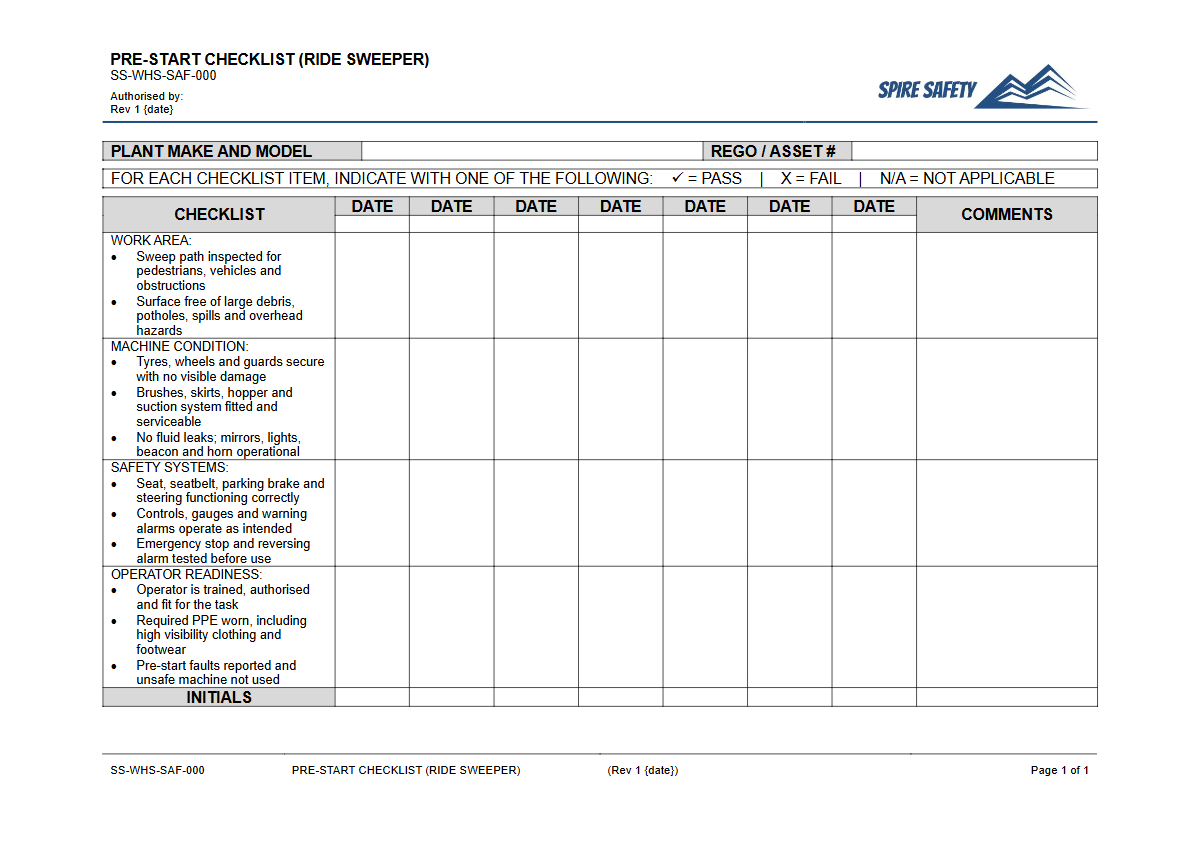
Using a ride-on sweeper without first checking its condition introduces significant safety risks. This Free Pre-Start Checklist (Ride Sweeper) Template provides a structured framework for operators to conduct thorough, documented inspections before starting work.
By formalising this process, you can proactively identify mechanical faults, damage, or missing safety components that could lead to an incident. A consistent inspection routine is a fundamental part of managing risks associated with plant and equipment in the workplace.
The checklist encourages a systematic review of critical components, from brakes and steering to warning devices and dust suppression systems. Documenting these checks creates a historical record of the machine's condition, which is invaluable for demonstrating due diligence, tracking maintenance needs, and informing safety discussions.
For a broader perspective on equipment safety, our Pre-Start Checks and Plant Maintenance Toolbox Talk can help reinforce these principles with your team.
Video walkthrough
How to use the Free Pre-Start Checklist (Ride Sweeper) Template
This resource is available for download as a DOCX file for easy customisation or as a PDF for immediate printing. To use it effectively, operators should walk around the machine and physically verify each item on the list.
The checklist guides them through visual inspections (e.g., checking for leaks, tyre condition, and structural damage) and functional tests (e.g., testing the horn, lights, and brakes).
It is crucial that this document is adapted to your specific workplace. Before implementation, you must review and modify the checklist to reflect the unique make and model of your ride-on sweeper, the specific hazards of your operating environment (e.g., indoor vs.
outdoor, presence of pedestrians), and your organisation's safety procedures. Verifying operator competency is also a key control measure, and this checklist serves as an excellent operational tool to complement a Verification of Competency for a Ride-On Sweeper.
Customisation is Essential
Please note: This document is a template and must be customised to suit the specific make and model of your equipment, your operating environment, and your organisation's specific WHS policies. We recommend seeking WHS consulting services if you need assistance tailoring it to your needs.
Always consult the manufacturer’s operating manual for specific inspection requirements.
Once customised, the checklist should be integrated into your daily operations. Completed forms must be signed, dated, and reviewed by a supervisor.
Any identified defects or faults must be reported immediately through your established reporting channels, and the equipment should be tagged out of service until it is repaired by a qualified person. Integrating these forms and procedures into your comprehensive WHS management systems ensures that actions are tracked and safety issues are resolved effectively.
When to use it
The pre-start checklist should be completed by the operator before the start of every shift or before using the ride-on sweeper for the first time that day. This regular frequency ensures that any issues that may have developed overnight or during a previous shift are caught before the machine is put into operation. This routine is often discussed as part of a daily safety briefing, which can be formalised using pre-start meeting documentation.
Additional checks are also recommended after major maintenance or repair work has been performed, or if the equipment has been idle for an extended period. This helps verify that the machine is safe to return to service and that all systems are functioning as intended.
Who should use it
This checklist is designed for use by trained and competent ride-on sweeper operators. These are the individuals with hands-on control of the equipment and are best positioned to notice subtle changes in its condition or performance.
They have a duty to ensure the equipment is safe before they use it.
Supervisors and managers also have a key role. They are responsible for ensuring operators are trained on the pre-start inspection procedure, that checks are being completed correctly, and that the completed checklists are reviewed.
They must also take action to address any reported defects, ensuring that unsafe plant is not used. For more tools to support your safety processes, browse our complete free WHS resources library.
Common mistakes
Common mistakes to avoid
- Ticking boxes without physically inspecting the corresponding item ('pencil-whipping').
- Using a generic checklist that doesn't match the specific make, model, or configuration of the sweeper.
- Failing to report identified defects or continuing to use a machine with a known fault.
- Neglecting to check safety-critical features like the emergency stop, brakes, or warning devices.
Legal references
Legal considerations
The following legal requirements may be relevant to this type of work.
- Work Health and Safety Act (Harmonised) — Provides the primary duties for protecting workers and other people from work health and safety risks.
- Work Health and Safety Regulations (Harmonised) — Sets out requirements supporting the management of workplace hazards and risks.
The following codes may be relevant to this type of work.
- Managing WHS Risks Code of Practice — Provides practical guidance on identifying hazards, assessing risks and applying effective controls.
- Work Health and Safety Consultation, Cooperation and Coordination Code of Practice — Provides practical guidance on consulting workers and coordinating with other duty holders.
- Managing the Work Environment and Facilities Code of Practice — Provides practical guidance on safe work environments, workplace facilities and related controls.
Did you know
Dust Suppression
Many industrial ride-on sweepers are equipped with water misting systems. These systems are critical for suppressing airborne dust, which can contain silica or other hazardous substances, protecting both the operator and other workers from respiratory hazards.
Battery Hazards
Battery-electric sweepers are common, but their power source introduces specific risks. The charging process can produce flammable hydrogen gas, and handling batteries carries risks of acid burns and electrical shock, requiring specific safety protocols.
FAQ
Frequently asked questions
01What should be included in a ride-on sweeper pre-start checklist?
02How often should ride-on sweeper pre-start checks be done?
03Who is responsible for ensuring pre-start checks are completed?
04Is this template enough to ensure WHS compliance for my sweeper?
Share this resource
Free Pre-Start Checklist (Ride Sweeper) Template
Browse Categories
How To Use It
- 1Download and open in Word or PDF.
- 2Replace the placeholders with your business details.
- 3Get it reviewed by a WHS specialist before rollout.
Need it customised?
Our WHS consultants can adapt this template to your site, run a gap analysis, or audit what you already have in place.
Book a Free Consultation WHS consulting servicesor call 1300 156 382