
Free Pre-Start Checklist (Rigid Truck) Template
Download our free Pre-Start Checklist (Rigid Truck) Template. This structured document helps formalise daily vehicle safety checks. Get your DOCX and PDF now.
Free Pre-Start Checklist (Rigid Truck) Template
DOCX • 125 KB + PDF
Updated Oct 2026
No signup required
Purpose of the Free Pre-Start Checklist (Rigid Truck) Template
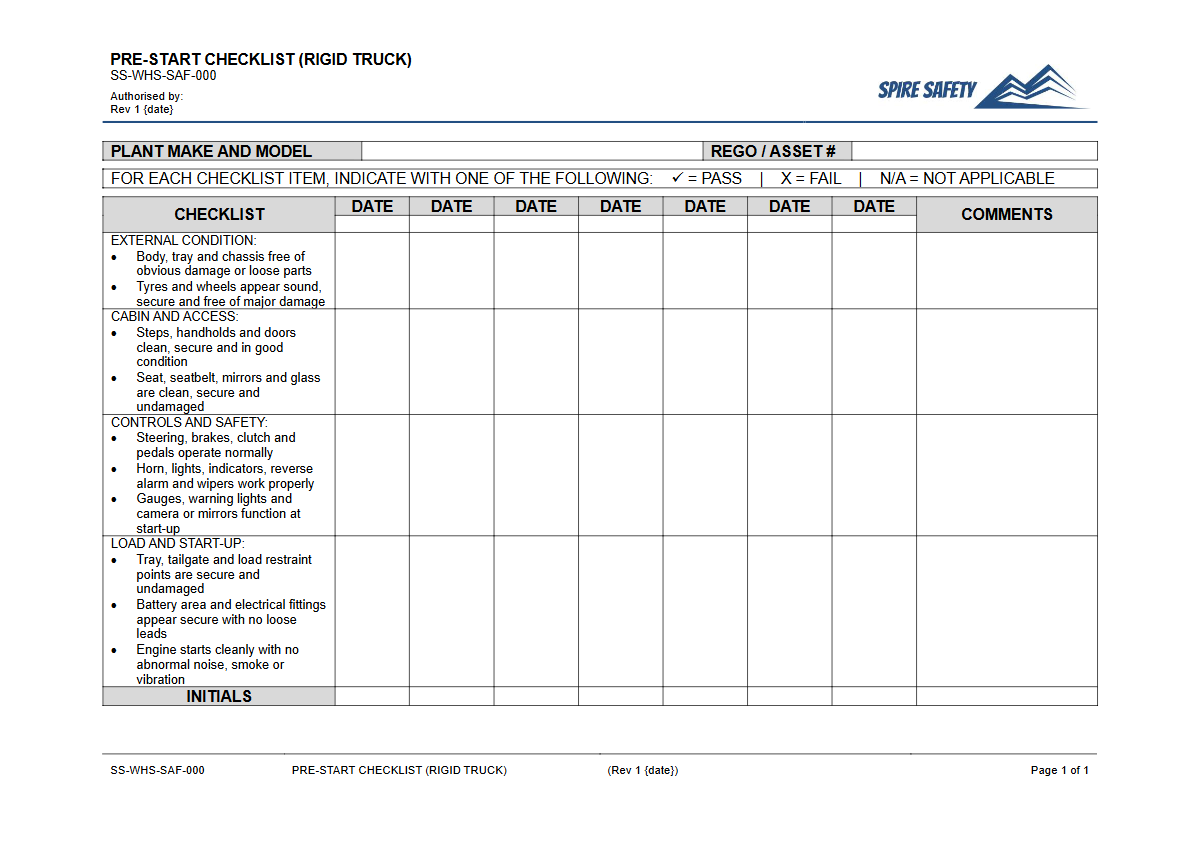
A rigid truck is a key piece of plant in many transport, logistics, and construction operations, and ensuring its roadworthiness is a fundamental WHS requirement. This Free Pre-Start Checklist (Rigid Truck) Template provides a structured framework for operators to conduct thorough, documented inspections before starting work.
Using a systematic checklist helps identify potential faults or defects—from worn tyres to faulty brakes—that could lead to an incident on the road or at a worksite. It is a practical tool for a Person Conducting a Business or Undertaking (PCBU) to demonstrate due diligence in managing risks associated with heavy vehicles.
By formalising this process, you create a consistent record of vehicle condition, which is vital for maintenance scheduling and safety audits. Integrating these checks is a critical component of building comprehensive WHS management systems that proactively address plant and vehicle safety.
Ultimately, a diligent pre-start inspection protects the driver, other road users, and the public, while also helping to maintain the longevity and reliability of your assets.
Video walkthrough
How to use the Free Pre-Start Checklist (Rigid Truck) Template
Our template is available in both DOCX and PDF formats for your convenience. The DOCX file is fully editable, allowing you to tailor it to your specific operational needs.
To get the most out of this resource, it is crucial to adapt it to the unique characteristics of your fleet and work environment.
Important Note: We provide this template as a starting point. You must customise it to reflect the specific make, model, and configuration of your rigid trucks, as well as your site-specific hazards and operational procedures.
Consultation with operators and maintenance personnel during this process is highly recommended.
Steps for implementation:
- Download the DOCX template.
- Consult with drivers, supervisors, and mechanics to identify all critical safety and operational checks for your specific trucks (e.g., checks for tipper bodies, tailgate loaders, or other attachments).
- Add, remove, or modify checklist items to create a document that accurately reflects your equipment.
- Integrate the finalised checklist into your daily operating procedures and provide clear training to all operators on how to complete it correctly.
- Establish a clear process for reporting and rectifying any defects found during the inspection. If you need assistance developing these procedures, our specialist WHS consulting team can provide expert guidance.
When to use it
The pre-start checklist should be completed by the operator at the beginning of every shift, before the truck is used for the first time that day. It establishes a baseline for the vehicle's condition.
A check should also be conducted whenever there is a change of operator during a shift. Furthermore, conducting a post-start or post-trip inspection can help identify issues that may have developed during operation, ensuring they are addressed before the vehicle's next use.
Regular reviews of completed checklists are also essential for effective WHS compliance auditing to ensure procedures are being consistently followed.
Who should use it
This checklist is designed to be used by trained and competent truck operators who are familiar with the vehicle they are inspecting. It is their responsibility to carry out the checks diligently and accurately.
Supervisors and fleet managers also play a key role; they are responsible for reviewing the completed checklists, ensuring any reported faults are addressed promptly, and scheduling preventative maintenance based on the findings. This documentation creates a vital communication link between the operator on the ground and the maintenance team responsible for keeping the fleet safe.
While this document is for rigid trucks, similar principles apply to other heavy equipment, as seen in our pre-start checklist for a forwarder used in forestry operations.
Organisations that use various types of vehicle-mounted equipment will find the structured approach easily adaptable. For example, a company with a waste management fleet might use this template for its trucks and a separate bin lifter pre-start checklist for the attached machinery, ensuring all components are inspected.
The goal is to embed a culture of safety where every operator takes ownership of their equipment's condition. You can explore more templates for different types of plant and equipment in our free WHS resources library to build a complete safety documentation suite for your business.
Common mistakes
Common mistakes to avoid
- Treating the checklist as a "tick and flick" exercise without physically checking items.
- Failing to report minor defects, which can escalate into major failures.
- Using a generic checklist that doesn't match the specific truck model or its attachments.
- Not having a clear procedure for what to do when a fault is identified and the vehicle must be taken out of service.
Legal references
Legal considerations
The following legal requirements may be relevant to this type of work.
- Work Health and Safety Act (Harmonised) — Provides the primary duties for protecting workers and other people from work health and safety risks.
- Work Health and Safety Regulations (Harmonised) — Sets out requirements supporting the management of workplace hazards and risks.
The following codes may be relevant to this type of work.
- Managing WHS Risks Code of Practice — Provides practical guidance on identifying hazards, assessing risks and applying effective controls.
- Work Health and Safety Consultation, Cooperation and Coordination Code of Practice — Provides practical guidance on consulting workers and coordinating with other duty holders.
- Managing the Work Environment and Facilities Code of Practice — Provides practical guidance on safe work environments, workplace facilities and related controls.
Did you know
Chain of Responsibility
Under Chain of Responsibility (CoR) laws in Australia, every party in the heavy vehicle supply chain has a duty to ensure safety. A pre-start checklist is a key tool for drivers and operators to meet their obligations.
Tyre Safety
The National Heavy Vehicle Regulator (NHVR) reports that tyre issues are a significant factor in truck-related incidents. Regular checks of tyre pressure and condition are a non-negotiable part of any pre-start inspection.
FAQ
Frequently asked questions
01What should be included in a rigid truck pre-start check?
02How often should a pre-start check be done on a truck?
03Is a digital pre-start checklist better than a paper one?
04What happens if a defect is found during a pre-start check?
Share this resource
Free Pre-Start Checklist (Rigid Truck) Template
Browse Categories
How To Use It
- 1Download and open in Word or PDF.
- 2Replace the placeholders with your business details.
- 3Get it reviewed by a WHS specialist before rollout.
Need it customised?
Our WHS consultants can adapt this template to your site, run a gap analysis, or audit what you already have in place.
Book a Free Consultation WHS consulting servicesor call 1300 156 382