
Free Pre-Start Checklist (Ride On Toy) Template
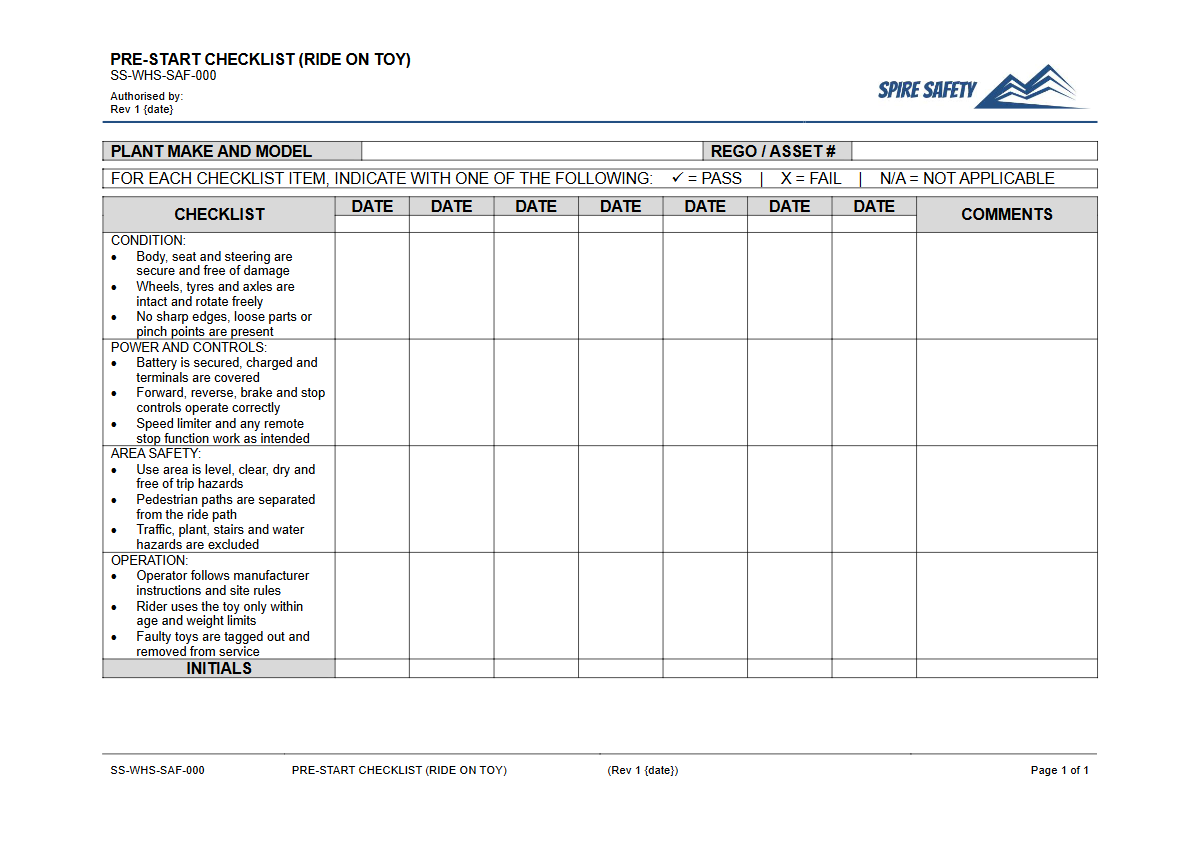
Download our Free Pre-Start Checklist (Ride On Toy) Template. This structured DOCX & PDF resource helps formalise equipment safety inspections. Get started.
Free Pre-Start Checklist (Ride On Toy) Template
DOCX • 125 KB + PDF
Updated Oct 2026
No signup required
Purpose of the Free Pre-Start Checklist (Ride On Toy) Template
This Free Pre-Start Checklist (Ride On Toy) Template provides a structured starting point for organisations to formalise their daily equipment inspections. While often associated with play, ride-on toys used in commercial settings—such as childcare centres, entertainment venues, or agricultural operations—are considered plant under WHS legislation.
Regular pre-start checks are a critical risk management activity, helping to identify potential faults, damage, or wear and tear before the equipment is used. By systematically inspecting the item, operators can prevent incidents, minimise the risk of injury to users and bystanders, and ensure the equipment remains in a safe, operational condition.
Using a documented checklist helps create a consistent inspection process across all shifts and operators. It also serves as a valuable record, demonstrating that the Person Conducting a Business or Undertaking (PCBU) has taken proactive steps to manage risks associated with the plant.
This documentation is a key component of a robust safety management system, promoting a positive safety culture where equipment care and hazard identification are prioritised. Regularly conducting and documenting these checks can form part of your evidence for maintaining safe systems of work.
A comprehensive safety framework often includes a range of tools, and you may find our Pre-Start Checks and Plant Maintenance Toolbox Talk useful for reinforcing these procedures with your team.
Video walkthrough
How to use the Free Pre-Start Checklist (Ride On Toy) Template
This template is designed to be a foundation for your specific operational needs. Start by downloading the DOCX or PDF file.
The DOCX version is fully editable, allowing for easy customisation.
Review the checklist items against the manufacturer’s instructions and the specific model of ride-on toy you use. Add, remove, or modify checks to suit your equipment and the environment it operates in.
Key areas to inspect typically include wheels and tyres, steering, braking systems, battery charge and connections, warning devices (if any), and the general structural integrity of the machine, checking for cracks or sharp edges.
- Customise: Adapt the checklist to reflect the unique features and risks of your specific ride-on toy model and its operating environment.
- Train: Ensure all operators are trained on how to properly conduct each check and what to do if they identify a fault.
- Implement: Integrate the checklist into your daily routine, making it mandatory before the first use of each day or shift.
- Document: Keep completed checklists as a record of your safety and maintenance activities.
- Action: Establish a clear process for reporting defects and removing faulty equipment from service until it is repaired by a competent person.
Please note: This document is a template only. We have provided it as a starting point, and it must be customised to suit the specific equipment, tasks, and risks in your workplace.
Integrating this process into your broader WHS management systems ensures a cohesive approach to safety.
When to use it
A pre-start checklist for a ride-on toy should be completed before it is used for the first time each day or at the beginning of each shift. This frequency ensures that any damage or defects that may have occurred overnight, during charging, or during a previous shift are identified before the equipment is put into operation.
Additional checks are also recommended after any significant event, such as a collision, after a long period of inactivity, or following maintenance or repairs to verify its safe working order. These checks are a core part of maintaining any mobile plant, and consistent safety messaging can be delivered using tools like a free Pre-Start Meeting Template to brief your team.
Who should use it
The pre-start checklist should be completed by the person who will be operating the ride-on toy. This user is in the best position to notice subtle changes in the equipment's condition or performance.
It is crucial that operators are deemed competent to not only use the machine but also to conduct these safety inspections effectively. Supervisors or managers should periodically review completed checklists to ensure they are being filled out correctly and that any reported issues are being addressed promptly.
Verifying an operator's ability to perform these checks safely is an important part of confirming competency, a process you can formalise with a document like a Verification of Competency (Ride-On Sweeper) template, which can be adapted for similar machinery.
Ensuring the effectiveness of your safety procedures, including pre-start checks, is a vital part of your compliance obligations. Activities like WHS compliance auditing can help verify that your documented processes are being followed correctly in practice.
While a ride-on toy may seem simple, its management falls under the same principles as heavier machinery, where documenting procedures is key. For example, a SWMS for Concrete Truck Operation serves a similar risk-management function for a different type of plant.
By implementing this checklist, your organisation reinforces its commitment to safety across all types of equipment. For more templates and safety documents, browse our complete free WHS resources library.
Common mistakes
Common mistakes to avoid
- Failing to customise the generic template for the specific model of ride-on toy.
- Operators 'pencil-whipping' the form without physically performing the checks.
- Not having a clear procedure to tag-out and remove faulty equipment from service.
- Forgetting to train workers on how to conduct the checks and why they are important.
Legal references
Legal considerations
The following legal requirements may be relevant to this type of work.
- Work Health and Safety Act (Harmonised) — Provides the primary duties for protecting workers and other people from work health and safety risks.
- Work Health and Safety Regulations (Harmonised) — Sets out requirements supporting the management of workplace hazards and risks.
The following codes may be relevant to this type of work.
- Managing WHS Risks Code of Practice — Provides practical guidance on identifying hazards, assessing risks and applying effective controls.
- Work Health and Safety Consultation, Cooperation and Coordination Code of Practice — Provides practical guidance on consulting workers and coordinating with other duty holders.
- Managing the Work Environment and Facilities Code of Practice — Provides practical guidance on safe work environments, workplace facilities and related controls.
Did you know
Plant Under Law
In a commercial context, even small equipment like ride-on toys are considered 'plant' under Australian WHS laws, requiring the PCBU to manage associated risks.
Record Keeping
Maintaining completed pre-start checklists provides documented evidence of your organisation's proactive approach to safety and due diligence in managing workplace risks.
FAQ
Frequently asked questions
01What should be included in a pre-start checklist for a ride-on toy?
02How often should pre-start checks be performed on ride-on toys in a commercial setting?
03Who is responsible for completing the ride-on toy pre-start checklist?
04Is this template suitable for all types of battery-powered ride-on toys?
Share this resource
Free Pre-Start Checklist (Ride On Toy) Template
Browse Categories
How To Use It
- 1Download and open in Word or PDF.
- 2Replace the placeholders with your business details.
- 3Get it reviewed by a WHS specialist before rollout.
Need it customised?
Our WHS consultants can adapt this template to your site, run a gap analysis, or audit what you already have in place.
Book a Free Consultation WHS consulting servicesor call 1300 156 382