
Free Pre-Start Checklist (Ribbon Blender) Template
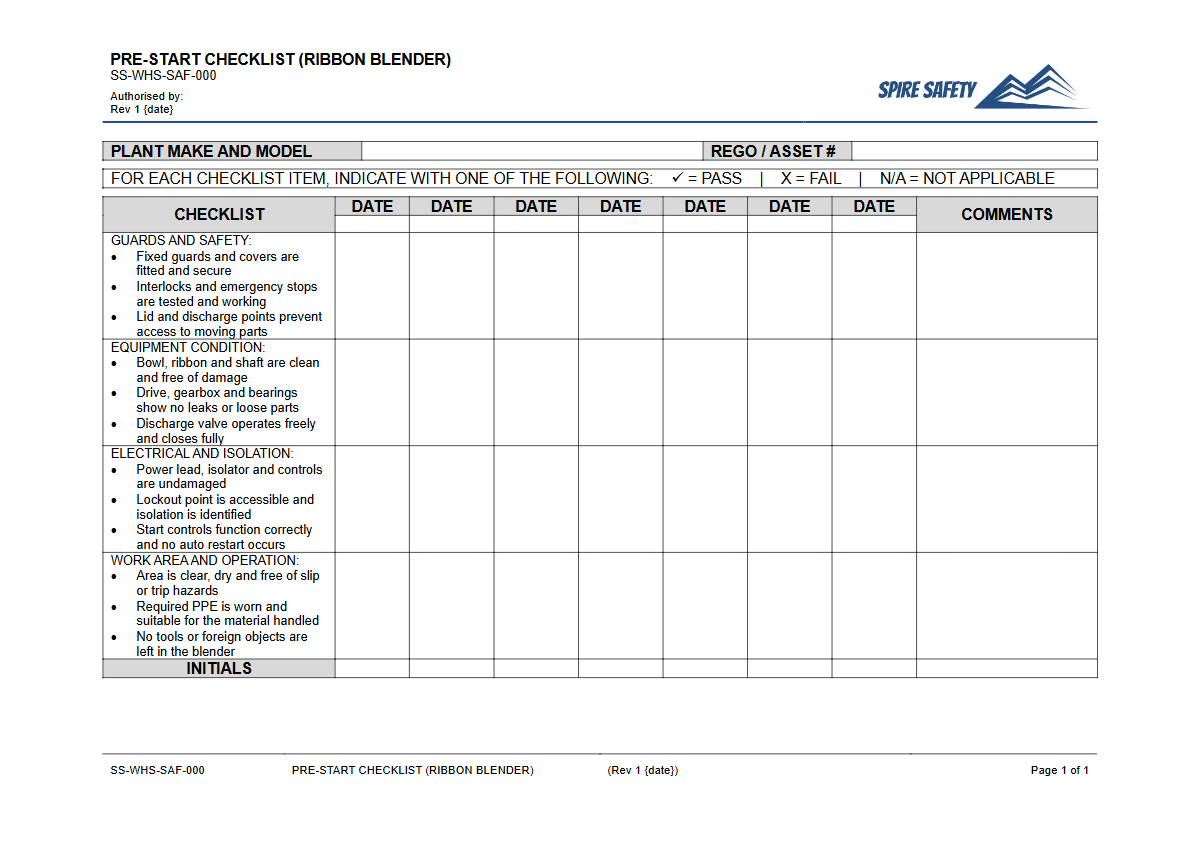
Download our free Pre-Start Checklist (Ribbon Blender) Template to formalise daily equipment inspections.
Free Pre-Start Checklist (Ribbon Blender) Template
DOCX • 125 KB + PDF
Updated Oct 2026
No signup required
Purpose of the Free Pre-Start Checklist (Ribbon Blender) Template
A ribbon blender presents significant risks, including entanglement, crushing, and exposure to hazardous substances. Implementing a consistent inspection routine is a critical control measure to manage these risks.
Our Free Pre-Start Checklist (Ribbon Blender) Template provides a structured starting point for operators to verify the equipment is safe to use before commencing work. This formalises the inspection process, creating a record that demonstrates due diligence and helps identify potential faults before they lead to incidents. This check is a crucial component of your overall plant safety procedures, which should be documented within your comprehensive WHS management systems.
Key Objectives of this Pre-Start Checklist
- Hazard Identification: Systematically prompts the operator to inspect critical safety components like guarding, emergency stops, and interlocks.
- Proactive Maintenance: Helps detect early signs of wear, damage, or malfunction, allowing for scheduled repairs rather than costly and dangerous breakdowns.
- Operator Accountability: Creates a clear record that the operator has conducted their safety diligence before using the machinery.
- Improved Safety Culture: Reinforces the organisation's commitment to safety by embedding checks into daily operational routines.
Video walkthrough
How to use the Free Pre-Start Checklist (Ribbon Blender) Template
This template is provided in both DOCX and PDF formats for your convenience. The DOCX file is fully editable, allowing you to tailor it to the specific make, model, and configuration of the ribbon blenders used in your workplace.
A generic checklist cannot account for the unique features and risks of your equipment and operational environment.
Important Note: This document is a template only. To be effective, you must customise it with your business details and adapt the checklist items to reflect the specific hazards, controls, and operating procedures relevant to your workplace.
We recommend a competent person, such as a safety professional or an experienced supervisor, reviews and approves the final version.
Once customised, the process is straightforward:
- The operator obtains a copy of the checklist before their shift begins.
- They physically inspect each item listed on the checklist, marking it as satisfactory or identifying a fault.
- If any faults are found, the operator must immediately report them to their supervisor and follow the site's tag-out and isolation procedures. The equipment must not be used.
- If all items are satisfactory, the operator signs and dates the form, which is then filed according to your record-keeping procedures. The findings from these checks can be a valuable topic for daily safety discussions, which can be structured using a pre-start meeting template.
When to use it
A pre-start checklist for a ribbon blender should be completed at the beginning of every shift before the equipment is operated for the first time. It should also be completed after any significant stoppage, such as for maintenance, cleaning, or after a long period of inactivity.
This ensures that the machine's condition has not changed and it remains safe to use. Reinforce the importance of these inspections with regular training, such as a focused Pre-Start Checks and Plant Maintenance Toolbox Talk.
Who should use it
The pre-start check should be conducted by the person who will be operating the ribbon blender. This direct responsibility ensures that the individual running the equipment is personally satisfied with its safety condition.
Supervisors have a key role in ensuring these checks are completed correctly and consistently, reviewing the completed forms, and taking prompt action on any reported faults. Ensuring these checks are consistently and correctly performed is a key verification point during regular WHS compliance auditing. While this checklist is for a ribbon blender, the process is similar for other automated machinery, as shown in our Free Pre-Start Checklist (CNC Router) Template.
This foundational safety practice helps create a safer environment for everyone. Similar principles apply to other mixing equipment, and our free Pre-Start Checklist for Agitators offers a comparable framework.
By integrating this simple yet effective tool into your daily operations, you take a significant step towards preventing plant-related incidents.
Common mistakes
Common mistakes to avoid
- Using a generic checklist that hasn't been customised for the specific blender model.
- "Pencil-whipping" the form without physically inspecting each item.
- Failing to remove the equipment from service and apply a danger tag when a fault is found.
- Supervisors failing to review completed checklists and follow up on reported issues.
Legal references
Legal considerations
The following legal requirements may be relevant to this type of work.
- Work Health and Safety Act (Harmonised) — Provides the primary duties for protecting workers and other people from work health and safety risks.
- Work Health and Safety Regulations (Harmonised) — Sets out requirements supporting the management of workplace hazards and risks.
The following codes may be relevant to this type of work.
- Managing WHS Risks Code of Practice — Provides practical guidance on identifying hazards, assessing risks and applying effective controls.
- Work Health and Safety Consultation, Cooperation and Coordination Code of Practice — Provides practical guidance on consulting workers and coordinating with other duty holders.
- Managing the Work Environment and Facilities Code of Practice — Provides practical guidance on safe work environments, workplace facilities and related controls.
Did you know
Entanglement Risk
Contact with moving parts of machinery, particularly rotating shafts or agitators like those in a ribbon blender, is a leading cause of serious workplace injuries. Even a moment of contact can cause a severe or fatal entanglement.
Hierarchy of Control
Pre-start checks are considered an 'administrative control' under the Hierarchy of Control. They are a crucial step but should be used to verify higher-level controls, like engineering solutions (guards, interlocks), are in place and working effectively.
FAQ
Frequently asked questions
01What are the main hazards associated with a ribbon blender?
02Is a pre-start checklist a legal requirement in Australia?
03How often should a ribbon blender pre-start check be performed?
04What happens if a fault is found during a ribbon blender pre-start check?
Share this resource
Free Pre-Start Checklist (Ribbon Blender) Template
Browse Categories
How To Use It
- 1Download and open in Word or PDF.
- 2Replace the placeholders with your business details.
- 3Get it reviewed by a WHS specialist before rollout.
Need it customised?
Our WHS consultants can adapt this template to your site, run a gap analysis, or audit what you already have in place.
Book a Free Consultation WHS consulting servicesor call 1300 156 382