
Free Pre-Start Checklist (Rebar Bender) Template
Formalise daily equipment inspections for rebar benders with our free template.
Free Pre-Start Checklist (Rebar Bender) Template
DOCX • 125 KB + PDF
Updated Oct 2026
No signup required
Purpose of the Free Pre-Start Checklist (Rebar Bender) Template
A rebar bender is a powerful piece of plant used to bend reinforcing steel bars on construction sites and in fabrication workshops. Due to its moving parts and the forces involved, it presents significant risks, including entanglement, crushing, and cutting hazards.
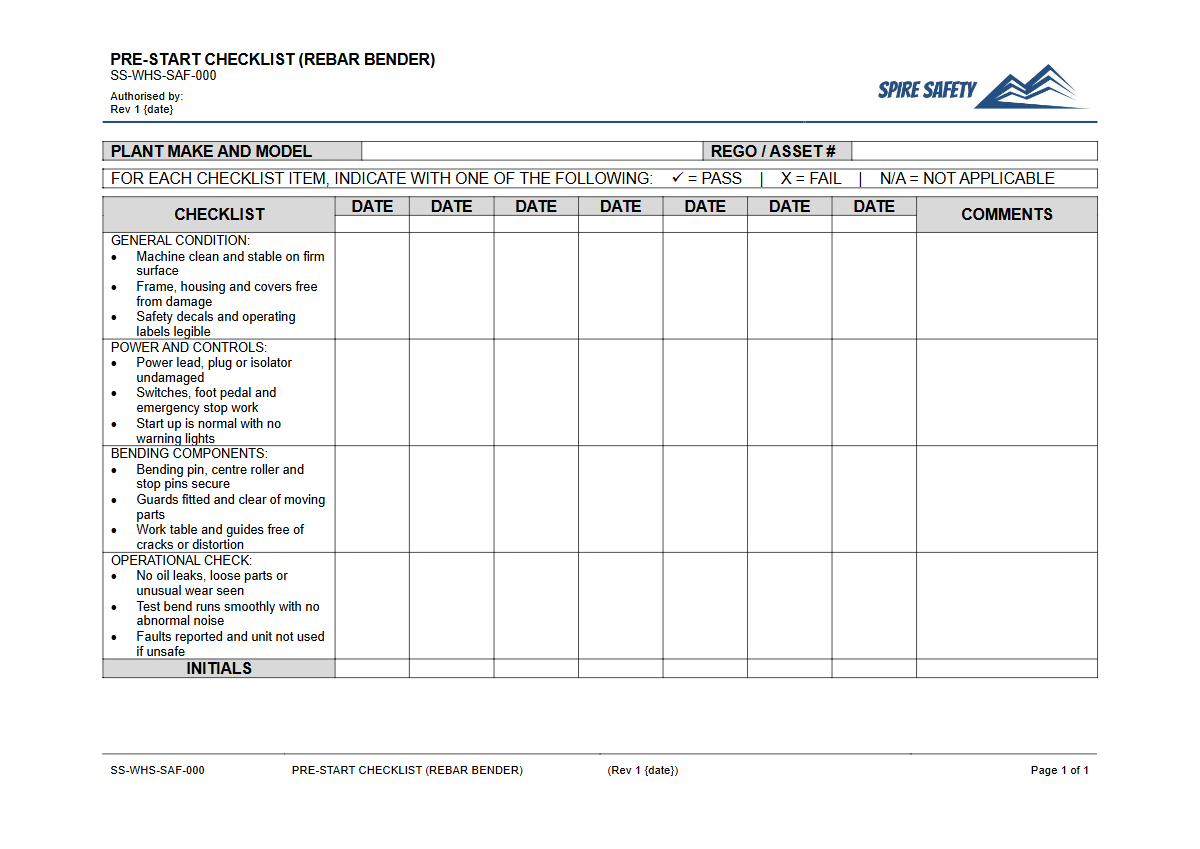
This free Pre-Start Checklist (Rebar Bender) Template provides a structured framework for operators to conduct consistent and thorough safety inspections before each use. Formalising these checks helps your organisation identify potential faults or damage early, preventing equipment failure, incidents, and costly downtime.
Using a documented checklist is a practical step towards meeting your duty of care under Australian WHS legislation.
This template is designed as a starting point, aligned with the principles of the model WHS framework. It helps integrate safety checks into your daily operations and forms a crucial part of broader risk management activities.
Properly implemented, these checks contribute to more effective comprehensive WHS management systems by creating a verifiable record of equipment safety status.
Video walkthrough
How to Use the Free Pre-Start Checklist (Rebar Bender) Template
Integrating this checklist into your workflow is straightforward. First, download the template in your preferred format (DOCX or PDF).
The DOCX version is fully editable, allowing for easy customisation.
Next, and most importantly, you must adapt the template to your specific needs. Every workplace is different, and so is every piece of equipment.
Your checklist should reflect the specific make, model, and configuration of the rebar bender you use, along with any unique environmental or operational risks at your site. A generic checklist is not sufficient; a customised one is essential for effective risk management.
Important Customisation Note
You must customise this template to suit the specific make and model of the rebar bender in your workplace, as well as the unique risks and operational context. We've provided a solid foundation, but site-specific details are your responsibility to add.
If you require assistance in tailoring safety documentation for your specific plant, consider engaging specialist WHS consulting services.
Once customised, ensure all operators are trained on how to use the checklist correctly. This training should cover not just what to check, but why it's important and what to do if a non-conformance is identified.
Finally, establish a process for collecting, reviewing, and storing the completed checklists.
When to Use It
A pre-start check, as the name implies, should be completed before the rebar bender is used for the first time each day or at the beginning of each shift. This ensures the equipment is safe for operation from the outset.
It's also best practice to conduct a check if the machine has been idle for an extended period, has been moved to a new location, or has just returned from maintenance or repair.
Consistent use of pre-start checklists is a key component of preventative maintenance. It helps create a culture of safety where equipment condition is constantly monitored.
Similar principles apply to other workshop equipment, as seen in our free Pre-Start Checklist for Bench Grinders, which also emphasises daily checks.
Who Should Use It
The primary person responsible for completing the Pre-Start Checklist is the operator assigned to use the rebar bender for that shift. Operators have the most hands-on interaction with the equipment and are best placed to notice subtle changes or developing faults.
They must be deemed competent to both operate the machine and conduct the pre-start inspection.
Supervisors and managers also have a crucial role. They are responsible for ensuring operators are completing the checklists correctly and consistently.
They must also review the completed forms, identify any recurring issues, and take prompt corrective action when faults are reported. These records can be a valuable input for scheduled WHS compliance audits to verify that safety procedures are being followed.
This process of inspection and verification is critical for many types of high-risk machinery. You can see a similar approach in our pre-start checklist for floor saws, where operator checks are the first line of defence against equipment-related incidents.
Documenting these checks is not just about compliance; it's about creating a safety partnership between workers and management. Just as with our Granulator Pre-Start Checklist template, this document encourages a proactive, hands-on approach to managing the risks associated with powerful machinery.
Common mistakes
Common mistakes to avoid
- Ticking boxes on the checklist without physically checking the item.
- Using a generic checklist that doesn't match the specific machine make and model.
- Failing to remove the machine from service and tag it out when a fault is found.
- Not training operators on how to perform the checks correctly and why they are important.
Legal references
Legal considerations
The following legal requirements may be relevant to this type of work.
- Work Health and Safety Act (Harmonised) — Provides the primary duties for protecting workers and other people from work health and safety risks.
- Work Health and Safety Regulations (Harmonised) — Sets out requirements supporting the management of workplace hazards and risks.
The following codes may be relevant to this type of work.
- Managing WHS Risks Code of Practice — Provides practical guidance on identifying hazards, assessing risks and applying effective controls.
- Work Health and Safety Consultation, Cooperation and Coordination Code of Practice — Provides practical guidance on consulting workers and coordinating with other duty holders.
- Managing the Work Environment and Facilities Code of Practice — Provides practical guidance on safe work environments, workplace facilities and related controls.
Did you know
Bending Force
Rebar, or reinforcing bar, is a key component in reinforced concrete, providing tensile strength that concrete lacks. A typical rebar bender can exert several tonnes of force to shape steel.
FAQ
Frequently asked questions
01What are the main hazards of a rebar bender?
02Is a pre-start checklist legally required for a rebar bender in Australia?
03What should happen if a fault is found during a rebar bender pre-start check?
04How often should a rebar bender be inspected?
Share this resource
Free Pre-Start Checklist (Rebar Bender) Template
Browse Categories
How To Use It
- 1Download and open in Word or PDF.
- 2Replace the placeholders with your business details.
- 3Get it reviewed by a WHS specialist before rollout.
Need it customised?
Our WHS consultants can adapt this template to your site, run a gap analysis, or audit what you already have in place.
Book a Free Consultation WHS consulting servicesor call 1300 156 382