
Free Pre-Start Checklist (Quick Hitch) Template
Download our free Pre-Start Checklist for Quick Hitches.
Free Pre-Start Checklist (Quick Hitch) Template
DOCX • 125 KB + PDF
Updated Oct 2026
No signup required
Purpose of the Free Pre-Start Checklist (Quick Hitch) Template
Quick hitches are a major efficiency booster on construction and earthmoving sites, but they also introduce significant risks if they fail. An unintentional release of an attachment can have catastrophic consequences.
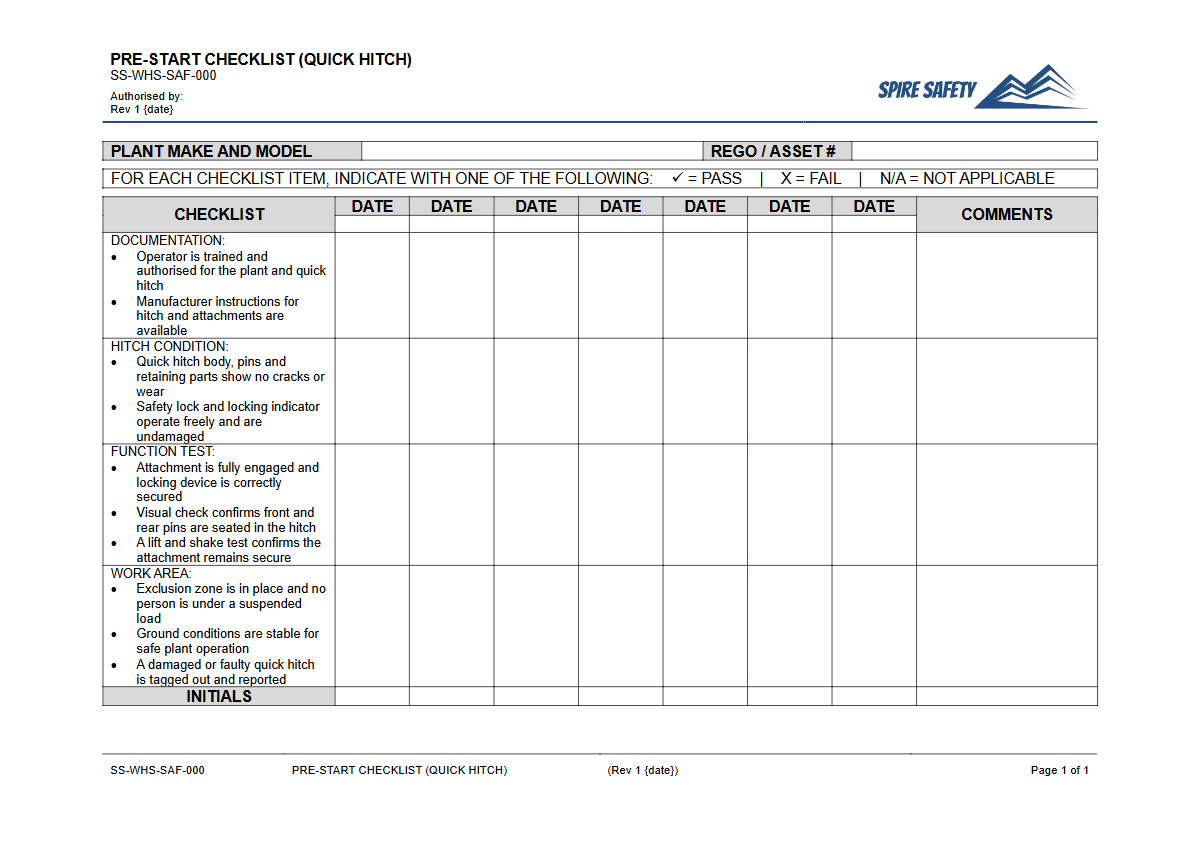
This Free Pre-Start Checklist (Quick Hitch) Template provides a structured framework for operators to conduct thorough, repeatable safety inspections before operating machinery. Formalising this process helps identify potential defects, wear, or damage before they lead to an incident, ensuring the equipment is safe for use.
By documenting these checks, your organisation can demonstrate its commitment to proactive risk management and create a safer working environment for everyone on site.
Video walkthrough
How to use the Free Pre-Start Checklist (Quick Hitch) Template
Using this template is a straightforward process designed to integrate into your daily site procedures. First, download the document in your preferred format (DOCX for easy editing or PDF for printing).
Next, adapt the checklist to your specific operational needs. Finally, train your operators on the new procedure and implement it as a mandatory pre-operational task.
Important: This template provides a strong foundation based on common Australian WHS principles. We strongly recommend you customise it to reflect the specific makes and models of quick hitches, host machines (e.g., excavators, loaders), and attachments used in your workplace.
A robust pre-start process is a key component of effective WHS management systems, so tailoring it to your unique risks is essential.
When to use it
A pre-start inspection of a quick hitch should be conducted at the beginning of every work shift. It is not a one-time check.
Furthermore, the check must be repeated every single time an attachment is changed. This frequency ensures that any issues that may have developed during operation or the attachment changeover process are caught immediately.
A comprehensive walkthrough of equipment safety routines is often covered in daily meetings, which can be guided by a Free Pre-Start Meeting Template to ensure all key points are addressed.
Who should use it
This checklist is designed to be used by trained and competent plant operators who are authorised to operate the machinery. It is their responsibility to ensure the equipment they are about to use is safe.
Supervisors and site managers should also be familiar with the checklist to oversee its correct implementation and to verify that checks are being completed and documented properly. The information gathered can also be valuable for maintenance personnel who need to track equipment condition over time. The principles of operator responsibility and procedural checks are fundamental to high-risk activities, similar to those outlined in a Safe Work Method Statement (Concrete Truck Operation) Template.
Key Inspection Areas
While the template provides a full list, key areas for inspection always include:
- Locking Mechanisms: Check that all safety pins, latches, or hydraulic locking systems are present, undamaged, and function correctly.
- Structural Integrity: Look for any cracks, bending, or excessive wear on the hitch body and attachment points.
- Hydraulic and Electrical Systems: Inspect hoses and connectors for leaks, fraying, or damage that could compromise the locking function.
- Compatibility: Confirm that the attachment is the correct size and type for the hitch, and that the manufacturer's pairing instructions are followed.
- Verification: After connecting an attachment, perform a physical test (e.g., the 'rattle test') to confirm it is securely locked before lifting it off the ground.
Regularly reinforcing these steps through site discussions is crucial. A Pre-Start Checks and Plant Maintenance Toolbox Talk Template can be a useful tool for facilitating these important safety conversations with your team.
Ensuring these checks are consistently performed and any identified issues are rectified before use is a cornerstone of plant safety. Periodic reviews of your safety procedures and records are also recommended, a process that can be formalised through WHS compliance auditing.
This document is one of many tools available to help you build a safer workplace. Explore our complete free WHS resources library for more templates, checklists, and guides to support your safety management efforts.
Common mistakes
Common mistakes to avoid
- Failing to visually and physically confirm the safety pin or locking mechanism is correctly engaged.
- Using attachments that are not a compatible size or type for the specific quick hitch model.
- Overlooking the integrity of hydraulic hoses or electrical connections during the inspection.
- Not documenting the completion of the pre-start check, leading to poor record-keeping and accountability.
Legal references
Legal considerations
The following legal requirements may be relevant to this type of work.
- Work Health and Safety Act (Harmonised) — Provides the primary duties for protecting workers and other people from work health and safety risks.
- Work Health and Safety Regulations (Harmonised) — Sets out requirements supporting the management of workplace hazards and risks.
The following codes may be relevant to this type of work.
- Managing WHS Risks Code of Practice — Provides practical guidance on identifying hazards, assessing risks and applying effective controls.
- Work Health and Safety Consultation, Cooperation and Coordination Code of Practice — Provides practical guidance on consulting workers and coordinating with other duty holders.
- Managing the Work Environment and Facilities Code of Practice — Provides practical guidance on safe work environments, workplace facilities and related controls.
Did you know
The 'Rattle Test'
A common industry practice for verifying a secure connection is the 'rattle test'—gently pushing and curling the attachment against the ground to confirm the locking pins are fully engaged and there is no excessive movement.
A Preventable Risk
A significant number of serious incidents involving excavators are caused by the failure of quick hitch devices. Many of these are preventable through robust inspection and verification procedures as outlined in a pre-start checklist.
FAQ
Frequently asked questions
01What are the main hazards associated with quick hitches?
02Is a visual check enough to confirm a quick hitch is locked?
03How often should quick hitch pre-start checks be performed?
04Who is responsible for ensuring quick hitches are used safely?
Share this resource
Free Pre-Start Checklist (Quick Hitch) Template
Browse Categories
How To Use It
- 1Download and open in Word or PDF.
- 2Replace the placeholders with your business details.
- 3Get it reviewed by a WHS specialist before rollout.
Need it customised?
Our WHS consultants can adapt this template to your site, run a gap analysis, or audit what you already have in place.
Book a Free Consultation WHS consulting servicesor call 1300 156 382