
Free Pre-Start Checklist (Range Hood) Template
Formalise your kitchen equipment safety checks with our free Pre-Start Checklist (Range Hood) Template.
Free Pre-Start Checklist (Range Hood) Template
DOCX • 125 KB + PDF
Updated Oct 2026
No signup required
Purpose of the Free Pre-Start Checklist (Range Hood) Template
Commercial range hoods are critical for maintaining air quality and fire safety in kitchens. Regular inspections are essential for ensuring they function correctly and do not pose a risk to workers.
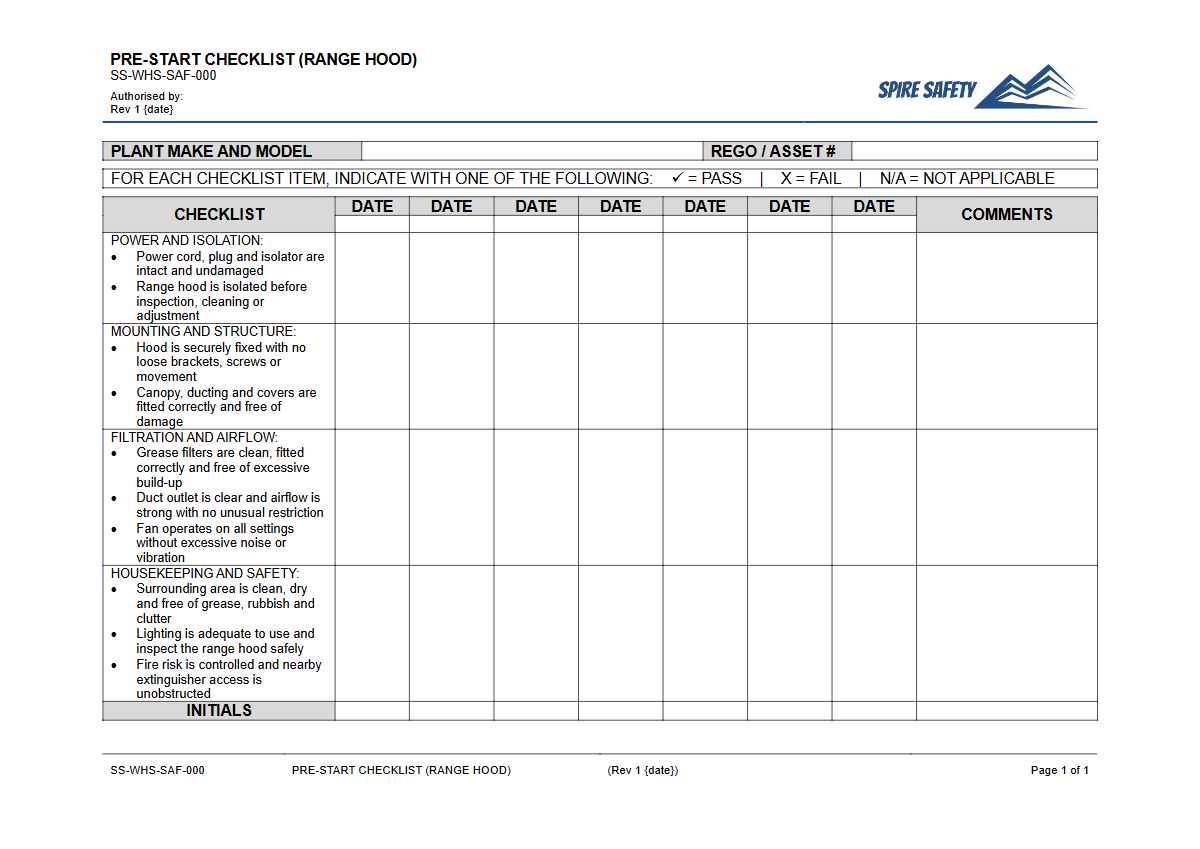
This free Pre-Start Checklist (Range Hood) Template provides a structured framework to guide operators through a thorough pre-use inspection. Using a formal checklist helps to standardise safety procedures, identify potential faults before they escalate, and document due diligence in managing workplace hazards.
The primary goals of this checklist are to verify that the extraction system is clear, the filters are clean, and all electrical and mechanical components are in safe working order. It encourages a proactive approach to safety, helping to prevent grease fires, carbon monoxide buildup, and equipment failure.
Integrating such checks into daily operations is a key component of effective WHS management systems, demonstrating a commitment to a safe work environment.
Video walkthrough
How to use the Free Pre-Start Checklist (Range Hood) Template
This template is available in both DOCX and PDF formats for your convenience. The DOCX version is fully editable, allowing you to tailor the checklist to the specific make, model, and installation of the range hoods in your workplace.
The PDF version is ready for immediate printing and use.
To implement the checklist effectively:
- Download the DOCX file.
- Review each checklist item and add, remove, or modify points to reflect your equipment and operational risks. Consider factors like the type of cooking, hours of operation, and manufacturer recommendations.
- Train all relevant kitchen staff and supervisors on how to complete the checklist correctly and what actions to take if a fault is identified.
- Integrate the completed checklists into your safety records as part of your overall plant and equipment maintenance program.
Important: This document is a template only. It provides a starting point aligned with Australian WHS principles, but it is not a complete, out-of-the-box solution.
To be effective, you must customise it to address the specific hazards and control measures relevant to your workplace. We recommend a thorough risk assessment of your kitchen equipment to ensure all potential issues are covered.
When to use a Range Hood Pre-Start Checklist
A pre-start check for a commercial range hood should be completed before the first use each day or at the beginning of each shift in a 24-hour operation. This frequency ensures that any issues that may have developed overnight or during a previous shift are caught before cooking begins.
Regular checks are fundamental to preventing the accumulation of grease, which is a major fire hazard. Consistent daily inspections can be reinforced through regular safety discussions, such as those facilitated by a Pre-Start Checks and Plant Maintenance Toolbox Talk.
Additional checks may be warranted after deep cleaning, maintenance, or any event that could have affected the system's integrity, such as a power outage or minor fire. The goal is to make the inspection a routine, non-negotiable part of the daily kitchen opening procedure.
Who should use this Checklist
This checklist is designed for use by the workers who operate cooking equipment under the range hood, such as chefs and kitchen hands. The person starting up the kitchen for the day is typically the ideal individual to perform the check.
Supervisors or kitchen managers are responsible for ensuring the checks are completed and for actioning any reported defects or maintenance requirements. For facilities with complex HVAC systems, it can be useful to cross-reference procedures with those for other equipment, such as what might be found in a free Pre-Start Checklist (Air Handler) Template.
Ultimately, everyone working in the kitchen has a responsibility to maintain a safe environment. Documenting daily safety actions helps formalise these responsibilities.
These checks can be discussed in daily briefings, which can be structured using a Pre-Start Meeting Template to ensure all safety points are covered before service begins. Periodically, an external party may be engaged to confirm that your safety processes are being followed correctly through services like WHS compliance auditing.
This document is just one of many tools available to help you build a robust safety system. For other equipment-specific templates, such as a Pre-Start Checklist (Agitator) Template for mixing equipment, explore our complete free WHS resources library for more downloads.
Common mistakes
Common mistakes to avoid
- Ticking boxes without physically inspecting the item ('pencil-whipping').
- Failing to clean or replace grease filters according to a regular schedule.
- Ignoring signs of poor extraction, such as a smoky kitchen or unusual fan noises.
- Not immediately reporting faults or tagging out faulty equipment, allowing it to be used in an unsafe state.
Legal references
Legal considerations
The following legal requirements may be relevant to this type of work.
- Work Health and Safety Act (Harmonised) — Provides the primary duties for protecting workers and other people from work health and safety risks.
- Work Health and Safety Regulations (Harmonised) — Sets out requirements supporting the management of workplace hazards and risks.
The following codes may be relevant to this type of work.
- Managing WHS Risks Code of Practice — Provides practical guidance on identifying hazards, assessing risks and applying effective controls.
- Work Health and Safety Consultation, Cooperation and Coordination Code of Practice — Provides practical guidance on consulting workers and coordinating with other duty holders.
- Managing the Work Environment and Facilities Code of Practice — Provides practical guidance on safe work environments, workplace facilities and related controls.
Did you know
Grease Fires
According to Fire and Rescue NSW, about 40% of all fires in restaurants start in the kitchen, with dirty exhaust hoods and ductwork being a major contributing factor.
Ventilation Standards
Australian Standard AS 1668.2 specifies minimum ventilation rates for commercial kitchens to ensure contaminants like smoke, steam, and carbon monoxide are effectively removed, protecting worker health.
FAQ
Frequently asked questions
01What is the main purpose of a range hood pre-start check?
02How often should a range hood pre-start check be completed?
03Are pre-start checklists a legal requirement in Australia?
04What are the key fire hazards associated with commercial range hoods?
Share this resource
Free Pre-Start Checklist (Range Hood) Template
Browse Categories
How To Use It
- 1Download and open in Word or PDF.
- 2Replace the placeholders with your business details.
- 3Get it reviewed by a WHS specialist before rollout.
Need it customised?
Our WHS consultants can adapt this template to your site, run a gap analysis, or audit what you already have in place.
Book a Free Consultation WHS consulting servicesor call 1300 156 382