
Free Pre-Start Checklist (Printing Press) Template
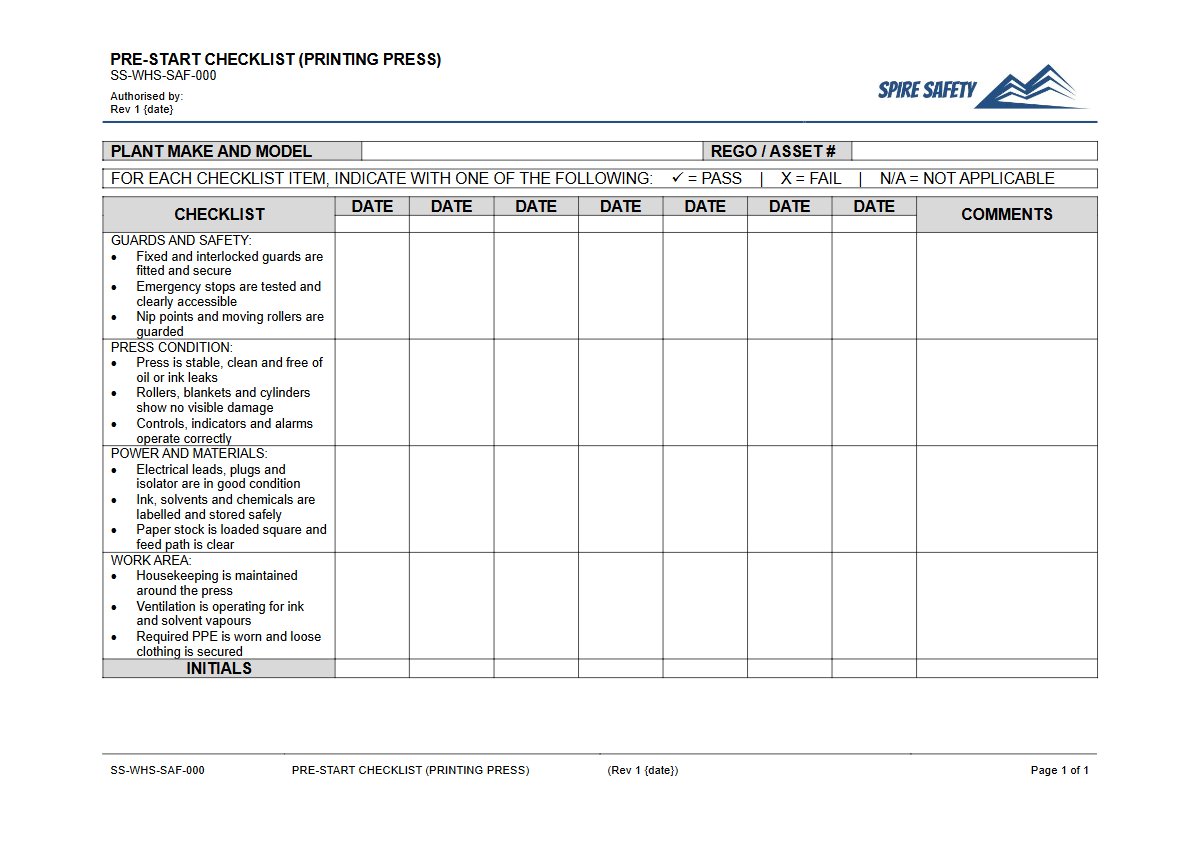
Download our free Pre-Start Checklist for Printing Presses. This structured template (DOCX & PDF) helps formalise safety inspections and manage WHS risks.
Free Pre-Start Checklist (Printing Press) Template
DOCX • 125 KB + PDF
Updated Oct 2026
No signup required
Purpose of the Free Pre-Start Checklist (Printing Press) Template
Operating a printing press involves significant risks, including moving parts, nip points, high pressure, and exposure to chemicals. A pre-start inspection is a fundamental safety control that helps identify and address hazards before work commences.
Our Free Pre-Start Checklist (Printing Press) Template provides a structured framework to formalise these essential checks. Consistent use of this checklist helps your organisation demonstrate due diligence, prevent incidents, ensure the press is fit for purpose, and reduce costly downtime from unexpected equipment failure.
Implementing documented checks like this is a key component of effective WHS management systems. It creates a verifiable record that safety procedures are being followed, which is invaluable during safety audits and in the event of an incident. This proactive approach fosters a stronger safety culture by reinforcing the importance of operator responsibility and equipment integrity.
Video walkthrough
How to use the Free Pre-Start Checklist (Printing Press) Template
This template is designed to be a practical starting point. Download the DOCX file and adapt it to the specific requirements of your workplace. Key steps for implementation include:
- Customise: Add your company branding and, most importantly, modify the checklist items to match the specific make, model, and configuration of your printing press(es).
- Consult: Involve the operators and maintenance personnel who use the equipment daily. Their direct knowledge is crucial for creating a relevant and effective checklist.
- Train: Ensure all relevant workers are trained on how to properly complete the checklist, what each item means, and the procedure for reporting faults.
- Implement: Integrate the checklist into your daily operational workflow. Make it a non-negotiable step before any operator begins their shift.
IMPORTANT: This document is a template only. You must customise it to reflect the specific machinery, tasks, and control measures unique to your workplace.
We cannot guarantee its suitability for your specific circumstances. A customised checklist should work alongside other key documents, such as a specific Hydraulic Press SOP (Safe Operating Procedure) template, to form a complete safe system of work.
When to use it
A pre-start checklist should be completed at several key intervals to ensure ongoing safety. The most critical time is at the beginning of every shift, before the printing press is used for production.
It should also be used after any significant maintenance or repair work has been performed to verify that the equipment is safe to return to service. Additionally, if there is a change of operator mid-shift, the incoming operator should conduct their own pre-start check to confirm the machine's condition.
Regularly reinforcing this habit is crucial for maintaining a safe workplace. Discussing the importance of these checks can be a valuable topic for safety meetings, which can be guided by resources like our Pre-Start Checks and Plant Maintenance Toolbox Talk.
Who should use it
This checklist should be completed by persons who are trained, competent, and authorised to operate the specific printing press. This includes press operators and apprentices working under direct supervision.
Supervisors or team leaders should be responsible for reviewing the completed checklists, ensuring any reported faults are addressed promptly, and verifying the process is being followed correctly. It is a Person Conducting a Business or Undertaking's (PCBU) duty to ensure workers have the necessary training and instruction to perform their work safely.
Verifying that these checks are being performed correctly by competent individuals can be a focus area during safety reviews. These reviews are a core part of the continuous improvement cycle and can be supported by formal WHS compliance auditing to ensure your safety systems remain effective.
Key Inspection Areas
While your customised checklist will be specific to your equipment, it should cover several critical safety areas. These typically include:
- Guarding: All guards are in place, secured, and not damaged. Interlock switches must be functional.
- Emergency Stops: E-stops are accessible, clearly marked, and function correctly when tested.
- Operating Controls: All buttons, levers, and touch screens are in good condition and respond as expected.
- Rollers and Cylinders: Check for damage, wear, or foreign objects. Ensure nip points are adequately guarded.
- Inking and Dampening Systems: Look for leaks and ensure fluid levels are correct.
- Electrical: Inspect cables and connections for damage. Ensure control panels are closed and secured.
- Housekeeping: The area around the press must be clear of clutter, slip hazards, and flammable materials.
It is critical that operators are competent not just to operate the machine, but also to identify these potential faults. Competency can be formally assessed using tools like our free Drill Press VOC (Verification of Competency) Template, adapted for your specific plant.
Integrating Checklists into Your Safety System
A pre-start checklist is more than just a piece of paper; it's a tool that integrates with your broader WHS framework. The records generated can be used to identify recurring mechanical issues, informing your preventative maintenance schedule.
They provide valuable information during incident investigations and can be used as a practical training aid for new operators. This same principle of pre-use inspection applies to other complex machinery, and you can adapt the methodology using other resources like our Free Pre-Start Checklist (CNC Router) Template.
By embedding this process into your daily operations, you move from a reactive to a proactive safety mindset. For more tools to build out your safety system, explore our complete free WHS resources library.
Common mistakes
Common mistakes to avoid
- Using a generic checklist without customising it for the specific press model and its unique features.
- Operators 'pencil-whipping' the form without physically inspecting each item.
- Failing to immediately tag out unsafe equipment and report the defect when a fault is found.
- Poor record-keeping, making it difficult to track recurring faults or prove due diligence.
Legal references
Legal considerations
The following legal requirements may be relevant to this type of work.
- Work Health and Safety Act (Harmonised) — Provides the primary duties for protecting workers and other people from work health and safety risks.
- Work Health and Safety Regulations (Harmonised) — Sets out requirements supporting the management of workplace hazards and risks.
The following codes may be relevant to this type of work.
- Managing WHS Risks Code of Practice — Provides practical guidance on identifying hazards, assessing risks and applying effective controls.
- Work Health and Safety Consultation, Cooperation and Coordination Code of Practice — Provides practical guidance on consulting workers and coordinating with other duty holders.
- Managing the Work Environment and Facilities Code of Practice — Provides practical guidance on safe work environments, workplace facilities and related controls.
Did you know
Nip Point Dangers
Nip points, where rollers meet or come close to each other, can draw in objects at high speed. A gap of just a few millimetres is enough to cause a severe crushing or amputation injury.
Industry Risk Profile
According to Safe Work Australia data, the printing industry has significant injury risks, with 'being trapped by moving machinery' being a leading cause of serious workers' compensation claims.
FAQ
Frequently asked questions
01Why is a pre-start checklist for a printing press necessary?
02How often should a printing press pre-start check be completed?
03What happens if a fault is found during a printing press pre-start check?
04Is this printing press checklist template compliant with Australian WHS laws?
Share this resource
Free Pre-Start Checklist (Printing Press) Template
Browse Categories
How To Use It
- 1Download and open in Word or PDF.
- 2Replace the placeholders with your business details.
- 3Get it reviewed by a WHS specialist before rollout.
Need it customised?
Our WHS consultants can adapt this template to your site, run a gap analysis, or audit what you already have in place.
Book a Free Consultation WHS consulting servicesor call 1300 156 382