
Free Pre-Start Checklist (Pressure Wash) Template
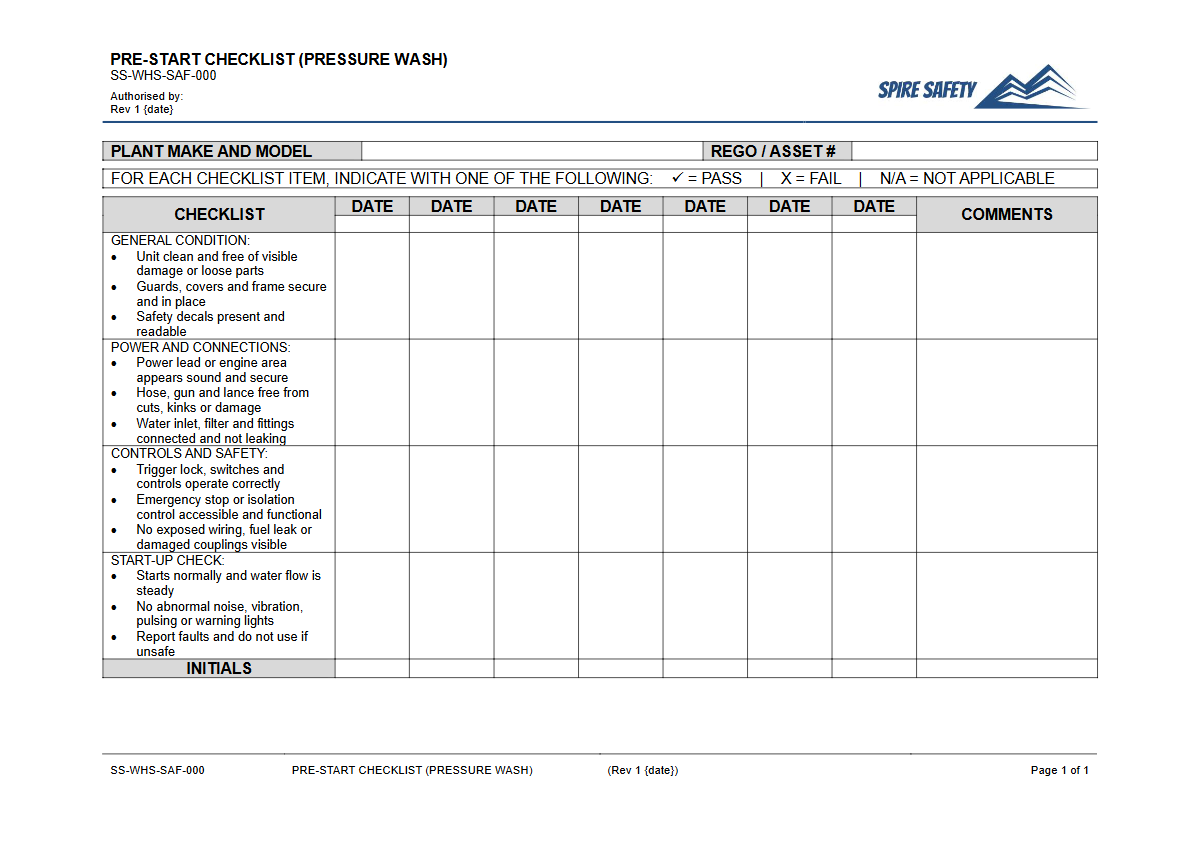
Download our free Pre-Start Checklist (Pressure Wash) template. This DOCX & PDF resource helps formalise daily safety checks to manage WHS risks.
Free Pre-Start Checklist (Pressure Wash) Template
DOCX • 125 KB + PDF
Updated Oct 2026
No signup required
Purpose of the Free Pre-Start Checklist (Pressure Wash) Template
Using a pressure washer involves significant risks, including high-pressure water injection, electrical shock, and slips, trips, and falls. Implementing a consistent inspection process is a critical control measure.
This Free Pre-Start Checklist (Pressure Wash) Template provides a structured format to help workers identify potential faults or hazards before operating the equipment. Regular use helps formalise safety procedures, reduce the likelihood of equipment failure, and demonstrate a proactive approach to risk management.
By documenting these checks, you create a clear record of equipment condition over time, which is a fundamental component of effective WHS management systems. It helps ensure that any pressure washer used on site is in safe, working order, protecting both the operator and others in the vicinity. This systematic approach supports compliance with the PCBU's primary duty of care to provide and maintain safe plant.
Video walkthrough
How to use the Free Pre-Start Checklist (Pressure Wash) Template
Our template is available in both DOCX and PDF formats, providing a ready-made starting point for your organisation's safety protocols. The checklist guides the operator through a series of essential checks covering the power source, hoses, nozzles, safety features, and the immediate work area.
It is designed to be straightforward, allowing for quick but thorough inspections before every shift or use.
Important: This document is a template and must be customised to your specific workplace. We recommend a competent person reviews and adapts it to reflect the exact make and model of pressure washers in use, your site-specific hazards (e.g., working near electricity, on slippery surfaces), and your internal safety procedures.
This process is similar to adapting our free template for bench grinders or any other equipment-specific document.
When to use a Pressure Wash Pre-Start Checklist
A pre-start check should be completed before the first use of the pressure washer on any given day or shift. If the equipment is used by multiple operators during a single shift, a new check should ideally be conducted at each handover.
This ensures continuous oversight and accountability for the equipment's condition.
These completed checklists serve as valuable records. They can be reviewed during safety meetings, incident investigations, or as part of internal and external WHS compliance audits. Consistent documentation helps prove that safety processes are not just written down, but are actively being followed in practice.
Who should use this Pre-Start Checklist
This checklist is designed for several key roles within an organisation to ensure a comprehensive approach to safety.
Operators
The primary user is the person operating the pressure washer. They are responsible for physically conducting the checks and are the first line of defence against equipment-related incidents.
Operators must be trained and competent not only in using the pressure washer but also in understanding what each item on the checklist means. For instance, they need to recognise the signs of a worn or damaged high-pressure hose, rather than just ticking a box.
For equipment with different power systems, such as a concrete pre-start checklist for floor saws, the specific checks would differ but the operator's responsibility remains the same.
Supervisors and Managers
Supervisors are responsible for ensuring operators complete the pre-start checks correctly and consistently. They should periodically review completed checklists to identify recurring issues, maintenance needs, or gaps in operator training.
They also play a crucial role in the 'tag out' process if an operator flags a fault. Similar principles apply to managing the use of other machinery, such as documented checks for a pre-start check for bin lifters, ensuring all plant is safe before use.
PCBUs (Persons Conducting a Business or Undertaking)
The PCBU holds the ultimate responsibility for providing a safe working environment, which includes implementing safe systems of work. By mandating the use of pre-start checklists, the PCBU helps fulfil their duty of care. For organisations needing support in establishing such processes, our general WHS consulting services can provide expert guidance on tailoring and integrating these tools effectively. This template is one of many tools available in our free WHS resources library to assist PCBUs in meeting their obligations.
Common mistakes
Common mistakes to avoid
- Skipping the check for 'a quick job', which is often when incidents occur.
- Failing to inspect the spray nozzle for blockages or wear, which can cause dangerous pressure build-up.
- Ignoring minor leaks from hoses or couplings, which can worsen suddenly and cause hose whip or injection hazards.
- Proceeding with the job without ensuring all required Personal Protective Equipment (PPE), like eye protection and waterproof boots, is worn.
Legal references
Legal considerations
The following legal requirements may be relevant to this type of work.
- Work Health and Safety Act (Harmonised) — Provides the primary duties for protecting workers and other people from work health and safety risks.
- Work Health and Safety Regulations (Harmonised) — Sets out requirements supporting the management of workplace hazards and risks.
The following codes may be relevant to this type of work.
- Managing WHS Risks Code of Practice — Provides practical guidance on identifying hazards, assessing risks and applying effective controls.
- Work Health and Safety Consultation, Cooperation and Coordination Code of Practice — Provides practical guidance on consulting workers and coordinating with other duty holders.
- Managing the Work Environment and Facilities Code of Practice — Provides practical guidance on safe work environments, workplace facilities and related controls.
Did you know
Injection Injury Risk
High-pressure water jets can penetrate the skin and underlying tissues, causing severe injuries that may not appear serious initially. These injuries require immediate medical attention as they can lead to bacterial infections, permanent disability, or even amputation.
Pressure vs. Flow
A pressure washer's cleaning power comes from a combination of pressure (measured in PSI) and water flow rate (litres per minute). A high PSI provides the force to dislodge dirt, while a higher flow rate helps wash it away more quickly.
FAQ
Frequently asked questions
01What are the most critical hazards of using a pressure washer?
02Is a pre-start check for a pressure washer a legal requirement in Australia?
03How often should a pressure washer be professionally serviced?
04Can I use this template for both electric and petrol-powered pressure washers?
Share this resource
Free Pre-Start Checklist (Pressure Wash) Template
Browse Categories
How To Use It
- 1Download and open in Word or PDF.
- 2Replace the placeholders with your business details.
- 3Get it reviewed by a WHS specialist before rollout.
Need it customised?
Our WHS consultants can adapt this template to your site, run a gap analysis, or audit what you already have in place.
Book a Free Consultation WHS consulting servicesor call 1300 156 382