
Free Pre-Start Checklist (Pressure Vessel) Template
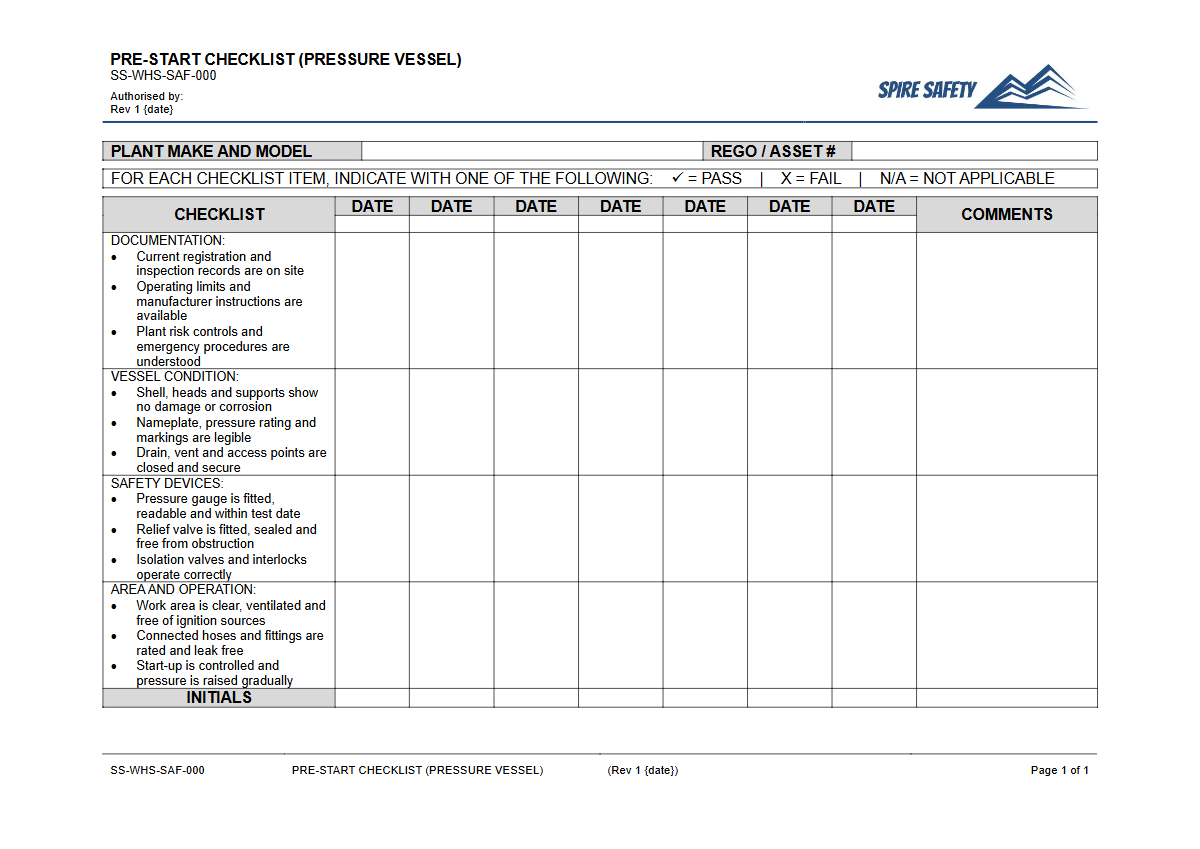
Download our free Pre-Start Checklist (Pressure Vessel) Template. This structured Word & PDF resource helps formalise safety checks for pressure equipment.
Free Pre-Start Checklist (Pressure Vessel) Template
DOCX • 125 KB + PDF
Updated Oct 2026
No signup required
Purpose of the Free Pre-Start Checklist (Pressure Vessel) Template
Operating pressure vessels, such as air receivers, boilers, and autoclaves, involves significant risks due to the high levels of stored energy. A systematic pre-start inspection is a critical control measure to ensure the equipment is safe to operate before each use.
This free Pre-Start Checklist (Pressure Vessel) Template provides a structured framework for operators to verify key safety components, identify potential defects, and confirm that the equipment is in a safe condition. By formalising this process, organisations can proactively manage risks associated with pressure equipment failure, such as explosions, ruptures, or the uncontrolled release of hazardous substances.
Using a documented checklist helps standardise safety procedures and creates a record of due diligence. It prompts operators to physically inspect gauges, valves, safety devices, and vessel integrity, rather than relying on assumption.
Integrating these checks into daily operations is a cornerstone of effective plant safety management. For broader discussions on this topic with your team, our Pre-Start Checks and Plant Maintenance Toolbox Talk can be a valuable resource to reinforce safe work habits.
Video walkthrough
How to use the Free Pre-Start Checklist (Pressure Vessel) Template
This template is provided in both DOCX and PDF formats for your convenience. Download the file and integrate it into your organisation's safety management system.
The DOCX version is fully editable, allowing you to tailor the content to the specific make, model, and operational context of your pressure vessels. It is crucial to add or remove checks based on the manufacturer’s instructions, Australian Standards, and the unique hazards of your workplace.
Important: This is a template, not a finished document. To be effective, you must customise it to reflect the specific equipment and operational risks at your site.
We recommend consulting with the equipment manufacturer, a competent person, and your safety team to ensure all relevant inspection points are included. A checklist is just one part of a safe system of work; it should be supported by comprehensive procedures, such as a detailed Pressure Washer SOP for other types of pressurised equipment.
When to use it
A pre-start checklist for a pressure vessel should be completed by a competent operator before the equipment is used for the first time on any given day or shift. It should be a mandatory step in the start-up procedure.
The frequency ensures that any damage or defects that may have occurred overnight, during maintenance, or in the previous shift are identified before the vessel is pressurised. This routine helps build a consistent safety culture where equipment checks are non-negotiable.
Completed checklists should be reviewed by a supervisor and securely filed as part of your operational health and safety records. These records are essential for demonstrating compliance, tracking equipment condition over time, and identifying recurring issues that may require more significant maintenance or replacement.
These practices are a key component of effective WHS management systems, providing tangible evidence of risk management in action.
Who should use it
This checklist is designed to be used by trained and competent operators who are authorised to work with the specific pressure vessel. The user must have a thorough understanding of the equipment's functions, potential hazards, and the purpose of each item on the checklist.
Supervisors or managers are responsible for ensuring that operators are adequately trained and that the pre-start process is being followed correctly. They should also be the point of contact for reporting any defects or 'No' answers on the form, initiating corrective actions, and ensuring the equipment is isolated from use until it is deemed safe.
Verifying that an operator is competent to not only use the equipment but also to conduct a thorough pre-start inspection is a critical responsibility for a Person Conducting a Business or Undertaking (PCBU). While this checklist is for a pressure vessel, a similar principle of assessing worker skill can be seen in tools like our Pressure Cleaner VOC, which helps confirm competency for other high-risk plant.
Regular WHS compliance auditing can further validate that these procedures are embedded and effective within your organisation's daily operations. For more templates and tools, you can browse our complete free WHS resources library.
Common mistakes
Common mistakes to avoid
- Using the template without customising it for the specific pressure vessel model.
- Operators 'pencil-whipping' the form without conducting a genuine physical inspection.
- Failing to immediately report and act on identified defects, allowing unsafe equipment to remain in service.
- Inadequate record-keeping, making it difficult to track equipment history or prove due diligence.
Legal references
Legal considerations
The following legal requirements may be relevant to this type of work.
- Work Health and Safety Act (Harmonised) — Provides the primary duties for protecting workers and other people from work health and safety risks.
- Work Health and Safety Regulations (Harmonised) — Sets out requirements supporting the management of workplace hazards and risks.
The following codes may be relevant to this type of work.
- Managing WHS Risks Code of Practice — Provides practical guidance on identifying hazards, assessing risks and applying effective controls.
- Work Health and Safety Consultation, Cooperation and Coordination Code of Practice — Provides practical guidance on consulting workers and coordinating with other duty holders.
- Managing the Work Environment and Facilities Code of Practice — Provides practical guidance on safe work environments, workplace facilities and related controls.
Did you know
Defining a Vessel
According to Australian Standard AS/NZS 1200, the definition of pressure equipment includes vessels subject to internal or external pressure, including boilers, pressure vessels, and pressure piping.
Stored Energy
The energy stored in a compressed air vessel can be immense. A catastrophic failure of a medium-sized industrial air receiver can release energy equivalent to an explosion, capable of causing serious structural damage and fatal injuries.
FAQ
Frequently asked questions
01What is a pressure vessel pre-start checklist for?
02Are pressure vessels considered high-risk plant in Australia?
03How often should pressure vessel inspections be conducted?
04Can I use a generic checklist for any pressure vessel?
Share this resource
Free Pre-Start Checklist (Pressure Vessel) Template
Browse Categories
How To Use It
- 1Download and open in Word or PDF.
- 2Replace the placeholders with your business details.
- 3Get it reviewed by a WHS specialist before rollout.
Need it customised?
Our WHS consultants can adapt this template to your site, run a gap analysis, or audit what you already have in place.
Book a Free Consultation WHS consulting servicesor call 1300 156 382