
Free Pre-Start Checklist (Pressure Pot) Template
Download our Free Pre-Start Checklist (Pressure Pot) Template to formalise daily equipment inspections.
Free Pre-Start Checklist (Pressure Pot) Template
DOCX • 125 KB + PDF
Updated Oct 2026
No signup required
Purpose of the Free Pre-Start Checklist (Pressure Pot) Template
Pressure pots are essential in many industries for tasks like spray painting, resin casting, and adhesive application. However, their operation involves significant stored energy, posing serious risks if not managed correctly.
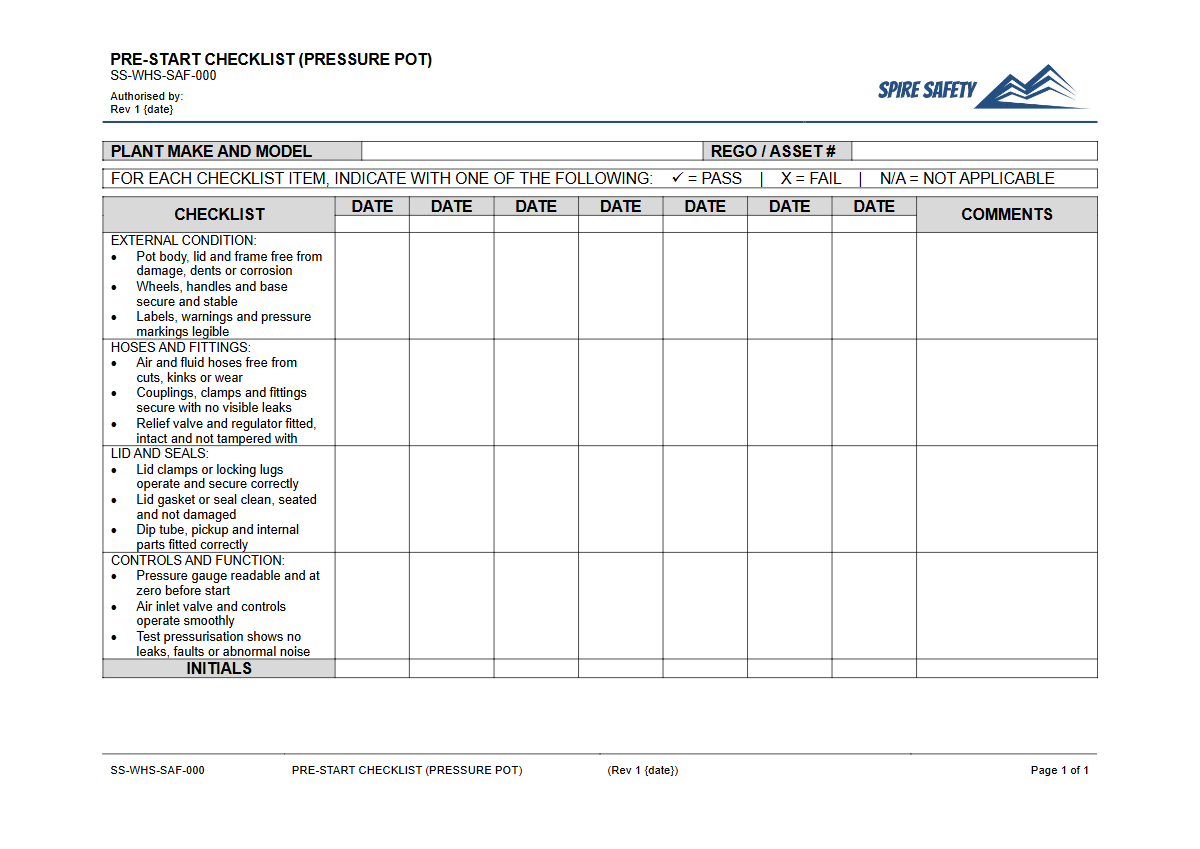
This Free Pre-Start Checklist (Pressure Pot) Template provides a structured framework for operators to conduct consistent and thorough safety inspections before each use. Using this checklist helps formalise your safety procedures, create a documented record of inspections, and proactively identify potential faults such as leaking seals, faulty gauges, or blocked relief valves before they can lead to catastrophic failure, injury, or exposure to hazardous substances.
Implementing a routine pre-start inspection is a critical component of plant and equipment safety management. It demonstrates a commitment to workplace health and safety by ensuring equipment is fit for service.
The checklist guides users to examine critical safety components, verify operational controls, and assess the overall integrity of the unit. This process is foundational to any robust risk management program, helping to prevent incidents and ensure the long-term reliability of your equipment.
It also supports worker training and competency by reinforcing the key safety features and correct operational checks required for the specific plant.
Video walkthrough
How to use the Free Pre-Start Checklist (Pressure Pot) Template
This template is designed for immediate use and easy customisation. Start by downloading the DOCX or PDF file.
While the document is aligned with Australian WHS principles, it serves as a general guide. It's crucial to adapt the checklist to the specific make, model, and configuration of the pressure pots in your workplace.
Add or remove items to ensure every check is relevant to your equipment and operational risks. Once customised, integrate the checklist into your daily operational workflow, making it a mandatory step before any pressure pot is put into service.
This systematic approach forms a key part of your overarching WHS management systems, providing auditable records of your safety diligence.
The checklist should be completed by a trained and competent operator at the beginning of their shift or before the first use of the day. The operator should physically inspect each item listed, ticking off each point as it is verified to be in safe working order.
If any defects, damage, or faults are identified (e.g., a cracked hose, a non-responsive gauge, or a tampered safety valve), the equipment must be immediately tagged out of service and reported to a supervisor for repair. Completed checklists should be filed and retained as part of your safety records, which can be reviewed during safety meetings or audits.
A Note on Customisation
It's important to remember that this is a template. We strongly recommend you customise it to reflect the specific make, model, and operational context of the pressure pots used in your workplace.
You should also incorporate any specific requirements from the manufacturer's instructions or your own risk assessments.
When to use it
A pre-start check on a pressure pot should be conducted before every use or, at a minimum, at the start of each shift in which the pot will be operated. The potential for component failure in pressurised systems is significant, and conditions can change quickly.
A hose that was safe yesterday could have developed a weak spot overnight, or a gauge could have been damaged since its last use. This high frequency of checks is essential for identifying such issues before the system is energised, mitigating the risk of sudden, uncontrolled releases of pressure or hazardous materials.
Regular inspections are particularly important when equipment is used by multiple operators or in demanding industrial environments where the risk of damage is higher. For other common workshop equipment, a similar daily inspection protocol is best practice.
For example, our Free Pre-Start Checklist (Bench Grinder) Template outlines checks that should be done before switching on the machine.
Who should use it
This checklist should be completed by personnel who are trained, competent, and authorised to operate pressure pots. This includes workshop technicians, spray painters, production workers, and maintenance staff.
Competency involves more than just knowing how to operate the equipment; it requires a thorough understanding of the associated hazards, the function of safety-critical components like pressure relief valves, and the emergency procedures in case of a failure. Supervisors and safety officers should also be familiar with the checklist to oversee its correct implementation and to verify that operators are completing the checks diligently.
Ensuring that these documented procedures are being followed correctly is a key part of internal process verification. A periodic review of completed checklists can highlight recurring issues or gaps in training, forming an important input for your continuous improvement cycle.
For a more formal verification, organisations may consider engaging external experts for WHS compliance auditing to ensure procedures meet regulatory expectations.
Key Risks of Pressure Pot Operation
The primary risk associated with pressure pots is the uncontrolled release of stored energy, which can result in the vessel rupturing or components being ejected at high velocity. This can be caused by over-pressurisation, corrosion, physical damage, or the failure of safety devices.
Another significant risk is exposure to hazardous materials, such as paints, solvents, or resins, which can be released through leaks or during operation. In many cases, this work is done in an area requiring specific ventilation controls, like those detailed in our Free Pre-Start Checklist (Fume Cabinet) Template.
Other risks include ignition of flammable contents or vapours, chemical burns, and ergonomic injuries from manual handling of the pots. The pre-start checklist is your first line of defence against these hazards, designed to catch the warning signs before they escalate into an incident.
You can find more targeted safety documents in our free WHS resources library to help manage a wide range of workplace risks.
Common mistakes
Common mistakes to avoid
- Neglecting to manually test the pressure relief valve (PRV) to ensure it is not stuck or blocked.
- Using non-standard or damaged parts, such as incorrect fittings, kinked hoses, or worn seals.
- Failing to fully depressurise the pot and verify with the gauge before attempting to open the lid.
- Becoming complacent and skipping the pre-start check 'just this once' to save time, especially for routine jobs.
Legal references
Legal considerations
The following legal requirements may be relevant to this type of work.
- Work Health and Safety Act (Harmonised) — Provides the primary duties for protecting workers and other people from work health and safety risks.
- Work Health and Safety Regulations (Harmonised) — Sets out requirements supporting the management of workplace hazards and risks.
The following codes may be relevant to this type of work.
- Managing WHS Risks Code of Practice — Provides practical guidance on identifying hazards, assessing risks and applying effective controls.
- Work Health and Safety Consultation, Cooperation and Coordination Code of Practice — Provides practical guidance on consulting workers and coordinating with other duty holders.
- Managing the Work Environment and Facilities Code of Practice — Provides practical guidance on safe work environments, workplace facilities and related controls.
Did you know
Stored Energy
A standard 10-litre pressure pot pressurised to 60 PSI (approx. 4 bar) contains a significant amount of stored pneumatic energy. If the vessel were to rupture, this energy is released instantaneously, with an explosive force equivalent to a small bomb.
Code Compliance
In Australia, pressure vessels are typically designed and manufactured to a specific standard, such as AS 1210. The design registration number is usually stamped on a data plate affixed to the vessel, which must not be removed or painted over.
FAQ
Frequently asked questions
01What is the most critical check on a pressure pot pre-start checklist?
02How often does a pressure pot need to be professionally inspected?
03Can I use a generic checklist for all my pressure equipment?
04What training do operators need to use a pressure pot safely?
Share this resource
Free Pre-Start Checklist (Pressure Pot) Template
Browse Categories
How To Use It
- 1Download and open in Word or PDF.
- 2Replace the placeholders with your business details.
- 3Get it reviewed by a WHS specialist before rollout.
Need it customised?
Our WHS consultants can adapt this template to your site, run a gap analysis, or audit what you already have in place.
Book a Free Consultation WHS consulting servicesor call 1300 156 382