
Free Pre-Start Checklist (Press Brake) Template
Download our free Pre-Start Checklist (Press Brake) Template to formalise daily equipment inspections and manage WHS risks in your workshop.
Free Pre-Start Checklist (Press Brake) Template
DOCX • 125 KB + PDF
Updated Oct 2026
No signup required
Purpose of the Free Pre-Start Checklist (Press Brake) Template
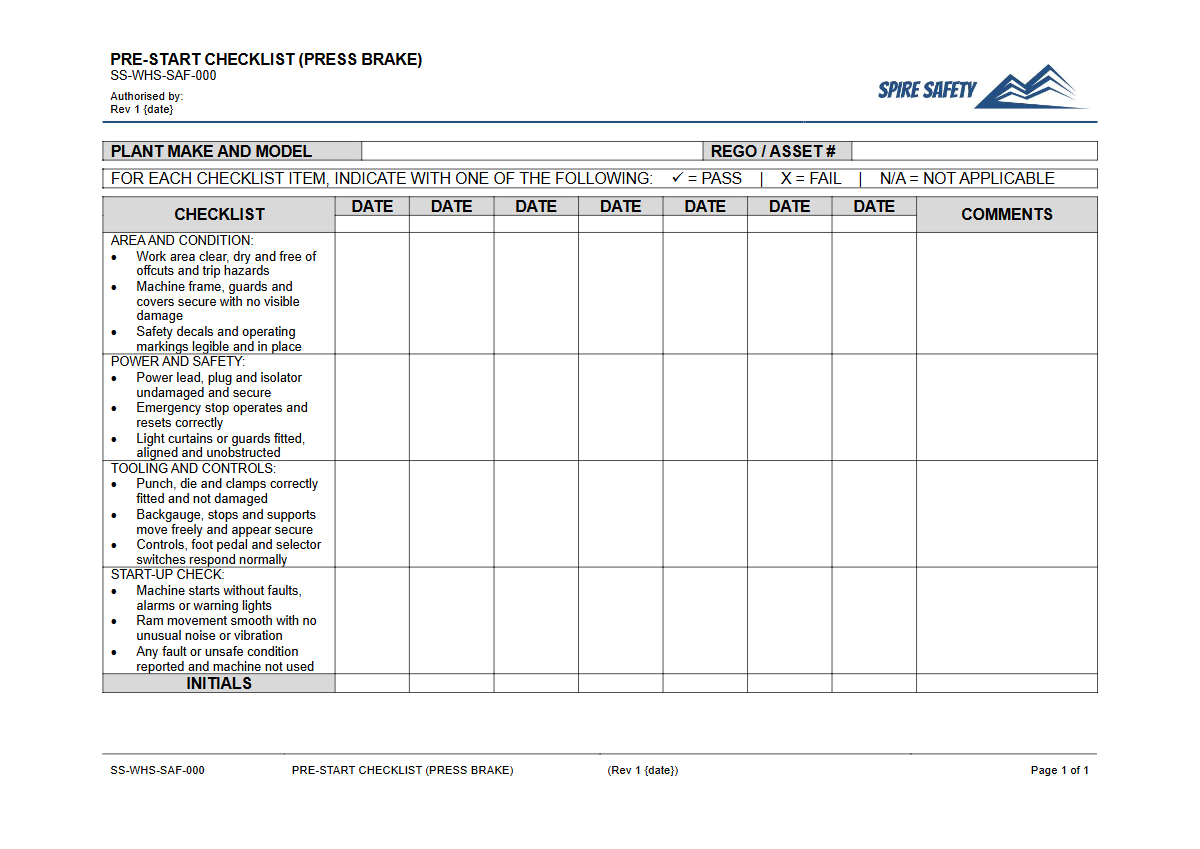
A press brake is a powerful piece of workshop equipment that presents significant risks if not maintained and operated correctly. This free Pre-Start Checklist (Press Brake) Template provides a structured format for operators to verify that the machine is safe to use before commencing work.
Regular, documented checks are a critical control measure to identify faults, damage, or missing guards before they can lead to a serious incident. Using this checklist helps your organisation demonstrate its commitment to proactive risk management and supports your overall safety procedures.
Integrating systematic checks like this into your daily operations is a cornerstone of an effective safety framework. A well-designed checklist ensures that nothing is overlooked, from emergency stops and light curtains to the physical condition of tooling.
This formal process forms part of a robust WHS management system, creating a verifiable record that safety verifications are being consistently performed.
Video walkthrough
How to use the Free Pre-Start Checklist (Press Brake) Template
This template is available as a fully editable DOCX file and a ready-to-print PDF. Simply download the format that best suits your needs.
The checklist is designed as a comprehensive starting point aligned with Australian WHS practice. It includes checks for key safety components, mechanical elements, and the immediate work area.
Important: This template provides a solid foundation. However, to ensure it is effective, you must customise it to reflect the specific make, model, and configuration of your press brake, as well as your unique workplace procedures and environment.
We cannot guarantee its suitability for your specific circumstances without this customisation. Different machinery requires specific checks, which is why we also offer distinct resources like a free Pre-Start Checklist for Drill Presses.
When to use it
A press brake pre-start check should be completed by the operator at the beginning of each shift or before their first time using the machine on any given day. If operator shifts change over during the day, the incoming operator should perform their own check before starting work.
This frequency ensures that any issues that may have developed overnight or during a previous shift are identified and addressed immediately.
Maintaining a consistent log of these completed checklists provides essential evidence of your safety diligence. These records are invaluable during an internal review or a formal WHS compliance audit, demonstrating that plant safety is actively managed and documented within your business.
Who should use it
The pre-start checklist should be completed by a person who is trained, competent, and authorised to operate the specific press brake. The operator has the most hands-on interaction with the equipment and is best positioned to notice subtle changes in its performance or condition.
They must understand what each item on the checklist means and how to properly inspect it.
Supervisors or managers also have a role to play. They are responsible for ensuring that operators are completing the checklists correctly and consistently.
They must also review completed checklists, sign off on them where required, and take prompt action to address any faults, damage, or concerns noted by the operator. For workplaces with a variety of heavy machinery, it's beneficial to standardise this process across all equipment, including for items covered by our Granulator Pre-Start Checklist.
Integrating Checklists into Your Safety Program
While this template is a practical tool, it is most effective when used as part of a broader safety program. This includes providing comprehensive operator training, developing Safe Work Method Statements (SWMS) for press brake operations, and establishing clear procedures for reporting and isolating faulty equipment.
If you need assistance developing these integrated systems, our WHS consulting services can provide expert guidance tailored to your operational needs. By embedding these tools into your daily workflow, you foster a stronger safety-conscious culture. For more tools to support your safety framework, browse our complete free WHS resources library.
Common mistakes
Common mistakes to avoid
- Signing off the checklist without physically inspecting each item ('pencil whipping').
- Ignoring minor hydraulic leaks or unusual noises, which can be early indicators of major failure.
- Failing to check that light curtains are active and positioned correctly for the job.
- Neglecting to remove a 'Do Not Operate' tag and isolate the machine after a fault is identified.
Legal references
Legal considerations
The following legal requirements may be relevant to this type of work.
- Work Health and Safety Act (Harmonised) — Provides the primary duties for protecting workers and other people from work health and safety risks.
- Work Health and Safety Regulations (Harmonised) — Sets out requirements supporting the management of workplace hazards and risks.
The following codes may be relevant to this type of work.
- Managing WHS Risks Code of Practice — Provides practical guidance on identifying hazards, assessing risks and applying effective controls.
- Work Health and Safety Consultation, Cooperation and Coordination Code of Practice — Provides practical guidance on consulting workers and coordinating with other duty holders.
- Managing the Work Environment and Facilities Code of Practice — Provides practical guidance on safe work environments, workplace facilities and related controls.
Did you know
Immense Force
Modern hydraulic press brakes can exert force ranging from a few tonnes to over 1,000 tonnes. This immense power is why ensuring safety systems are functional before every use is not just best practice, but essential to preventing catastrophic failures and injuries.
FAQ
Frequently asked questions
01What are the most critical safety checks for a press brake?
02How often should a press brake pre-start check be completed?
03Who is responsible for completing a press brake checklist?
04Why can't I just use a generic machinery checklist for a press brake?
Share this resource
Free Pre-Start Checklist (Press Brake) Template
Browse Categories
How To Use It
- 1Download and open in Word or PDF.
- 2Replace the placeholders with your business details.
- 3Get it reviewed by a WHS specialist before rollout.
Need it customised?
Our WHS consultants can adapt this template to your site, run a gap analysis, or audit what you already have in place.
Book a Free Consultation WHS consulting servicesor call 1300 156 382