
Free Pre-Start Checklist (Power Rack) Template
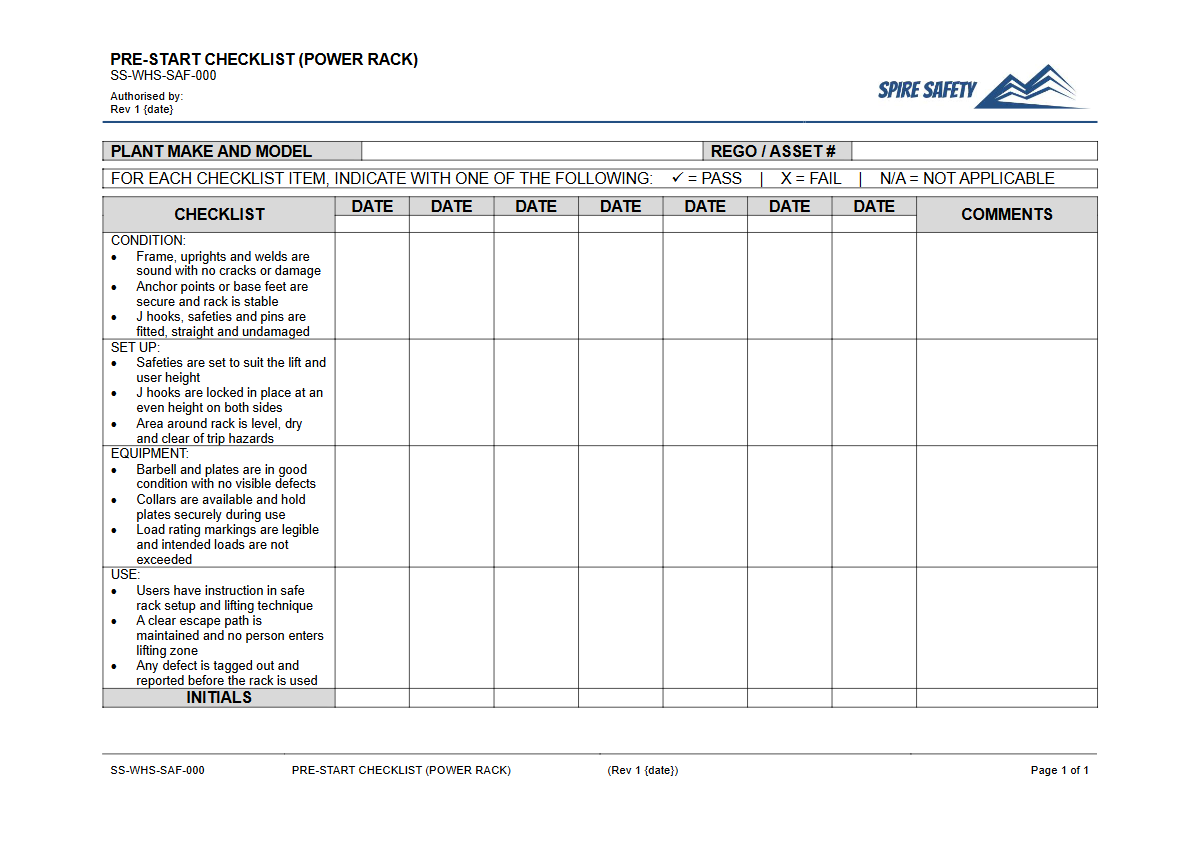
Download our free Pre-Start Checklist (Power Rack) Template. This structured Word & PDF resource helps formalise safety checks for your workshop equipment.
Free Pre-Start Checklist (Power Rack) Template
DOCX • 125 KB + PDF
Updated Oct 2026
No signup required
Purpose of the Free Pre-Start Checklist (Power Rack) Template
A power rack, or squat cage, is a core piece of equipment in many workplace gyms, physiotherapy clinics, and training facilities. While seemingly simple, its structural integrity is critical for user safety.
This Free Pre-Start Checklist (Power Rack) Template provides a structured starting point for operators to conduct routine safety inspections before use. Systematically checking the equipment helps identify potential hazards, prevent incidents, and document due diligence in maintaining a safe environment.
Integrating this check into your daily routine is a fundamental part of managing risks associated with physical training equipment.
Using a formal checklist helps standardise the inspection process, ensuring no critical points are overlooked. It forms a key part of a proactive safety culture, encouraging workers to be mindful of equipment condition.
For a broader discussion on equipment checks, our Pre-Start Checks and Plant Maintenance Toolbox Talk can help reinforce these principles with your team.
Video walkthrough
How to use the Free Pre-Start Checklist (Power Rack) Template
This template is designed for ease of use. Download the file in DOCX to customise it or PDF for immediate printing.
The checklist prompts the user to inspect key components of the power rack, such as the frame, J-hooks, spotter arms, and pull-up bar. The operator should physically check each item listed, note its condition, and sign off on the inspection.
Any identified faults or damage must be reported immediately to a supervisor, and the equipment should be taken out of service until it is repaired and deemed safe.
This document is a foundational template aligned with Australian WHS best practices. It is not an out-of-the-box compliance solution.
Effective safety management requires that you adapt this checklist to your specific circumstances. Consider the make and model of your power rack, manufacturer's instructions, and the unique risks present in your workplace.
A comprehensive approach involves embedding these checks within your overall WHS management system to ensure they are consistently applied and reviewed.
Customising the Pre-Start Checklist
Please note: We strongly recommend you customise this template. To be effective, the checklist must reflect the specific equipment at your site.
Add or remove checkpoints based on the manufacturer's recommendations and your own risk assessment. You might add checks for specific attachments, floor anchoring, or signage.
The goal is to create a document that is truly relevant to your operational context.
When to use it
A pre-start check for a power rack should be completed before its first use each day or at the beginning of each shift in a high-usage facility. This frequency ensures that any damage that may have occurred overnight or during a previous session is identified before another person uses the equipment.
It serves as a crucial final check to catch potential failures before they lead to an incident. If the power rack has been subject to maintenance or repair, a thorough inspection using the checklist should also be conducted before it is returned to service. While this checklist is for a power rack, similar principles apply to other equipment, as detailed in our Power Tool Safety Toolbox Talk Template.
Who should use it
The pre-start checklist should be completed by the person operating or using the equipment. This could be a gym member, an employee using a workplace facility, or a client in a physiotherapy setting.
Empowering the user to conduct the check promotes ownership and a higher level of safety awareness. Supervisors or facility managers are responsible for ensuring these checks are being completed correctly and for taking action when faults are reported.
They are also responsible for training users on how to properly inspect the equipment and complete the checklist. Periodically reviewing completed checklists is a good way to monitor the equipment's condition over time and can be a valuable input for WHS compliance auditing.
For facilities with a wide range of machinery, it's beneficial to have specific checklists for each type. For example, a workshop might use this power rack checklist alongside a Free Pre-Start Checklist (CNC Router) Template to cover all bases. You can find more templates like this in our free WHS resources library.
Common mistakes
Common mistakes to avoid
- Overlooking 'minor' damage like surface rust, bent pins, or worn J-hook lining, which can indicate underlying issues.
- Failing to check that adjustable components like safety bars and J-hooks move freely and lock securely into place at various heights.
- Neglecting to inspect the surrounding area for trip hazards, obstructions, or an unstable flooring surface.
- Using a generic checklist without customising it to the specific make, model, and attachments of the power rack in use.
Legal references
Legal considerations
The following legal requirements may be relevant to this type of work.
- Work Health and Safety Act (Harmonised) — Provides the primary duties for protecting workers and other people from work health and safety risks.
- Work Health and Safety Regulations (Harmonised) — Sets out requirements supporting the management of workplace hazards and risks.
The following codes may be relevant to this type of work.
- Managing WHS Risks Code of Practice — Provides practical guidance on identifying hazards, assessing risks and applying effective controls.
- Work Health and Safety Consultation, Cooperation and Coordination Code of Practice — Provides practical guidance on consulting workers and coordinating with other duty holders.
- Managing the Work Environment and Facilities Code of Practice — Provides practical guidance on safe work environments, workplace facilities and related controls.
Did you know
Hidden Dangers
Hairline cracks in welds or minor bends in the frame of a power rack can be early indicators of metal fatigue. If left unchecked, these seemingly small issues can lead to catastrophic structural failure under a heavy load.
Manual Handling Risk
While the power rack itself is static, a significant number of injuries are related to manual handling when loading and unloading weight plates. Safe lifting technique for the plates is as important as safe lifting technique for the exercise itself.
FAQ
Frequently asked questions
01What is the primary purpose of a power rack pre-start checklist?
02How often should a power rack be inspected?
03Who is responsible for completing the power rack pre-start check?
04Can I use this template for other types of gym equipment?
Share this resource
Free Pre-Start Checklist (Power Rack) Template
Browse Categories
How To Use It
- 1Download and open in Word or PDF.
- 2Replace the placeholders with your business details.
- 3Get it reviewed by a WHS specialist before rollout.
Need it customised?
Our WHS consultants can adapt this template to your site, run a gap analysis, or audit what you already have in place.
Book a Free Consultation WHS consulting servicesor call 1300 156 382