
Free Pre-Start Checklist (Pottery Wheel) Template
Download our free Pre-Start Checklist for Pottery Wheels. This DOCX & PDF template helps formalise safety checks for your art studio or workshop. Start today.
Free Pre-Start Checklist (Pottery Wheel) Template
DOCX • 125 KB + PDF
Updated Oct 2026
No signup required
Purpose of the Free Pre-Start Checklist (Pottery Wheel) Template
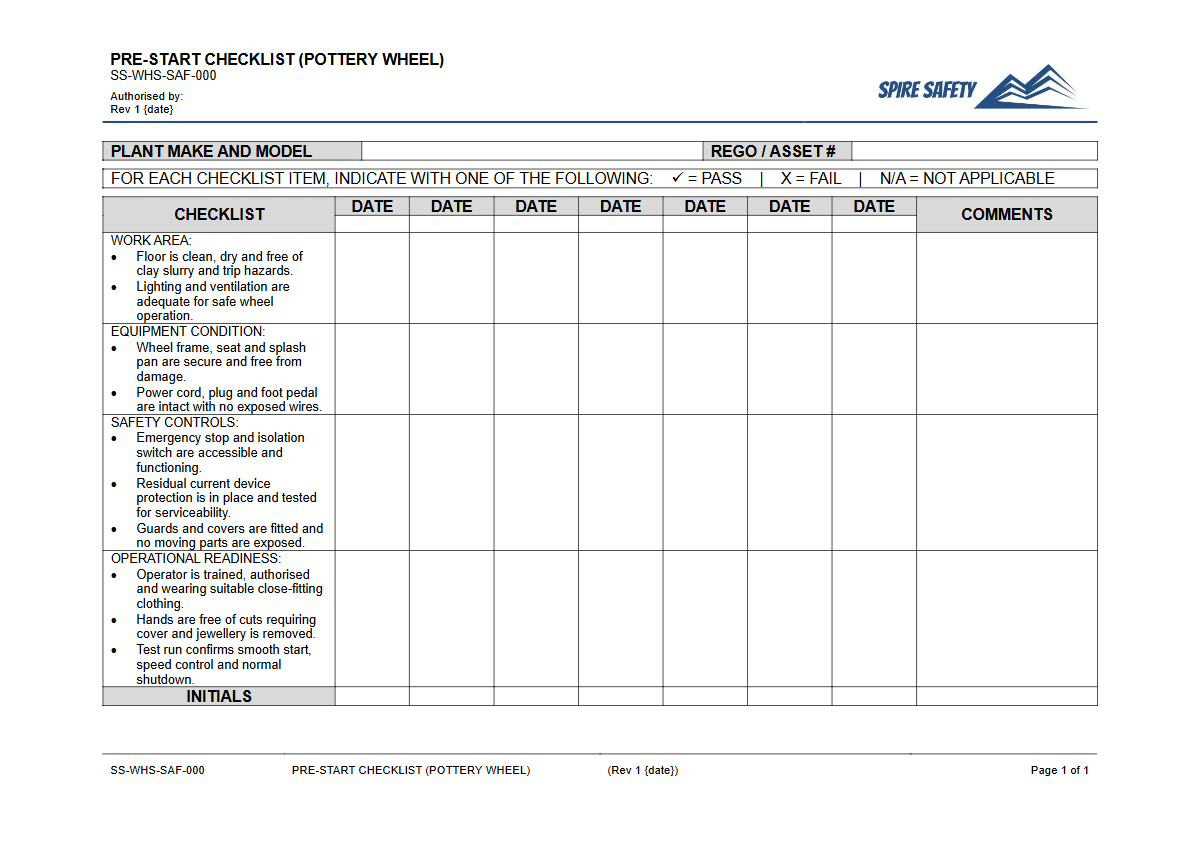
Using a pottery wheel involves interaction with moving parts and electrical components, introducing potential workplace hazards. Our Free Pre-Start Checklist (Pottery Wheel) Template provides a structured method for operators to conduct a quick, effective safety inspection before they begin work.
Systematically checking the equipment helps identify and control risks such as electrical faults, entanglement hazards from loose clothing or hair, and issues with the wheel’s stability or controls. Formalising this process is a key step in exercising due diligence and maintaining a safe environment for artists, students, and staff.
A documented pre-start check serves as a record that safety procedures are being followed. This proactive behaviour is fundamental to preventing incidents and equipment damage.
By integrating this simple check into your daily routine, you create a consistent safety-first mindset. This process is a core element of preventative maintenance, as reinforced in our Pre-Start Checks and Plant Maintenance Toolbox Talk. Consistently applied, these checks provide valuable data for your maintenance schedule and safety records.
This template acts as a practical tool to support your safety obligations. Implementing documented safety checks like this one is a foundational activity within broader WHS management systems, helping to demonstrate a proactive approach to risk management.
It encourages operators to take ownership of their safety and the condition of their equipment.
Video walkthrough
How to use the Free Pre-Start Checklist (Pottery Wheel) Template
This resource is available in both DOCX and PDF formats. The DOCX version is fully customisable, allowing you to tailor the checklist to the specific equipment and environment of your studio or workshop.
Start by downloading the file and opening it in a compatible word processor.
IMPORTANT: This is a template, not a finished document. You must customise it to suit the specific make and model of your pottery wheel(s), your studio environment, and your operational procedures.
We are not familiar with your specific workplace, so you are responsible for ensuring the final document is fit for purpose. Review each item, adding or removing checks to reflect your equipment’s features, such as specific guards, emergency stop button locations, foot pedal types, and electrical connections.
Consider the unique context of your workspace. For example, a community art centre may have different considerations than a private production studio.
The principles of pre-start checks apply across various types of workshop equipment, although the specific items will differ, as seen in our Free Pre-Start Checklist (3D Printer) Template. Once customised, print copies and place them in a visible, accessible location near the pottery wheel.
When to use it
A pre-start checklist for a pottery wheel should be completed before its first use each day or at the beginning of each work shift. This ensures that the equipment is verified as safe before any creative work or production begins.
It establishes a baseline of safe operating conditions for the day.
Additionally, the checklist should be used after the pottery wheel has been moved, serviced, or repaired. This confirms that it has been reassembled correctly and that no new hazards have been introduced.
These checks can form part of your daily opening procedures and can be discussed during safety briefings, which can be formalised using a pre-start meeting template to ensure all team members are aligned.
Who should use it
The checklist is designed to be completed by the person operating the pottery wheel. This includes professional potters, students in a classroom setting, hobbyists in a shared studio, or any employee tasked with using the equipment.
Empowering the user to conduct the check promotes personal responsibility and a stronger safety culture.
Supervisors, studio managers, and business owners (PCBUs) are responsible for implementing the checklist system. Their role is to ensure operators are trained on how to conduct the checks properly, understand each checkpoint's importance, and know the procedure for reporting and rectifying faults.
Maintaining completed records is essential for demonstrating procedural compliance, a focus area during any WHS compliance auditing process. These records provide a clear history of the equipment's condition and the actions taken to maintain its safety.
By implementing this checklist, you build a more robust safety framework in your creative space. For more tools to support your safety program, browse our complete free WHS resources library for a wide range of templates and guides.
Common mistakes
Common mistakes to avoid
- Failing to properly customise the template for the specific pottery wheel model.
- 'Pencil-whipping' the checklist without physically inspecting the items.
- Not having a clear procedure for reporting and immediately addressing identified faults.
- Forgetting to train new users, students, or staff on how to complete the check correctly.
Legal references
Legal considerations
The following legal requirements may be relevant to this type of work.
- Work Health and Safety Act (Harmonised) — Provides the primary duties for protecting workers and other people from work health and safety risks.
- Work Health and Safety Regulations (Harmonised) — Sets out requirements supporting the management of workplace hazards and risks.
The following codes may be relevant to this type of work.
- Managing WHS Risks Code of Practice — Provides practical guidance on identifying hazards, assessing risks and applying effective controls.
- Work Health and Safety Consultation, Cooperation and Coordination Code of Practice — Provides practical guidance on consulting workers and coordinating with other duty holders.
- Managing the Work Environment and Facilities Code of Practice — Provides practical guidance on safe work environments, workplace facilities and related controls.
Did you know
Ancient Origins
The potter's wheel is an ancient invention, with the earliest forms (slow wheels or tournettes) dating back to Mesopotamia around 4,500 BCE. The fast wheel, which uses flywheel momentum, appeared about a millennium later.
Ergonomic Risks
Prolonged work at a pottery wheel can lead to ergonomic injuries like carpal tunnel syndrome or back pain. Maintaining good posture, taking regular breaks, and proper studio setup are crucial for preventing these repetitive strain injuries.
FAQ
Frequently asked questions
01What should be included in a pottery wheel pre-start check?
02Is a pre-start checklist a legal requirement for a pottery wheel in Australia?
03How often should a pottery wheel pre-start check be performed?
04Can I use a digital version of this checklist?
Share this resource
Free Pre-Start Checklist (Pottery Wheel) Template
Browse Categories
How To Use It
- 1Download and open in Word or PDF.
- 2Replace the placeholders with your business details.
- 3Get it reviewed by a WHS specialist before rollout.
Need it customised?
Our WHS consultants can adapt this template to your site, run a gap analysis, or audit what you already have in place.
Book a Free Consultation WHS consulting servicesor call 1300 156 382