
Free Pre-Start Checklist (Pottery Kiln) Template
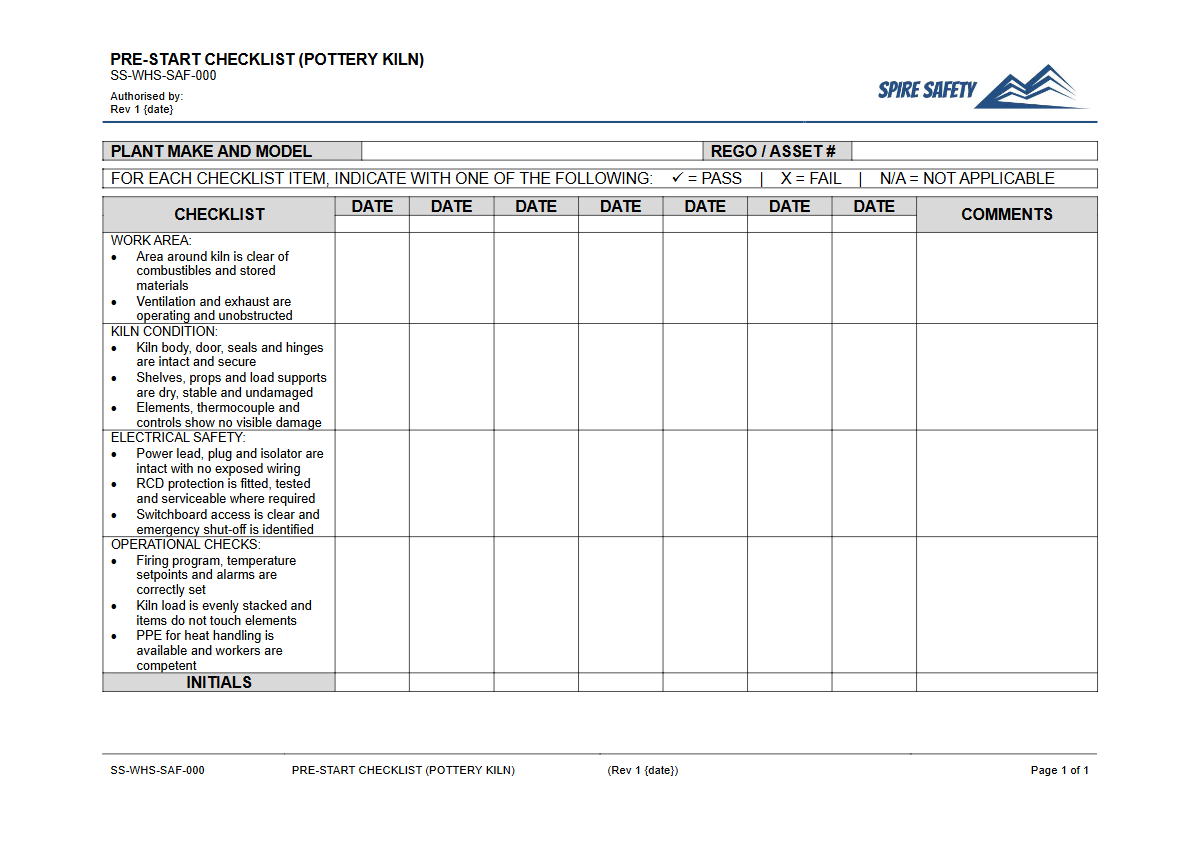
Download our free Pre-Start Checklist (Pottery Kiln) Template. This DOCX & PDF resource helps identify and control hazards before firing.
Free Pre-Start Checklist (Pottery Kiln) Template
DOCX • 125 KB + PDF
Updated Oct 2026
No signup required
Purpose of the Free Pre-Start Checklist (Pottery Kiln) Template
Operating a pottery kiln involves significant risks, including extreme heat, electrical hazards, and potential exposure to fumes. A systematic inspection before each use is a critical control measure to ensure the equipment is safe to operate.
Our Free Pre-Start Checklist (Pottery Kiln) Template provides a structured format for operators to verify the condition of the kiln and its surrounding environment, helping to identify and mitigate potential hazards before they cause an incident. This document formalises the inspection process, creating a record that the equipment was checked and deemed safe for use.
Using this template helps organisations demonstrate a commitment to proactive safety management. It serves as a practical tool within broader WHS management systems to manage risks associated with high-temperature equipment.
Regular, documented checks support a culture of safety, reduce the likelihood of equipment failure, and ensure operators are actively thinking about safety before they begin work. This checklist is designed as a starting point, aligned with Australian WHS principles for plant and equipment safety.
Video walkthrough
How to use the Free Pre-Start Checklist (Pottery Kiln) Template
This template is provided in both DOCX and PDF formats for your convenience. The DOCX file is fully editable, allowing you to tailor the checklist to the specific make, model, and installation of your kiln. Effective implementation involves a few key steps:
- Customisation: Review and modify the checklist items to reflect your specific equipment and workplace risks. Add or remove checks related to ventilation, power supply, controllers, shelving, and any unique features of your kiln. It is crucial that you customise this document for your specific needs, as we cannot guarantee it covers every hazard in your workplace.
- Training: Ensure all operators are trained not only on how to use the kiln safely but also on how to complete the pre-start checklist thoroughly. They must understand the 'why' behind each check and what to do if they identify a fault or non-conformance.
- Implementation: Integrate the checklist into your standard operating procedure for the kiln. Make it a mandatory step before any firing cycle begins. The checklist should be readily accessible near the equipment.
- Review and Action: If an operator identifies an issue during the pre-start check, there must be a clear procedure to follow. This typically involves not using the equipment, tagging it out of service, and reporting the fault to a supervisor or maintenance personnel for rectification.
For a broader perspective on equipment checks, consider using our Pre-Start Checks and Plant Maintenance Toolbox Talk Template to brief your team on the importance of this daily task.
When to use this Pre-Start Checklist
A pre-start checklist for a pottery kiln should be completed before every firing cycle. Given that kilns are often run for long, unattended periods, confirming the equipment's integrity before starting is non-negotiable.
It is particularly important after maintenance, after a long period of inactivity, or if a different person is operating the kiln than who last used it. Establishing this routine ensures a consistent safety standard is applied every single time the equipment is energised.
Who should use this Pre-Start Checklist
This checklist should be completed by the person operating the kiln for that specific firing. This individual must be competent and authorised to use the equipment, with adequate training on its specific functions and associated hazards.
In some organisations, a supervisor may review the completed checklist before approving the start of a firing cycle. The responsibility for the check lies with the operator, as they are the person most immediately exposed to the risks if something goes wrong.
Regular WHS compliance auditing can verify that these procedures are being consistently followed by all authorised personnel.
While this checklist is for a kiln, the principles apply to other workshop equipment. For example, similar checks are vital for ensuring the safe operation of computer-controlled machinery, as outlined in our Free Pre-Start Checklist (CNC Router) Template. The core behaviour—inspecting before use—is a universal safety habit. You can find more templates for various types of plant and equipment in our free WHS resources library.
Even modern, automated equipment like 3D printers require safety verification before operation. If your workplace uses additive manufacturing technologies, you may find our Free Pre-Start Checklist for 3D Printers a useful complementary resource for managing those specific hazards.
Common mistakes
Common mistakes to avoid
- Forgetting to check that the ventilation system is on and functioning correctly before starting a firing.
- Placing flammable or combustible materials too close to the kiln.
- Incorrectly loading the kiln, leading to uneven heating, damage to wares, or contact with thermocouples.
- Ignoring error codes or unusual noises from the controller or relays, assuming they will resolve themselves.
Legal references
Legal considerations
The following legal requirements may be relevant to this type of work.
- Work Health and Safety Act (Harmonised) — Provides the primary duties for protecting workers and other people from work health and safety risks.
- Work Health and Safety Regulations (Harmonised) — Sets out requirements supporting the management of workplace hazards and risks.
The following codes may be relevant to this type of work.
- Managing WHS Risks Code of Practice — Provides practical guidance on identifying hazards, assessing risks and applying effective controls.
- Work Health and Safety Consultation, Cooperation and Coordination Code of Practice — Provides practical guidance on consulting workers and coordinating with other duty holders.
- Managing the Work Environment and Facilities Code of Practice — Provides practical guidance on safe work environments, workplace facilities and related controls.
Did you know
Kiln Temperatures
Modern electric pottery kilns can reach temperatures exceeding 1300°C (2372°F). This is hotter than the melting point of many metals, including aluminium (660°C) and brass (around 930°C).
FAQ
Frequently asked questions
01What are the main hazards associated with pottery kilns?
02How often should a pottery kiln be professionally serviced?
03What should I do if I find a fault during a pre-start check?
04Is special personal protective equipment (PPE) required for operating a kiln?
Share this resource
Free Pre-Start Checklist (Pottery Kiln) Template
Browse Categories
How To Use It
- 1Download and open in Word or PDF.
- 2Replace the placeholders with your business details.
- 3Get it reviewed by a WHS specialist before rollout.
Need it customised?
Our WHS consultants can adapt this template to your site, run a gap analysis, or audit what you already have in place.
Book a Free Consultation WHS consulting servicesor call 1300 156 382