
Free Pre-Start Checklist (Pool Cleaner) Template
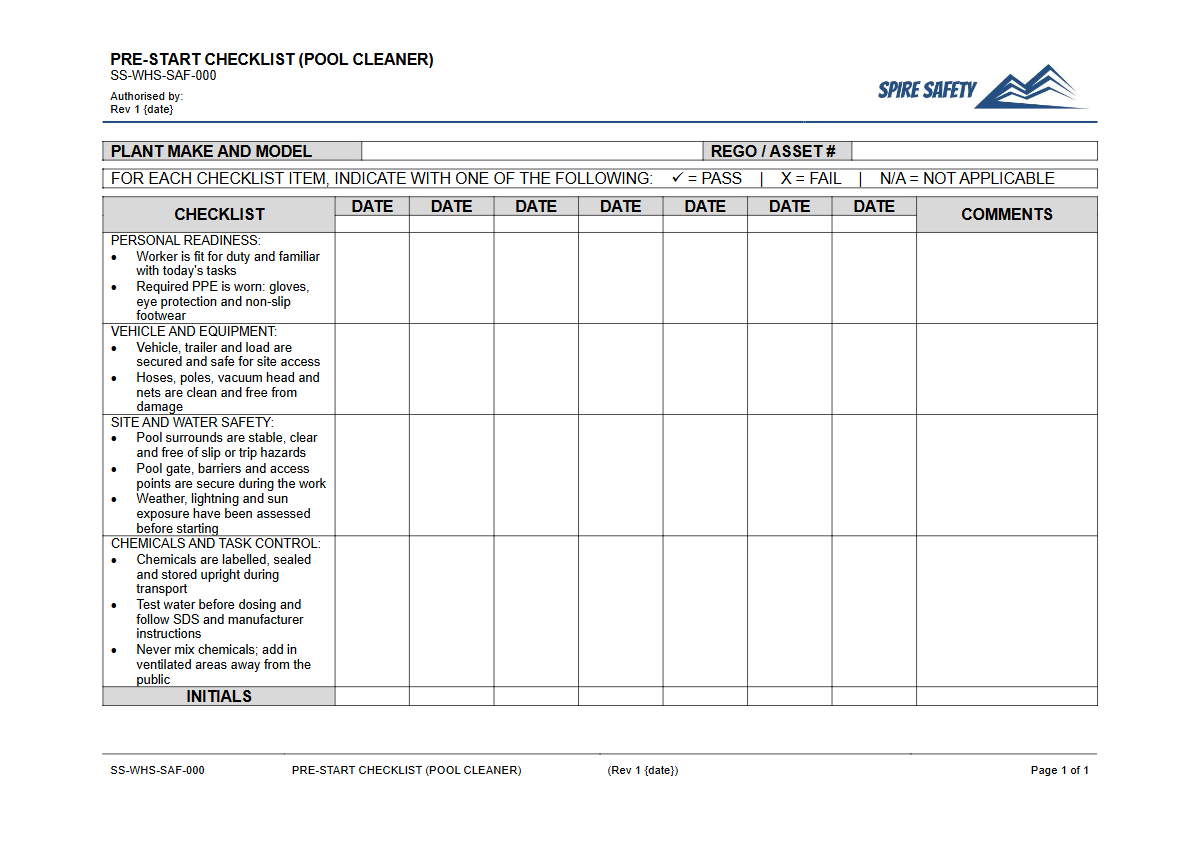
Download our free Pre-Start Checklist (Pool Cleaner) Template. This DOCX & PDF resource helps formalise equipment checks and identify hazards.
Free Pre-Start Checklist (Pool Cleaner) Template
DOCX • 125 KB + PDF
Updated Oct 2026
No signup required
Purpose of the Free Pre-Start Checklist (Pool Cleaner) Template
Operating pool cleaning equipment involves significant risks, from electrical hazards and chemical exposure to manual handling injuries. This free Pre-Start Checklist (Pool Cleaner) Template provides a structured framework for technicians to inspect their equipment before each use.
By formalising this process, organisations can proactively identify and control hazards such as frayed electrical cords, malfunctioning pumps, leaking chemical containers, or damaged vacuum heads before they lead to an incident. A consistent pre-start inspection process is a cornerstone of a proactive safety culture, demonstrating a commitment to worker wellbeing and operational diligence.
Using a dedicated checklist helps ensure that no critical safety item is overlooked. It prompts the operator to physically verify the condition of electrical components, check for chemical leaks, inspect hoses for integrity, and confirm that safety mechanisms like Residual Current Devices (RCDs) are functional.
Integrating this check into daily routines is a simple yet effective risk management strategy. This process can be reinforced with regular team discussions, such as a pool and aquatic safety toolbox talk, to keep safety front of mind for all staff working in and around aquatic environments.
Video walkthrough
How to use the Free Pre-Start Checklist (Pool Cleaner) Template
This document is provided as a starting point in both DOCX and PDF formats. First, download the template in the format that best suits your needs.
The DOCX version is fully editable, allowing for extensive customisation.
It is crucial to adapt the checklist to your specific workplace. Review the contents and add, remove, or modify items to reflect the exact make and model of the pool cleaning equipment your team uses.
Consider including checks for specific chemicals handled, unique site hazards (e.g., access issues, surrounding electrical equipment), and required Personal Protective Equipment (PPE). A generic checklist is less effective than one tailored to your operational reality.
Important: This document is a template only. We strongly recommend that you customise it to ensure it is relevant to the plant, equipment, and processes in your workplace.
A pre-start checklist is most effective when it forms part of broader comprehensive WHS management systems that include safe work procedures, training, and incident reporting.
When to use the Pre-Start Checklist
The Pre-Start Checklist should be completed by the operator before commencing work at the start of every shift or before using the equipment for the first time that day. It is not a weekly or monthly task; its value lies in its frequency.
The check should take only a few minutes but is one of the most effective ways to prevent equipment-related incidents.
Regularly performing these checks helps embed a safety-first mindset and supports a preventative maintenance culture. For a deeper dive into formalising this practice across all workplace plant, you can use our Pre-Start Checks and Plant Maintenance Toolbox Talk to train your team on the importance of these inspections.
Who should use the Pre-Start Checklist
The primary user of this checklist is the competent person designated to operate the pool cleaning equipment. The operator has the most hands-on experience with the machinery and is best positioned to notice small changes, unusual noises, or minor damage that could indicate a developing fault.
They are the first line of defence against equipment failure.
Supervisors and managers also have a role. They should periodically review completed checklists to ensure they are being filled out correctly and diligently.
These reviews help managers identify recurring faults with specific pieces of equipment, spot trends in operator behaviour, and confirm that safety procedures are being followed. For related equipment, ensuring operator competency can be documented using a resource like our free Pressure Cleaner VOC template.
Integrating Pre-Starts into Your WHS Framework
A checklist is only effective if it drives action. Your procedure must clearly define what an operator should do if they identify a fault.
The standard process involves immediately removing the equipment from service, applying a 'Do Not Operate' tag, and reporting the defect to a supervisor. The equipment must not be used until it has been repaired by a competent person and verified as safe.
Documenting these steps and the findings from your pre-start checks provides valuable data for WHS audits and risk assessments. This information can help justify equipment upgrades, changes to maintenance schedules, or additional training.
If you need assistance developing these integrated safety processes, our specialist WHS consulting services can provide expert guidance.
Documenting and Retaining Records
Completed pre-start checklists should be retained as part of your WHS records. These documents serve as tangible proof of your organisation's due diligence in managing plant and equipment safety.
They demonstrate that you have a system in place to ensure equipment is safe before use, which can be critical during an audit or in the event of a workplace incident investigation. You can explore hundreds of other document templates in our free WHS resources library to build out your safety management system.
Common mistakes
Common mistakes to avoid
- 'Pencil-whipping' the checklist without physically inspecting each item.
- Ignoring minor faults like small leaks or frayed cords that can escalate into major failures.
- Failing to check that the required Personal Protective Equipment (PPE) is available and in good condition before handling chemicals.
- Continuing to use equipment after a fault has been identified but not yet repaired or cleared by a supervisor.
Legal references
Legal considerations
The following legal requirements may be relevant to this type of work.
- Work Health and Safety Act (Harmonised) — Provides the primary duties for protecting workers and other people from work health and safety risks.
- Work Health and Safety Regulations (Harmonised) — Sets out requirements supporting the management of workplace hazards and risks.
The following codes may be relevant to this type of work.
- Managing WHS Risks Code of Practice — Provides practical guidance on identifying hazards, assessing risks and applying effective controls.
- Work Health and Safety Consultation, Cooperation and Coordination Code of Practice — Provides practical guidance on consulting workers and coordinating with other duty holders.
- Managing the Work Environment and Facilities Code of Practice — Provides practical guidance on safe work environments, workplace facilities and related controls.
Did you know
Chemical Hazards
Many pool-related injuries in the workplace are not from slips or falls but from the improper handling of concentrated pool chemicals, which can cause severe respiratory irritation, chemical burns, or even explosions if mixed incorrectly.
Electrical Risk
A damaged power cord or a faulty Residual Current Device (RCD) on portable pool equipment presents a fatal electrocution risk. The combination of water and electricity means that even minor electrical faults must be treated as critical hazards.
FAQ
Frequently asked questions
01What should be included in a pool cleaner pre-start check?
02Is this pre-start checklist a legal requirement in Australia?
03How often should pool cleaning equipment be inspected?
04What should happen if a fault is found during a pre-start check?
Share this resource
Free Pre-Start Checklist (Pool Cleaner) Template
Browse Categories
How To Use It
- 1Download and open in Word or PDF.
- 2Replace the placeholders with your business details.
- 3Get it reviewed by a WHS specialist before rollout.
Need it customised?
Our WHS consultants can adapt this template to your site, run a gap analysis, or audit what you already have in place.
Book a Free Consultation WHS consulting servicesor call 1300 156 382