
Free Pre-Start Checklist (Pool Lift) Template
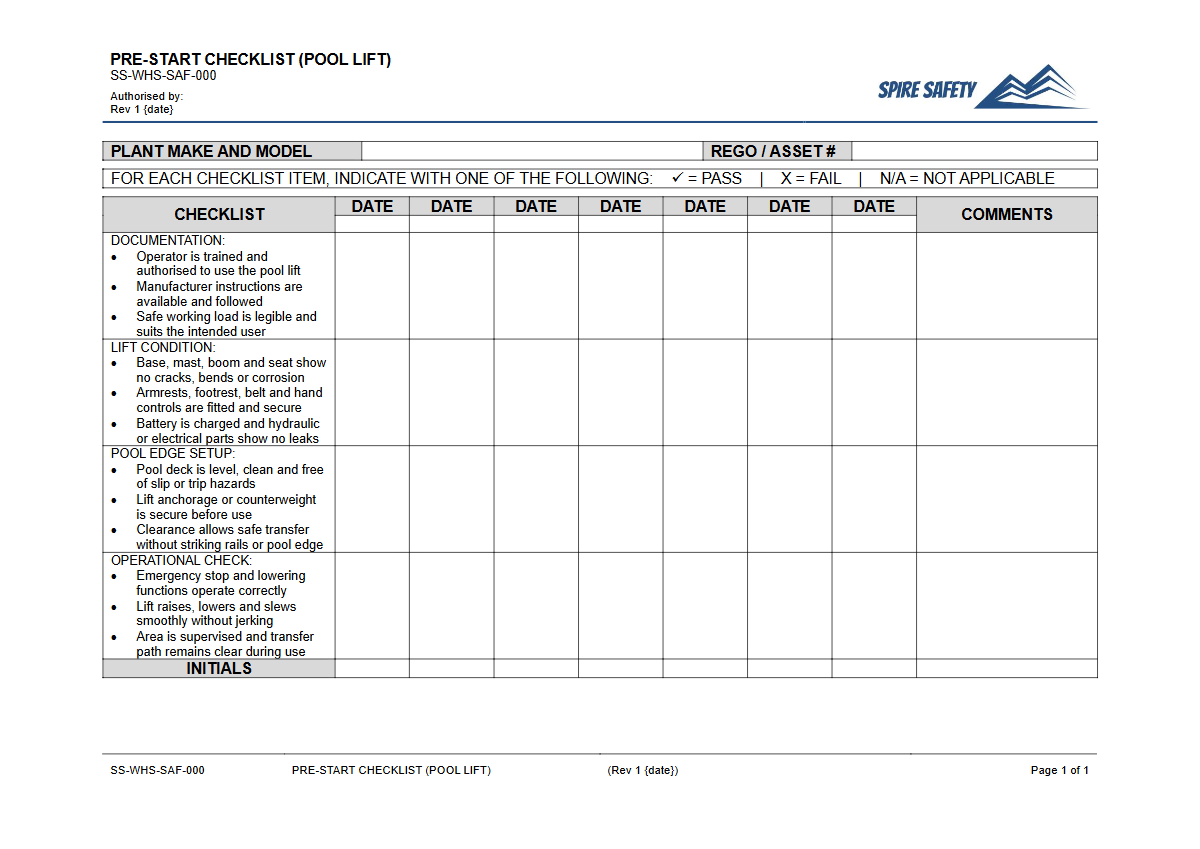
Download our free Pre-Start Checklist (Pool Lift) Template. This structured Word and PDF document helps formalise safety checks for aquatic access equipment.
Free Pre-Start Checklist (Pool Lift) Template
DOCX • 125 KB + PDF
Updated Oct 2026
No signup required
Purpose of the Free Pre-Start Checklist (Pool Lift) Template
Ensuring the safe and reliable operation of aquatic access equipment is a critical responsibility for swimming pools, hydrotherapy centres, and aged care facilities. This free Pre-Start Checklist (Pool Lift) Template provides a structured framework for conducting routine safety inspections before use.
Regular checks help identify potential hazards such as mechanical faults, structural wear, or electrical issues before they can lead to equipment failure or injury. By formalising this process, organisations can demonstrate due diligence in managing risks and protecting both the equipment users and the operators assisting them.
Integrating this checklist into daily operations helps build a proactive safety culture. It serves as a practical tool to support your overall approach to Pool and Aquatic Safety, ensuring that accessibility equipment remains in a safe and serviceable condition.
Documenting these checks creates a valuable record for maintenance scheduling, incident investigation, and compliance verification.
Video walkthrough
How to use the Free Pre-Start Checklist (Pool Lift) Template
This resource is available for immediate download in both DOCX and PDF formats. The DOCX version is fully editable, allowing you to tailor the checklist to your specific operational needs.
The PDF is ideal for printing and immediate use. Simply download the file, add your company branding, and adjust the inspection points to match the make and model of the pool lift(s) used at your facility.
A consistent inspection routine is a cornerstone of effective equipment management. Reinforcing the importance of these checks can be done effectively through regular safety meetings, such as a Pre-Start Checks and Plant Maintenance Toolbox Talk, which helps embed the right safety behaviours in your team.
Important: This document is a template designed as a starting point. We have developed it to align with general Australian WHS principles, but you must customise it to reflect the specific equipment, environment, and risk controls relevant to your workplace.
Its effectiveness is dependent on its correct customisation and implementation.
Key Elements of a Pool Lift Inspection
A thorough pre-start inspection covers several critical areas to ensure the lift is safe for operation. While your customised checklist will be specific to your equipment, it should generally assess:
- Structural Components: Check the frame, base, and anchor points for any signs of corrosion, cracks, or damage. Ensure all bolts and fasteners are secure.
- Lifting Mechanism: Inspect the actuator, hydraulic or electric systems, and lifting arm for leaks, damage, or unusual noises during operation.
- Power System: Verify that the battery is adequately charged for cordless models. For wired models, inspect the power cord and connections for damage or fraying.
- Controls: Test the handset or control panel to ensure all functions (up, down, rotation) are responsive and working correctly.
- Slings and Attachments: Examine any slings, seats, or harnesses for fraying, tears, or worn stitching. Check that attachment points are secure.
- Safety Features: Confirm that the emergency stop button functions correctly and that any safety latches or brakes are engaging as required.
Integrating these specific checks into documented procedures is a fundamental part of building robust WHS management systems that effectively control risks associated with plant and equipment.
When to use it
The pre-start checklist should be completed at the beginning of each day or shift before the pool lift is first used. It should also be performed after any period of inactivity, maintenance work, or repairs to confirm it has been returned to service in a safe condition.
Completing a check after a reported near-miss or minor incident is also a crucial step in preventing recurrence.
Regularly reviewing completed checklists can help identify recurring issues, informing maintenance schedules and procurement decisions. These records are invaluable during a WHS compliance auditing process, as they provide tangible evidence of your organisation's commitment to safety management.
Who should use it
This checklist is designed for use by competent persons who have been trained in the safe operation of the specific pool lift. This may include lifeguards, facility managers, maintenance staff, or healthcare professionals in hydrotherapy or aged care settings.
Supervisors should review the completed checklists to ensure they are being performed correctly and to action any reported faults promptly.
Proper training is essential, not just on how to use the lift but also on the associated risks and control measures. For related sectors, discussions like an Aged Care Manual Handling Toolbox Talk can help reinforce the importance of using mechanical aids like pool lifts correctly to prevent musculoskeletal injuries to staff.
By implementing this checklist, you provide your team with the tools they need to take ownership of safety. For more templates and safety documents, explore our complete free WHS resources library.
Common mistakes
Common mistakes to avoid
- Signing the checklist without physically inspecting each item ('pencil-whipping').
- Failing to check the battery charge, leading to the lift becoming inoperable during a transfer.
- Using a generic checklist that doesn't cover the specific safety features of the installed model.
- Not removing a faulty lift from service immediately, creating a serious risk of injury.
Legal references
Legal considerations
The following legal requirements may be relevant to this type of work.
- Work Health and Safety Act (Harmonised) — Provides the primary duties for protecting workers and other people from work health and safety risks.
- Work Health and Safety Regulations (Harmonised) — Sets out requirements supporting the management of workplace hazards and risks.
The following codes may be relevant to this type of work.
- Managing WHS Risks Code of Practice — Provides practical guidance on identifying hazards, assessing risks and applying effective controls.
- Work Health and Safety Consultation, Cooperation and Coordination Code of Practice — Provides practical guidance on consulting workers and coordinating with other duty holders.
- Managing the Work Environment and Facilities Code of Practice — Provides practical guidance on safe work environments, workplace facilities and related controls.
Did you know
Accessibility is a Right
The Australian Disability Discrimination Act 1992 (DDA) makes it unlawful to discriminate against a person on the grounds of disability. Properly maintained equipment like pool lifts is essential for ensuring public facilities provide equitable access.
FAQ
Frequently asked questions
01What should happen if a fault is found during a pool lift pre-start check?
02How often should a pool lift be serviced by a professional?
03Are digital pre-start checklists better than paper ones?
04Is this pool lift checklist suitable for all brands like Aqua Creek or S.R. Smith?
Share this resource
Free Pre-Start Checklist (Pool Lift) Template
Browse Categories
How To Use It
- 1Download and open in Word or PDF.
- 2Replace the placeholders with your business details.
- 3Get it reviewed by a WHS specialist before rollout.
Need it customised?
Our WHS consultants can adapt this template to your site, run a gap analysis, or audit what you already have in place.
Book a Free Consultation WHS consulting servicesor call 1300 156 382