
Free Pre-Start Checklist (Pool Filter) Template
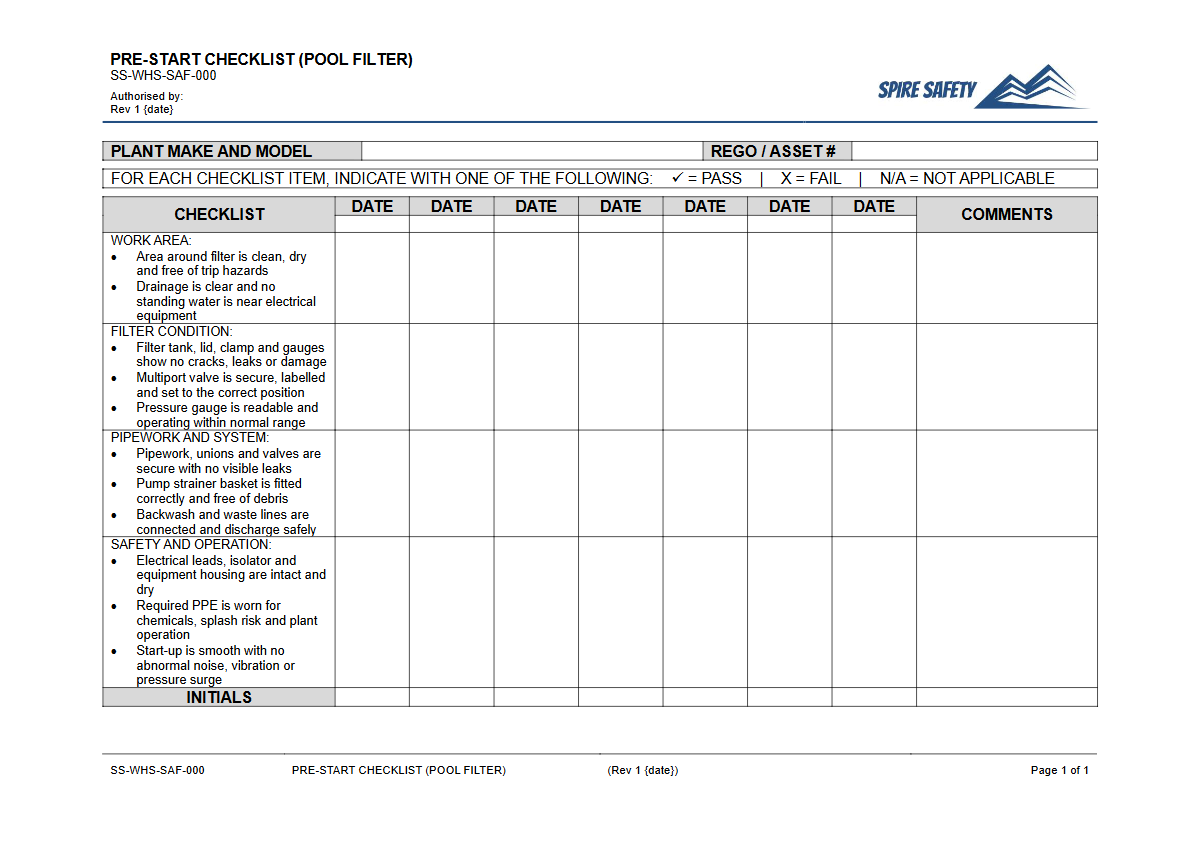
Download our free Pre-Start Checklist (Pool Filter) Template to formalise daily safety inspections. This DOCX and PDF helps identify hazards before use.
Free Pre-Start Checklist (Pool Filter) Template
DOCX • 125 KB + PDF
Updated Oct 2026
No signup required
Purpose of the Free Pre-Start Checklist (Pool Filter) Template
Regularly inspecting pool filtration equipment is a critical control measure for preventing incidents in aquatic facilities, commercial properties, and residential complexes. Using this Free Pre-Start Checklist (Pool Filter) Template helps your organisation formalise the process of checking equipment before it is operated.
It provides a structured way for workers to identify potential hazards such as water leaks, pressure irregularities, electrical faults, or damaged components that could lead to equipment failure, poor water quality, or serious injury. Consistent use of this checklist promotes a proactive safety culture, helps maintain plant integrity, and creates a documented record of due diligence, which is a cornerstone of any effective safety management system.
By catching issues early, you can schedule maintenance before minor problems escalate into costly breakdowns or dangerous situations. This template guides operators through a logical sequence of checks covering the pump, filter, valves, and surrounding area.
For more targeted safety reinforcement, our Pool and Aquatic Safety Toolbox Talk can complement your existing procedures.
Video walkthrough
How to use the Free Pre-Start Checklist (Pool Filter) Template
This template is provided as a starting point to help you build a robust safety process. It is delivered in both DOCX and PDF formats, allowing for easy customisation to suit your specific operational needs.
To implement it effectively, start by reviewing the checklist items against the manufacturer’s operating manual for your particular pool filter model. Add, remove, or modify checks to reflect the unique features and risks of your equipment and work environment.
For instance, you may need to add checks specific to automated chemical dosing systems or backwash controllers.
Once customised, train all relevant personnel on how to complete the checklist correctly and what actions to take if a fault or hazard is identified. It's crucial to establish a clear procedure for reporting defects, isolating unsafe equipment, and initiating repairs.
Important: This document is a template only. We have developed it as a guide, and it must be customised to your specific plant, site, and operational context.
A generic checklist cannot cover all potential hazards, so a thorough risk assessment should always inform your final document. Integrating these checks into broader WHS management systems ensures they are part of a comprehensive approach to safety.
When to use it
A pre-start checklist for a pool filter should be completed at the beginning of every shift or day of operation, especially in commercial settings like public pools, hotels, gyms, and apartment complexes. It is most effective when performed before the equipment is energised for its main operational cycle.
It should also be used after any significant maintenance event or if the equipment has been idle for an extended period to ensure it is safe to return to service. This routine reinforces the importance of diligence and makes safety checks a non-negotiable part of daily operations.
For broader training on this topic, consider using a Pre-Start Checks and Plant Maintenance Toolbox Talk with your team.
Who should use it
This checklist is designed for any person responsible for the operation or daily oversight of pool filtration systems. This includes pool technicians, plant operators, maintenance staff, facilities managers, and senior lifeguards with plant room responsibilities.
Providing these workers with a clear and concise tool empowers them to take ownership of safety in their work area. It ensures that the person most familiar with the equipment's day-to-day behaviour is the one conducting the checks, increasing the likelihood of spotting subtle changes or emerging faults.
For organisations looking to verify their overall safety processes, undertaking periodic WHS compliance auditing can provide valuable insights and assurance.
This document complements other plant-specific resources available in our free WHS resources library, such as our Pre-Start Checklist (Agitator) Template, which follows a similar safety-first structure for different types of machinery.
Common mistakes
Common mistakes to avoid
- Skipping the check entirely to save time during busy periods.
- Failing to wear appropriate personal protective equipment (PPE), like gloves and safety glasses, when inspecting chemical levels or equipment.
- Ignoring minor issues such as small leaks, unusual noises, or slight pressure variances that could indicate a developing fault.
- Not documenting the check or failing to report identified defects through the proper channels.
Legal references
Legal considerations
The following legal requirements may be relevant to this type of work.
- Work Health and Safety Act (Harmonised) — Provides the primary duties for protecting workers and other people from work health and safety risks.
- Work Health and Safety Regulations (Harmonised) — Sets out requirements supporting the management of workplace hazards and risks.
The following codes may be relevant to this type of work.
- Managing WHS Risks Code of Practice — Provides practical guidance on identifying hazards, assessing risks and applying effective controls.
- Work Health and Safety Consultation, Cooperation and Coordination Code of Practice — Provides practical guidance on consulting workers and coordinating with other duty holders.
- Managing the Work Environment and Facilities Code of Practice — Provides practical guidance on safe work environments, workplace facilities and related controls.
Did you know
Pressure Danger
A faulty pressure gauge on a sand filter can be extremely dangerous. If the system is over-pressurised without a correct reading, the filter lid or tank can fail explosively, causing serious injury.
Silent Hazard
Poorly maintained pool and spa filtration systems can become breeding grounds for Legionella bacteria, which can cause the serious lung infection Legionnaires' disease when inhaled via water aerosols.
FAQ
Frequently asked questions
01What are the main hazards associated with commercial pool filtration systems?
02How often should a pre-start check be performed on a commercial pool filter?
03What is the difference between a pre-start check and scheduled maintenance?
04Why is documenting pre-start checks important?
Share this resource
Free Pre-Start Checklist (Pool Filter) Template
Browse Categories
How To Use It
- 1Download and open in Word or PDF.
- 2Replace the placeholders with your business details.
- 3Get it reviewed by a WHS specialist before rollout.
Need it customised?
Our WHS consultants can adapt this template to your site, run a gap analysis, or audit what you already have in place.
Book a Free Consultation WHS consulting servicesor call 1300 156 382