
Free Pre-Start Checklist (Plate Compressor) Template
Download our Free Pre-Start Checklist (Plate Compressor) Template.
Free Pre-Start Checklist (Plate Compressor) Template
DOCX • 125 KB + PDF
Updated Oct 2026
No signup required
Purpose of the Free Pre-Start Checklist (Plate Compressor) Template
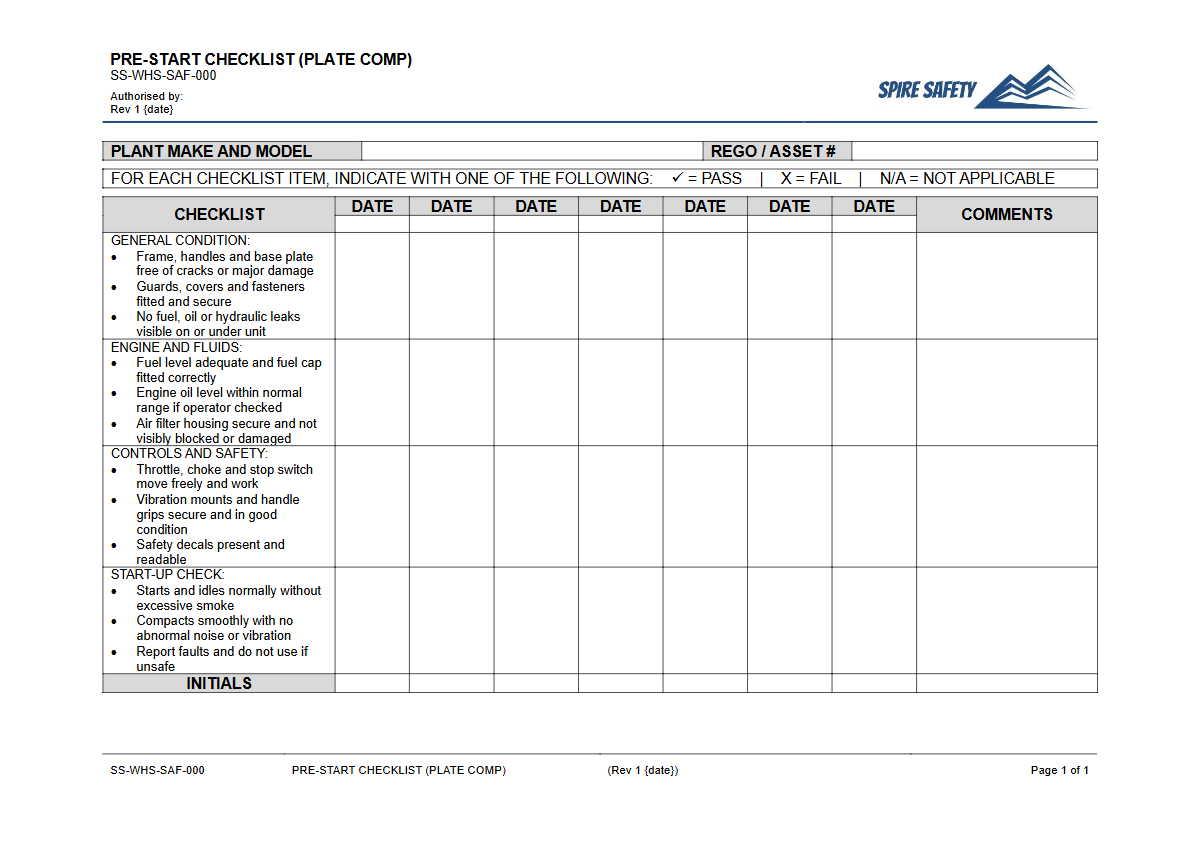
Operating a plate compressor, also known as a plate compactor or 'wacker plate', involves significant risks from vibration, noise, moving parts, and potential mechanical failure. This Free Pre-Start Checklist (Plate Compressor) Template provides a structured framework for operators to conduct consistent, thorough safety inspections before each use.
Implementing daily checks is a key part of fulfilling your duty of care under Australian WHS laws by ensuring the equipment is safe to operate and that potential hazards are identified before they cause an incident. Formalising this process helps to systematically manage risks associated with plant operation.
A documented pre-start process demonstrates a proactive approach to safety and is an essential component of a robust WHS management system. It helps create a safety-conscious culture where equipment condition is actively monitored, and faults are reported and rectified promptly. This not only protects workers but also extends the operational life of the equipment by catching minor issues before they become major failures.
Video walkthrough
How to Use the Free Pre-Start Checklist (Plate Compressor) Template
Using this template effectively involves a few simple steps. First, download the document in your preferred format (DOCX or PDF).
The DOCX version is fully editable, allowing for easy customisation to suit your specific needs. Integrate the checklist into your organisation's daily operational procedures and ensure all operators are trained on how to complete it correctly.
The process should be straightforward: the operator performs a visual and physical check of each item listed, ticking off each point as they confirm its safe condition. Any identified faults or concerns must be recorded and reported immediately.
A critical step is customisation. This template provides a solid foundation based on common safety checks for plate compressors.
However, to ensure it is effective for your specific circumstances, we stress that you must customise it. We recommend conducting a site-specific risk assessment to identify all relevant hazards associated with your particular model of plate compressor, the tasks it is used for, and the environment it operates in. Add, remove, or modify checklist items to align with the manufacturer's specifications and your risk assessment findings. The principles are similar for other high-vibration construction tools, as seen in our Pre-Start Checklist for Floor Saws.
When to Use This Pre-Start Checklist
The pre-start check should be completed before the plate compressor is used for the first time each day or at the beginning of every shift. It should also be performed whenever a new operator takes over the equipment during a shift.
Additionally, conducting a check is good practice after the equipment returns from servicing or repair to verify that it is in a safe condition and that all work has been completed satisfactorily. This routine establishes a consistent safety baseline for every single use.
Who Should Use It
This checklist is designed to be used by trained and competent operators who are authorised to use the plate compressor. Competency means the person has received instruction and training on the specific make and model, understands its operating procedures, and is aware of the associated hazards.
Supervisors and managers can also use the completed checklists to verify that inspections are being carried out correctly and to monitor the overall condition of the equipment fleet. Ensuring operators are competent is a key safety responsibility, a topic that can be explored further through professional WHS consulting.
Key Items to Include in Your Checklist
When customising your checklist, ensure it covers all critical safety components of the plate compressor. A comprehensive check should be organised into logical sections. Key areas to inspect include:
- Engine/Motor: Check fuel and oil levels, look for any leaks, and ensure the air filter is clean.
- Guards and Covers: Verify that all guards, particularly for the belt drive and exhaust, are securely in place and undamaged. Guarding is a critical control on all machinery, a principle also highlighted in our Granulator Pre-Start Checklist template.
- Handles and Controls: Inspect anti-vibration mounts on the handles for signs of wear or damage. Test the throttle control for smooth operation and ensure the engine kill switch or stop button functions correctly.
- Base Plate and Frame: Check the compactor plate and frame for cracks, excessive wear, or structural damage.
- General Condition: Ensure the machine is clean and free from excess dirt or debris that could pose a fire hazard or hide defects. Check that all safety decals and warning labels are legible.
Managing Records and Follow-Up
Completed checklists are important WHS records. They must be stored securely and be accessible for review.
These records help track the condition of the equipment over time and can be invaluable during an incident investigation or a formal WHS compliance audit. The most important part of the process is the follow-up action. If an operator identifies a defect, there must be a clear procedure to 'tag out' the equipment, preventing its use until it has been inspected and repaired by a qualified person.
This 'lock-out tag-out' procedure is a non-negotiable step in managing faulty plant.
Common mistakes
Common mistakes to avoid
- Using a generic checklist without customising it for the specific model and work environment.
- Operators 'pencil-whipping' the form without physically performing each check.
- Failing to take faulty equipment out of service immediately after a defect is identified.
- Poor record-keeping, making it difficult to track equipment history or prove due diligence.
Legal references
Legal considerations
The following legal requirements may be relevant to this type of work.
- Work Health and Safety Act (Harmonised) — Provides the primary duties for protecting workers and other people from work health and safety risks.
- Work Health and Safety Regulations (Harmonised) — Sets out requirements supporting the management of workplace hazards and risks.
The following codes may be relevant to this type of work.
- Managing WHS Risks Code of Practice — Provides practical guidance on identifying hazards, assessing risks and applying effective controls.
- Work Health and Safety Consultation, Cooperation and Coordination Code of Practice — Provides practical guidance on consulting workers and coordinating with other duty holders.
- Managing the Work Environment and Facilities Code of Practice — Provides practical guidance on safe work environments, workplace facilities and related controls.
Did you know
Vibration Risk
Prolonged use of high-vibration equipment like plate compressors can lead to Hand-Arm Vibration Syndrome (HAVS), a serious and permanent condition. Regular maintenance and checks on anti-vibration mounts are critical risk controls.
Record Keeping
Completed pre-start checklists are a form of WHS record. They can be used to demonstrate due diligence and track equipment condition over time, helping to identify recurring faults and inform maintenance schedules.
FAQ
Frequently asked questions
01Is using this template enough to be WHS-aligned?
02How often should a plate compressor be inspected?
03What happens if a fault is found during the check?
04Who is responsible for providing this checklist?
Share this resource
Free Pre-Start Checklist (Plate Compressor) Template
Browse Categories
How To Use It
- 1Download and open in Word or PDF.
- 2Replace the placeholders with your business details.
- 3Get it reviewed by a WHS specialist before rollout.
Need it customised?
Our WHS consultants can adapt this template to your site, run a gap analysis, or audit what you already have in place.
Book a Free Consultation WHS consulting servicesor call 1300 156 382