
Free Pre-Start Checklist (Play Equipment) Template
Download our free Pre-Start Checklist for Play Equipment. This template helps formalise safety inspections for playgrounds. Get your DOCX & PDF now.
Free Pre-Start Checklist (Play Equipment) Template
DOCX • 125 KB + PDF
Updated Oct 2026
No signup required
Purpose of the Free Pre-Start Checklist (Play Equipment) Template
Ensuring the safety of play equipment is a critical responsibility for any organisation managing public or private recreational spaces. This free Pre-Start Checklist (Play Equipment) Template provides a structured framework for conducting routine safety inspections before children use the area.
Regular, documented checks are essential for identifying hazards like broken components, sharp edges, or inadequate fall surfacing, helping to prevent injuries and demonstrate due diligence. Using a formal checklist promotes consistency and accountability, ensuring that no critical safety item is overlooked.
This document serves as a practical tool to integrate into your broader WHS management systems, strengthening your approach to risk management.
Video walkthrough
How to use the Free Pre-Start Checklist (Play Equipment) Template
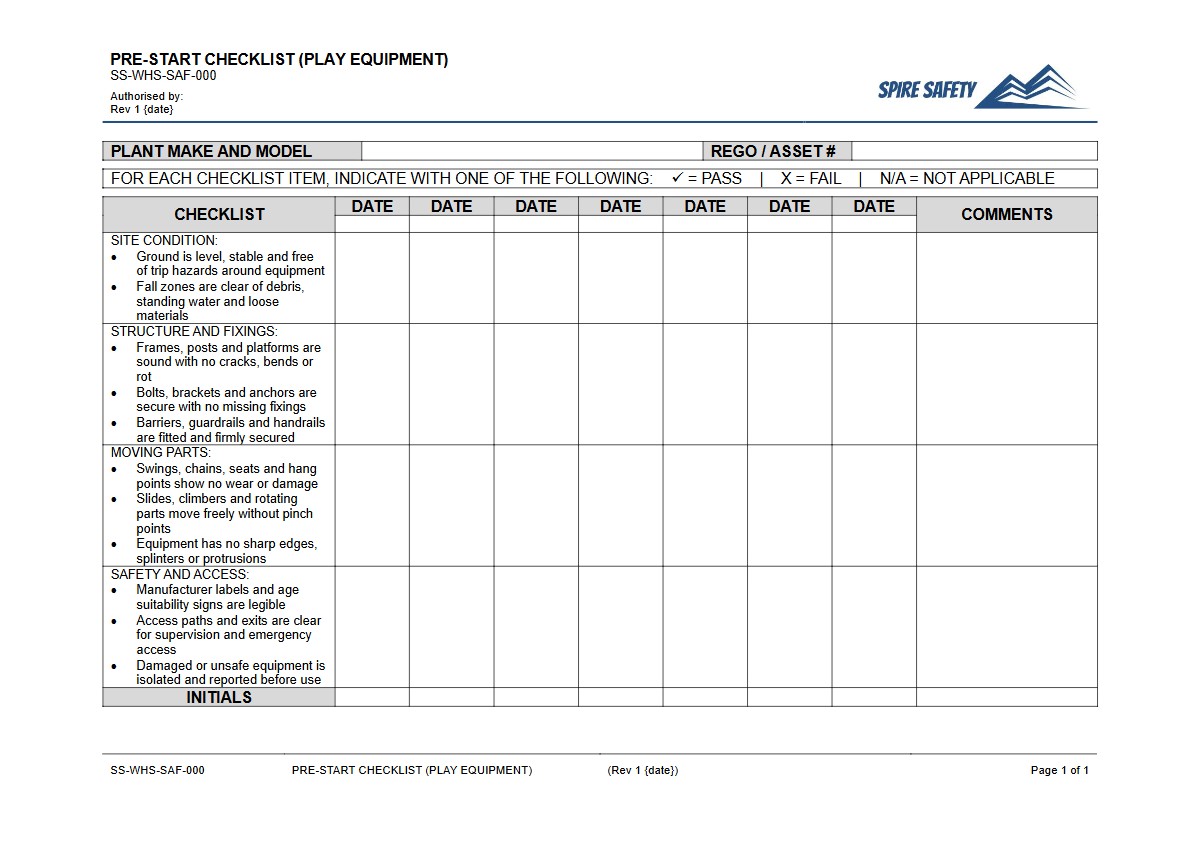
This template is available as a fully editable DOCX file and a print-ready PDF. To use it, simply download the file and adapt it to the specific types of equipment at your facility.
The checklist prompts the user to inspect key aspects such as structural integrity, component wear, moving parts, protrusions, and the condition of safety surfacing. It also includes sections for recording actions taken to rectify any identified faults.
Important: This is a template and must be customised. We have provided a comprehensive starting point, but you must add, remove, or modify checklist items to reflect the unique hazards and components of your specific play equipment, its age, and its surrounding environment.
A great way to ensure all staff understand their inspection duties is to use a Pre-Start Checks and Plant Maintenance Toolbox Talk to communicate procedures.
When to conduct a Play Equipment Pre-Start Check
Routine pre-start or pre-opening inspections should be conducted frequently. The exact frequency depends on the level of use, environmental factors, and manufacturer recommendations, but a daily or weekly visual inspection is common practice for high-use areas like schools or public parks.
This checklist is designed for these routine operational checks. It complements, but does not replace, the need for more comprehensive annual or post-installation inspections, which are often conducted by a qualified third-party inspector.
Regular use of this checklist helps create a continuous record of the equipment's condition, which can be invaluable during a WHS compliance auditing process.
Who should use this checklist
This Pre-Start Checklist is designed for any person responsible for the day-to-day safety and maintenance of playgrounds. This includes:
- Council maintenance staff and park rangers
- School groundskeepers and maintenance personnel
- Early learning centre and childcare facility staff
- Property managers for residential complexes or commercial sites
- Operators of indoor play centres
The user should be a competent person who is familiar with the equipment and has been trained to recognise potential hazards. For more complex sites or to develop a comprehensive safety framework, organisations may benefit from tailored WHS consulting. This checklist forms one part of a wider system, which should be governed by a clear internal procedure; our Plant and Equipment Procedure Template provides an excellent foundation for this.
This document is just one of many templates designed to assist Australian businesses. You can explore our complete free WHS resources library for more tools to support your safety management system.
Common mistakes
Common mistakes to avoid
- Ignoring 'minor' issues like small cracks or loose bolts, which can quickly become major failures.
- Failing to keep detailed, dated records of all inspections and maintenance actions.
- Using non-compliant parts or repair methods that inadvertently introduce new hazards.
- Focusing only on the equipment and neglecting the surrounding fall zones, surfacing, and fencing.
Legal references
Legal considerations
The following legal requirements may be relevant to this type of work.
- Work Health and Safety Act (Harmonised) — Provides the primary duties for protecting workers and other people from work health and safety risks.
- Work Health and Safety Regulations (Harmonised) — Sets out requirements supporting the management of workplace hazards and risks.
The following codes may be relevant to this type of work.
- Managing WHS Risks Code of Practice — Provides practical guidance on identifying hazards, assessing risks and applying effective controls.
- Work Health and Safety Consultation, Cooperation and Coordination Code of Practice — Provides practical guidance on consulting workers and coordinating with other duty holders.
- Managing the Work Environment and Facilities Code of Practice — Provides practical guidance on safe work environments, workplace facilities and related controls.
Did you know
Standard of Care
The Australian Standard AS 4685 is not law in itself, but it represents the accepted 'state of knowledge' and is used by courts to determine if an operator has met their duty of care in managing playground risks.
Fall Heights
Falls are the most common cause of playground injuries. The critical fall height of the surfacing material must be greater than the free height of fall from the highest designated play surface on the equipment.
FAQ
Frequently asked questions
01What Australian Standards apply to playground equipment?
02How often should playground equipment be inspected?
03What are the most common hazards found during play equipment checks?
04Who is a 'competent person' for inspecting play equipment?
Share this resource
Free Pre-Start Checklist (Play Equipment) Template
Browse Categories
How To Use It
- 1Download and open in Word or PDF.
- 2Replace the placeholders with your business details.
- 3Get it reviewed by a WHS specialist before rollout.
Need it customised?
Our WHS consultants can adapt this template to your site, run a gap analysis, or audit what you already have in place.
Book a Free Consultation WHS consulting servicesor call 1300 156 382