
Free Pre-Start Checklist (Plasma Cutter) Template
Download a free Pre-Start Checklist for Plasma Cutters. This DOCX & PDF template helps formalise safety checks to manage WHS risks in your Australian workplace.
Free Pre-Start Checklist (Plasma Cutter) Template
DOCX • 125 KB + PDF
Updated Oct 2026
No signup required
Purpose of the Free Pre-Start Checklist (Plasma Cutter) Template
Operating a plasma cutter involves significant hazards, including electric shock, severe burns, fire, arc eye, and exposure to toxic fumes. A systematic pre-start inspection is a critical control measure to ensure the equipment is safe to use before any work begins.
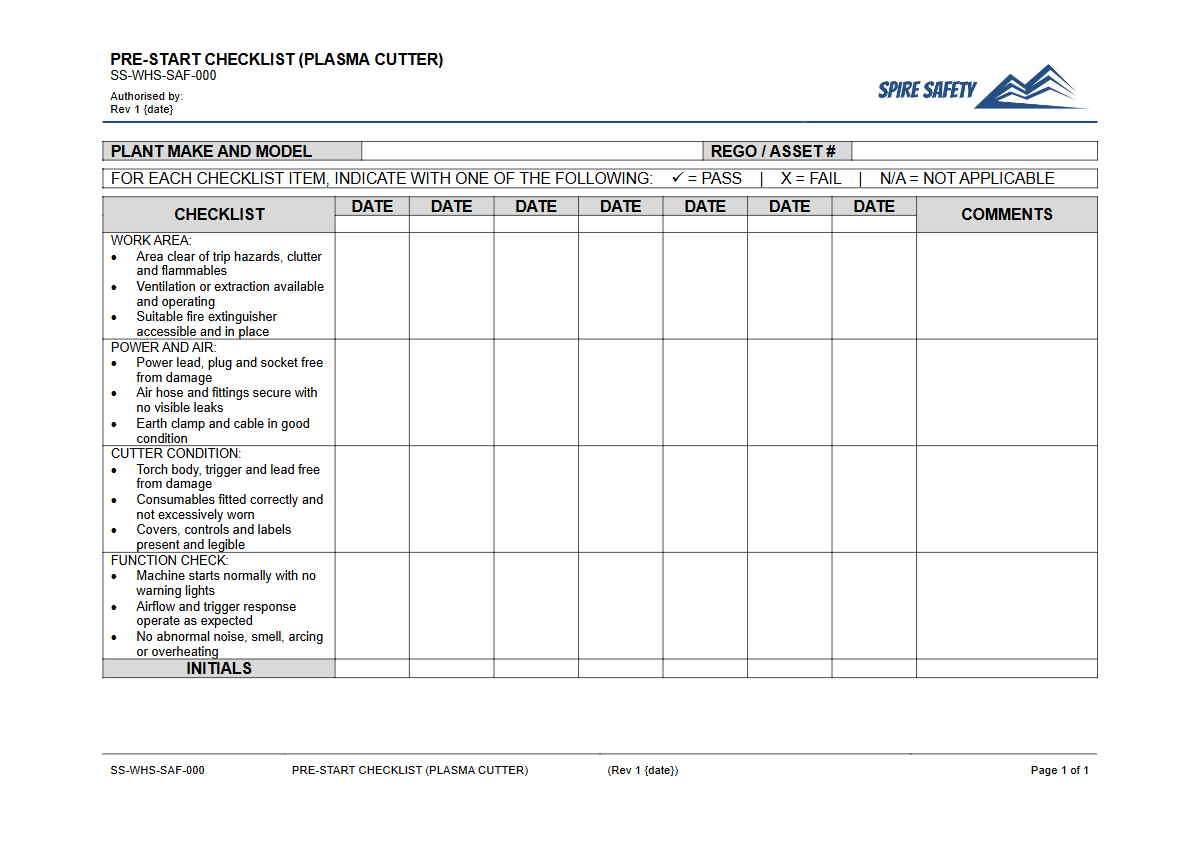
This Free Pre-Start Checklist (Plasma Cutter) Template provides a structured framework for operators to verify that key safety components and systems are functioning correctly. Consistent use of this checklist helps your organisation identify potential faults before they lead to injury or equipment failure, demonstrating a commitment to proactive WHS management.
The checklist guides the user through inspecting critical areas such as power sources, torch consumables, gas supply, leads, and personal protective equipment (PPE). Formalising this process helps in managing risks associated with airborne contaminants and electrical hazards.
For workshops using fixed ventilation, a Pre-Start Checklist for Fume Cabinets can complement your safety procedures.
Video walkthrough
How to use the Free Pre-Start Checklist (Plasma Cutter) Template
This template is designed as a practical starting point. To integrate it effectively into your safety management system, follow these steps:
- Download and Customise: The DOCX file is fully editable. You must adapt it to your specific workplace. Add your company branding and, most importantly, adjust the checklist items to match the make and model of the plasma cutters you use, your specific tasks, and the unique risks present in your work environment. While this checklist is for manual plasma cutters, those using automated systems might find our Pre-Start Checklist (CNC Plasma) Template more suitable.
- A Note on Customisation: We've designed this template to be aligned with Australian WHS principles, but it is not a one-size-fits-all solution. Your organisation is responsible for ensuring the final document is fit for purpose and addresses all relevant hazards in your specific context.
- Train Your Team: Ensure all operators and supervisors are trained on how to correctly complete the checklist, what each item means, and the procedure for reporting faults or 'Not Safe to Use' findings.
- Implement and Monitor: Integrate the checklist into your daily operational workflow. Supervisors should regularly monitor its use to ensure inspections are being completed diligently and that corrective actions are taken promptly.
- Review and Refine: Periodically review the checklist's effectiveness and update it following any incident, change in equipment, or updates to regulations.
When to use it
A plasma cutter pre-start check should be conducted before every use or, at a minimum, at the beginning of each shift where the equipment will be used. The goal is to catch issues early.
Making this a non-negotiable part of the daily routine fosters a strong safety culture and minimises the chance of an operator using faulty equipment. This discipline is a cornerstone of robust WHS management systems and helps meet due diligence obligations.
Who should use it
This Pre-Start Checklist is primarily for:
- Equipment Operators: The person operating the plasma cutter is responsible for conducting the pre-start inspection. They are the first line of defence against equipment-related incidents.
- Supervisors and Team Leaders: Supervisors must ensure that operators are completing the checks correctly and consistently. They are also responsible for actioning any reported defects, such as by tagging out unsafe equipment and arranging for repairs.
- Maintenance Personnel: Completed checklists provide valuable data for the maintenance team, highlighting recurring issues that may indicate a need for scheduled servicing or replacement parts. This documentation provides crucial evidence during a WHS compliance audit, showing that safety procedures are consistently followed.
The fundamental principles of operator-led checks apply to a wide range of equipment, from complex machinery to other high-risk tools like those covered in our Pre-Start Checklist for Floor Saws. By embedding these practices, your organisation reinforces the individual responsibility everyone has for maintaining a safe work environment. For more templates and safety tools, you can browse our entire free WHS resources library.
Common mistakes
Common mistakes to avoid
- Skipping the pre-start check for a 'quick job', which is often when incidents occur.
- Failing to customise the generic template to the specific make and model of the plasma cutter in use.
- Pencil-whipping the checklist without physically inspecting the items.
- Not taking faulty equipment out of service immediately and failing to follow tag-out procedures.
Legal references
Legal considerations
The following legal requirements may be relevant to this type of work.
- Work Health and Safety Act (Harmonised) — Provides the primary duties for protecting workers and other people from work health and safety risks.
- Work Health and Safety Regulations (Harmonised) — Sets out requirements supporting the management of workplace hazards and risks.
The following codes may be relevant to this type of work.
- Managing WHS Risks Code of Practice — Provides practical guidance on identifying hazards, assessing risks and applying effective controls.
- Work Health and Safety Consultation, Cooperation and Coordination Code of Practice — Provides practical guidance on consulting workers and coordinating with other duty holders.
- Managing the Work Environment and Facilities Code of Practice — Provides practical guidance on safe work environments, workplace facilities and related controls.
Did you know
Incredibly Hot
The plasma arc can reach temperatures of up to 25,000°C, which is hotter than the surface of the sun. This extreme heat is what allows it to melt and cut through electrically conductive metals with ease.
Invisible Danger
The ultraviolet (UV) and infrared (IR) radiation from a plasma arc can cause severe skin burns and permanent eye damage (arc eye) from a significant distance. Proper shielding and PPE are non-negotiable.
FAQ
Frequently asked questions
01What are the main hazards of using a plasma cutter?
02Is a pre-start check legally required for plasma cutters in Australia?
03How often should I review and update my plasma cutter checklist?
04Can I use a digital app for my pre-start checks instead of paper?
Share this resource
Free Pre-Start Checklist (Plasma Cutter) Template
Browse Categories
How To Use It
- 1Download and open in Word or PDF.
- 2Replace the placeholders with your business details.
- 3Get it reviewed by a WHS specialist before rollout.
Need it customised?
Our WHS consultants can adapt this template to your site, run a gap analysis, or audit what you already have in place.
Book a Free Consultation WHS consulting servicesor call 1300 156 382