
Free Pre-Start Checklist (Planet Mixer) Template
Download our free Pre-Start Checklist (Planet Mixer) Template. This structured DOCX & PDF helps formalise safety inspections & identify hazards.
Free Pre-Start Checklist (Planet Mixer) Template
DOCX • 125 KB + PDF
Updated Oct 2026
No signup required
Purpose of the Free Pre-Start Checklist (Planet Mixer) Template
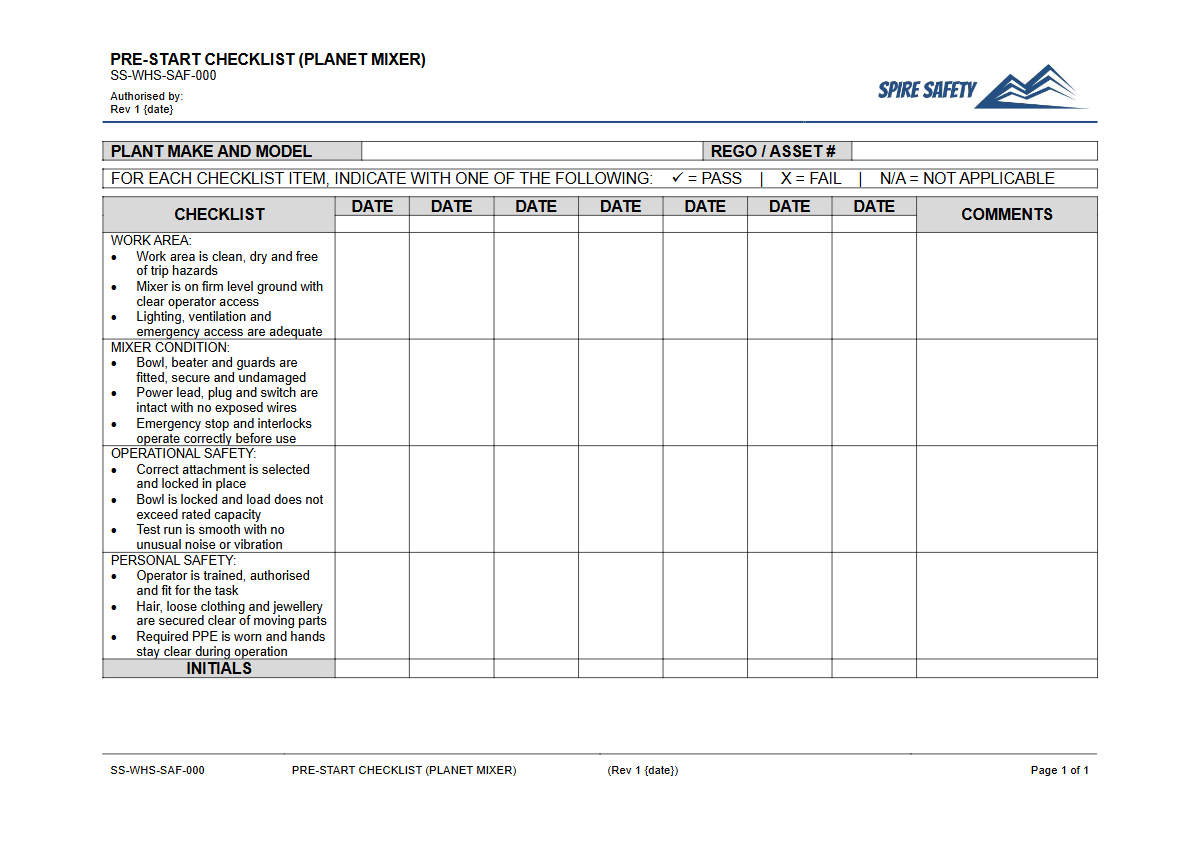
The primary purpose of this pre-start checklist is to ensure a planetary mixer is safe to operate before each shift or use. It serves as a formal record that key safety and operational checks have been completed.
This simple but effective tool helps your organisation manage risks associated with moving parts, electrical components, and hygiene standards.
- Hazard Identification: Systematically checks for common hazards such as damaged guards, faulty emergency stops, worn electrical cords, or insecure bowl locking mechanisms.
- Incident Prevention: Proactively identifies and addresses issues that could lead to entanglement, crushing injuries, electrical shock, or product contamination.
- Compliance and Record-Keeping: Creates a documented trail of due diligence, demonstrating that safety checks are being consistently performed as part of your operational procedures. This can be supported by regular safety meetings, such as those guided by our Pre-Start Checks and Plant Maintenance Toolbox Talk.
- Improved Maintenance: Early detection of wear and tear allows for timely preventative maintenance, reducing downtime and extending the life of the equipment.
Video walkthrough
How to use the Free Pre-Start Checklist (Planet Mixer) Template
Integrating this template into your daily workflow is straightforward. Follow these steps to get started:
- Download: Get the template in your preferred format, either DOCX for easy editing or PDF.
- Customise: This is the most critical step. You must adapt the checklist to the specific make and model of the planetary mixers used in your workplace. Consider adding checks for specific attachments (dough hook, whisk, paddle), bowl sizes, and unique features of your equipment. For similar rotating equipment, you may find our Free Pre-Start Checklist (Agitator) Template a useful reference.
- Train Operators: Ensure all operators are trained not only on how to use the mixer safely but also on how to complete the pre-start checklist thoroughly. They must understand what each checkpoint means and what to do if a fault is found.
- Implement: Make the checklist a mandatory step before any operator uses the mixer. Store completed checklists in a designated location for review by supervisors or managers.
- Review and Report: Supervisors should periodically review completed checklists to identify recurring issues or patterns of non-compliance. Any identified faults must be reported immediately through your workplace’s hazard reporting procedure and the mixer tagged out of service until it is repaired by a competent person.
IMPORTANT: This document is a template only. We provide it as a starting point.
You must customise it to reflect the specific equipment, hazards, and control measures relevant to your workplace. Its effectiveness depends entirely on its correct customisation and implementation.
When to Use This Pre-Start Checklist
A pre-start checklist for a planetary mixer should be completed:
- At the beginning of each shift: Before the mixer is used for the first time that day.
- When changing operators: If a new operator takes over mid-shift, they should verify the equipment's condition.
- After cleaning or maintenance: To ensure the machine has been reassembled correctly and is safe to return to service.
- If the mixer has been moved: To check for damage or instability in its new location.
Consistent use is key to building a strong safety culture. This is just one aspect of verifying worker capability; for a more comprehensive assessment, consider using a document like our Verification of Competency (Mortar Mixer) template as a guide for a similar process.
Who Should Use This Checklist
This checklist is designed to be completed by the person operating the planetary mixer. Competent operators have the hands-on knowledge to spot subtle changes in the equipment's condition or performance.
Supervisors and managers also have a role to play. They are responsible for:
- Ensuring the checklists are being completed correctly and consistently.
- Reviewing completed forms to identify trends or recurring faults.
- Taking prompt action when defects are reported, including isolating the equipment and arranging for repairs.
- Providing adequate training and resources to support the pre-start inspection process.
If your organisation is looking to formalise its safety procedures, an effective approach is developing a robust WHS management system that integrates tools like this checklist into a broader framework.
Explore our complete free WHS resources library for more templates, forms, and toolbox talks to support your safety management system.
Common mistakes
Common mistakes to avoid
- Failing to customise the template for the specific mixer model and its attachments.
- Operators 'pencil-whipping' the checklist without physically inspecting each item.
- Not removing faulty equipment from service immediately after a defect is identified.
- Poor record-keeping, making it impossible to track recurring faults or demonstrate due diligence.
Legal references
Legal considerations
The following legal requirements may be relevant to this type of work.
- Work Health and Safety Act (Harmonised) — Provides the primary duties for protecting workers and other people from work health and safety risks.
- Work Health and Safety Regulations (Harmonised) — Sets out requirements supporting the management of workplace hazards and risks.
The following codes may be relevant to this type of work.
- Managing WHS Risks Code of Practice — Provides practical guidance on identifying hazards, assessing risks and applying effective controls.
- Work Health and Safety Consultation, Cooperation and Coordination Code of Practice — Provides practical guidance on consulting workers and coordinating with other duty holders.
- Managing the Work Environment and Facilities Code of Practice — Provides practical guidance on safe work environments, workplace facilities and related controls.
Did you know
Guarding is Critical
Unguarded planetary mixers are a leading cause of serious injuries in commercial kitchens and bakeries. The rotating motion can easily catch loose clothing, hair, or utensils, leading to severe entanglement injuries.
Not Just for Baking
While famous in bakeries, planetary mixers are also used in laboratories for mixing chemicals, in cosmetics for creating emulsions, and in construction for preparing adhesives and mortars.
FAQ
Frequently asked questions
01What are the most common hazards associated with a planetary mixer?
02Is a pre-start checklist a legal requirement in Australia?
03What should an operator do if they find a fault during a pre-start check?
04Can I use this template for other types of food or construction mixers?
Share this resource
Free Pre-Start Checklist (Planet Mixer) Template
Browse Categories
How To Use It
- 1Download and open in Word or PDF.
- 2Replace the placeholders with your business details.
- 3Get it reviewed by a WHS specialist before rollout.
Need it customised?
Our WHS consultants can adapt this template to your site, run a gap analysis, or audit what you already have in place.
Book a Free Consultation WHS consulting servicesor call 1300 156 382