
Free Pre-Start Checklist (Planer) Template
Download our free Pre-Start Checklist (Planer) Template to formalise daily equipment checks and manage WHS risks.
Free Pre-Start Checklist (Planer) Template
DOCX • 125 KB + PDF
Updated Oct 2026
No signup required
Purpose of the Free Pre-Start Checklist (Planer) Template
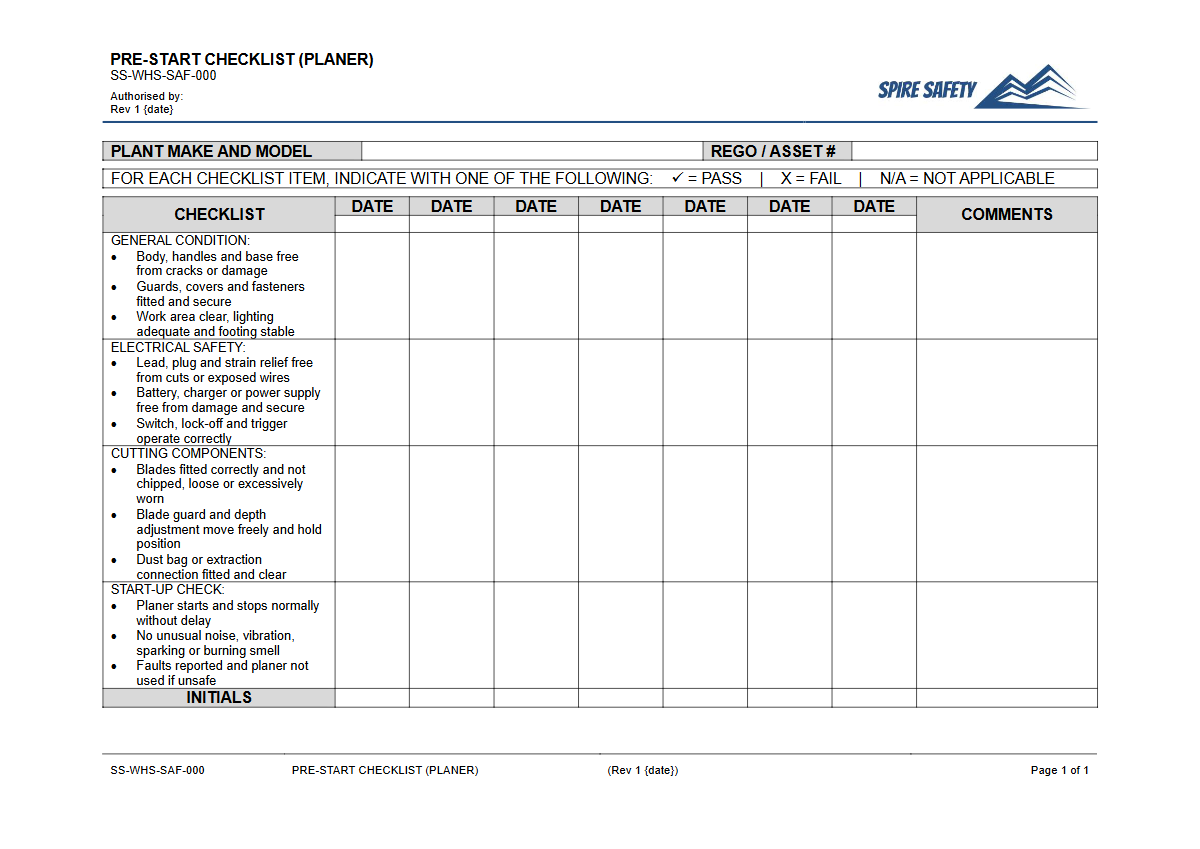
Effectively managing workshop safety involves consistent and thorough equipment inspections. This free Pre-Start Checklist (Planer) Template provides a structured framework for operators to verify that a wood planer is safe to use before commencing any work.
By formalising this process, you create a systematic approach to identifying and controlling hazards such as cuts from exposed blades, electrical faults, unexpected start-up, or issues with dust extraction systems. Using a documented checklist helps embed a critical safety behaviour and demonstrates a commitment to proactive risk management within your organisation's safety procedures.
A pre-start inspection is a fundamental part of managing plant safety, helping to prevent incidents before they occur. The checks outlined are designed to catch common points of failure or damage that could lead to injury.
Similar to conducting a pre-start checklist for a bench grinder, this process ensures the equipment's safety features are intact and functional, providing a safer environment for the operator and others in the vicinity. This template is aligned with Australian WHS principles for plant and equipment safety.
Video walkthrough
How to use the Free Pre-Start Checklist (Planer) Template
This resource is available for download in both DOCX and PDF formats. The DOCX version is fully editable, allowing you to tailor it to your specific workplace needs.
The checklist is a starting point designed to cover common inspection points for standard planers.
Important: This template must be customised to your business. We strongly recommend you adapt the checklist to reflect the specific makes and models of planers in your workshop, your unique operational risks, and any state or territory-specific regulations.
You should add your company branding and specific site details, and review the checklist items to ensure they are comprehensive for your equipment. For assistance in adapting this template or developing more complex safety documentation, our WHS consulting services can provide expert guidance.
Key Inspection Areas
Your customised checklist should prompt the operator to physically inspect key components and functions, including:
- Guards & Safety Devices: Ensure all guards (e.g., bridge guard, cutterhead guard) are in place, secure, and functioning correctly.
- Blades/Cutters: Check that blades are sharp, free from chips or damage, and securely fastened.
- Power & Electrics: Inspect power cords and plugs for damage, fraying, or exposed wires. Test the emergency stop button and on/off switches.
- Dust Extraction: Verify that the dust extraction system is connected properly and is effectively removing wood dust and shavings from the work area.
- Machine Condition: Check the overall stability of the machine, the condition of the infeed and outfeed tables, and for any signs of damage or loose parts.
- Work Area: Ensure the area around the planer is clear of obstructions, slip hazards, and flammable materials.
When to use this Pre-Start Checklist
A planer pre-start check should be conducted before the first use of the machine on any given day or shift. It should also be completed by a new operator taking over the equipment during a shift.
This regular frequency ensures that any faults or damage that may have occurred overnight, during transport, or from previous use are identified before the machine is operated again. For equipment that is used less frequently, the check must be completed before each use. This diligence is crucial for high-speed cutting equipment like planers and is a common requirement for other tools, as seen in a pre-start checklist for a floor saw.
Who should use it
The pre-start inspection must be carried out by the person who will be operating the planer. Operators must be deemed competent, meaning they have received adequate information, training, and instruction on how to use the specific model of planer safely.
This competency extends to understanding the items on the checklist and knowing what constitutes a 'pass' or 'fail' for each inspection point. Integrating these checks into daily operations is a core component of robust WHS management systems, reinforcing worker responsibility and safety awareness.
Upon completion, the checklist should be signed and dated by the operator. If any faults are identified that pose a risk to health and safety, the planer must be immediately taken out of service, tagged with an 'Out of Service' or 'Do Not Use' tag, and the issue reported to a supervisor or manager.
Completed checklists should be filed and retained as part of your safety records, which can be reviewed during WHS compliance audits to demonstrate due diligence in plant maintenance and safety.
Maintaining records of these inspections helps track the condition of your equipment over time, identifying recurring issues that may signal a need for more intensive maintenance or replacement. It forms a key part of the lifecycle management of workplace plant and machinery, a principle that applies to a wide range of equipment from woodworking tools to industrial machinery like that covered in a checklist for a granulator.
Common mistakes
Common mistakes to avoid
- Skipping checks on the dust extraction system, treating it as optional.
- Failing to check blade condition for sharpness and damage, leading to poor cuts and increased kickback risk.
- "Pencil-whipping" the checklist without physically inspecting each item.
- Not immediately removing a faulty planer from service after a failed check.
Legal references
Legal considerations
The following legal requirements may be relevant to this type of work.
- Work Health and Safety Act (Harmonised) — Provides the primary duties for protecting workers and other people from work health and safety risks.
- Work Health and Safety Regulations (Harmonised) — Sets out requirements supporting the management of workplace hazards and risks.
The following codes may be relevant to this type of work.
- Managing WHS Risks Code of Practice — Provides practical guidance on identifying hazards, assessing risks and applying effective controls.
- Work Health and Safety Consultation, Cooperation and Coordination Code of Practice — Provides practical guidance on consulting workers and coordinating with other duty holders.
- Managing the Work Environment and Facilities Code of Practice — Provides practical guidance on safe work environments, workplace facilities and related controls.
Did you know
Dust Dangers
Wood dust is not just an irritant; it is classified as a carcinogen. Effective dust extraction, checked during the pre-start, is a critical health control, not just a housekeeping measure.
Kickback Risk
The most common cause of serious planer injuries is kickback, where the workpiece is suddenly thrown back at the operator. Pre-start checks on anti-kickback pawls and proper machine setup are vital to prevent this.
FAQ
Frequently asked questions
01What should I do if a fault is found during a planer pre-start check?
02How often should a planer's blades be checked?
03Is this planer checklist a substitute for a Safe Work Method Statement (SWMS)?
04Do I need to keep completed pre-start checklists?
Share this resource
Free Pre-Start Checklist (Planer) Template
Browse Categories
How To Use It
- 1Download and open in Word or PDF.
- 2Replace the placeholders with your business details.
- 3Get it reviewed by a WHS specialist before rollout.
Need it customised?
Our WHS consultants can adapt this template to your site, run a gap analysis, or audit what you already have in place.
Book a Free Consultation WHS consulting servicesor call 1300 156 382