
Free Pre-Start Checklist (Pipe Cutter) Template
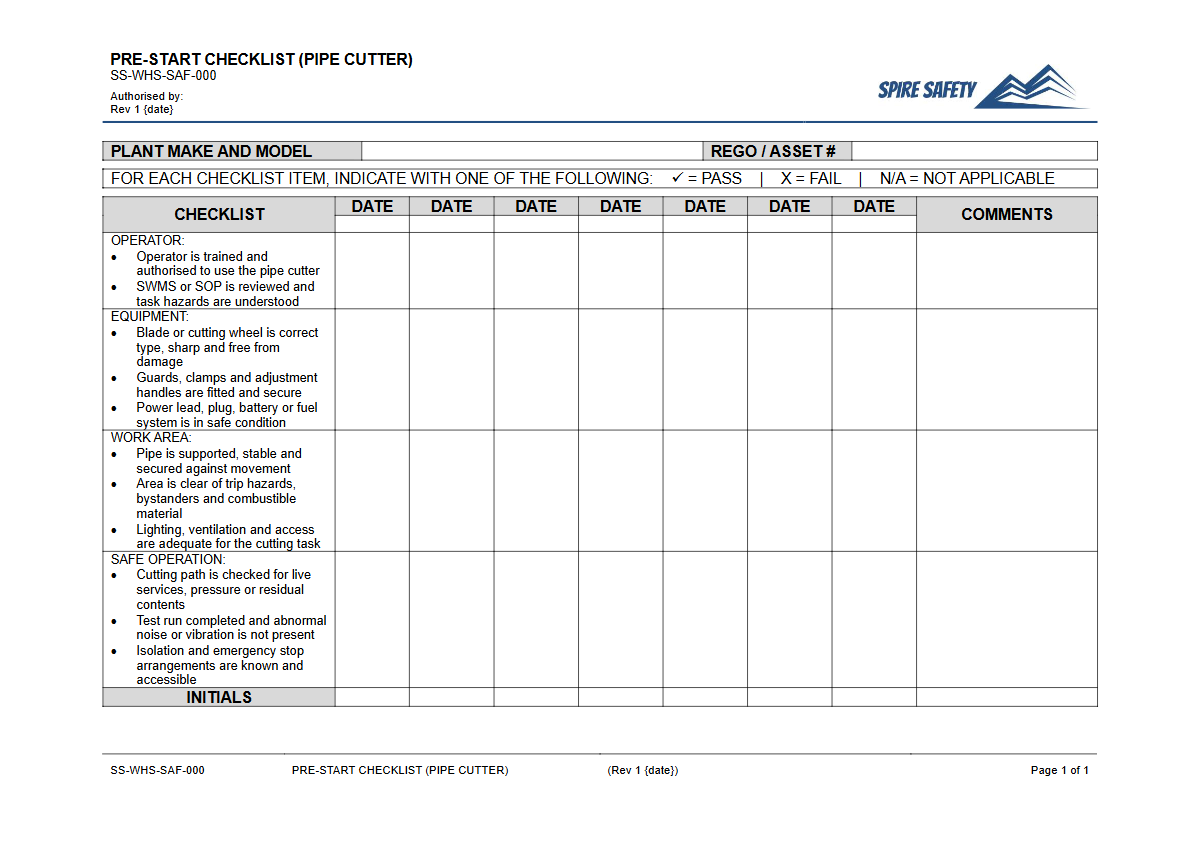
Download our free Pre-Start Checklist (Pipe Cutter) Template (DOCX & PDF). This structured checklist helps formalise equipment inspections and manage WHS risks.
Free Pre-Start Checklist (Pipe Cutter) Template
DOCX • 125 KB + PDF
Updated Oct 2026
No signup required
Purpose of the Free Pre-Start Checklist (Pipe Cutter) Template
Operating a pipe cutter, whether manual, hydraulic, or electric, involves significant risks if the equipment is not properly maintained. A systematic pre-start inspection is a critical control measure to ensure the equipment is safe for use.
This free Pre-Start Checklist (Pipe Cutter) Template provides a structured starting point for your organisation to formalise these essential safety checks, helping you identify and manage hazards before they cause an incident. Using a formal checklist helps create a record of inspections, demonstrating due diligence and a commitment to a safe system of work.
The primary purpose is to proactively identify mechanical, electrical, or structural defects such as dull blades, damaged power cords, faulty guards, or hydraulic leaks. It forms part of a holistic approach to safety, working alongside documents like a Verification of Competency (Pipe Cutter) Template to ensure both the machine and the operator are ready for the task.
Video walkthrough
How to use the Free Pre-Start Checklist (Pipe Cutter) Template
This template is designed for immediate use and straightforward customisation. First, download the document in your preferred format (DOCX or PDF).
Your team should then review the checklist items and adapt them to the specific make and model of pipe cutters used in your operations. Different types of cutters (e.g., ratchet, scissor, powered) will have unique inspection points.
Please note: This document is a template and must be customised to suit the specific models of pipe cutters, tasks, and risks in your workplace. We recommend consulting with operators and maintenance staff during this process.
Once customised, ensure all relevant workers are trained on how to conduct the checks thoroughly. This training can be reinforced with a practical demonstration or a specific Pre-Start Checks and Plant Maintenance Toolbox Talk. Finally, integrate the completed checklists into your safety documentation process for review by supervisors and for record-keeping.
When to use it
A pre-start check should be conducted before the pipe cutter is used for the first time on any given day or shift. This routine ensures that the equipment's condition has not changed unexpectedly overnight or between shifts. Additionally, a check is recommended in the following situations:
- After the equipment has undergone maintenance or repair.
- Before it is used by an operator for the first time.
- If the equipment has been transported to a new location on-site or to a different site.
- If any potential damage is suspected (e.g., if it has been dropped or impacted).
Who should use it
The primary user of the Pre-Start Checklist is the equipment operator. The person performing the work is best placed to conduct a hands-on inspection of the tool they are about to use.
They have the most immediate responsibility for their own safety and that of those around them.
Supervisors and managers also have a role. They are responsible for ensuring that operators are completing the checks correctly and consistently.
They should periodically review completed checklists to identify recurring faults or patterns that may indicate a need for more robust maintenance or equipment replacement. These principles extend to other workshop machinery, and you might find our Free Pre-Start Checklist (CNC Router) Template useful for those assets.
Key Items to Inspect
While your customised checklist will be more detailed, a thorough inspection of a pipe cutter typically includes:
- Blade/Cutting Wheel: Check for sharpness, chips, cracks, or excessive wear. A dull blade requires more force, increasing the risk of slips and injury.
- Guards & Safety Features: Ensure all guards are in place, secure, and functioning correctly.
- Power Source: For electric models, inspect cords and plugs for damage. For battery models, check battery housing for cracks. For hydraulic models, check hoses and connections for leaks.
- Frame & Handles: Look for cracks, bends, or other structural damage. Ensure grips are secure and not slippery.
- Controls & Switches: Test that all controls, including emergency stops and triggers, are responsive and function as intended.
Integrating Checks into Your Safety System
A pre-start checklist is most effective when it is a component of your organisation’s broader WHS management systems. This involves having clear procedures for what an operator should do if a defect is found. This typically includes immediately removing the equipment from service, applying a 'Do Not Use' tag, and reporting the fault to a supervisor or the maintenance team.
Documenting these steps ensures hazards are controlled promptly. For more templates and guides on managing workplace safety, browse our complete free WHS resources library.
Developing and embedding these safety processes can be complex. Our WHS consulting team can provide tailored advice to help your organisation build robust and practical safety procedures.
Common mistakes
Common mistakes to avoid
- Using a generic checklist that doesn't match the specific pipe cutter model.
- Completing the checklist from memory without physically inspecting the item ('tick and flick').
- Failing to remove faulty equipment from service immediately after a defect is found.
- Not providing adequate training to operators on how to perform a thorough inspection.
Legal references
Legal considerations
The following legal requirements may be relevant to this type of work.
- Work Health and Safety Act (Harmonised) — Provides the primary duties for protecting workers and other people from work health and safety risks.
- Work Health and Safety Regulations (Harmonised) — Sets out requirements supporting the management of workplace hazards and risks.
The following codes may be relevant to this type of work.
- Managing WHS Risks Code of Practice — Provides practical guidance on identifying hazards, assessing risks and applying effective controls.
- Work Health and Safety Consultation, Cooperation and Coordination Code of Practice — Provides practical guidance on consulting workers and coordinating with other duty holders.
- Managing the Work Environment and Facilities Code of Practice — Provides practical guidance on safe work environments, workplace facilities and related controls.
Did you know
A Common Injury
According to Safe Work Australia data, lacerations to hands and fingers are one of the most common types of workplace injury, frequently caused by contact with unsafe or improperly used machinery and hand tools.
FAQ
Frequently asked questions
01What is the difference between a pre-start checklist and a SWMS?
02How often should a pipe cutter be inspected?
03Is this checklist suitable for all types of pipe cutters?
04Who is responsible for ensuring pre-start checks are completed?
Share this resource
Free Pre-Start Checklist (Pipe Cutter) Template
Browse Categories
How To Use It
- 1Download and open in Word or PDF.
- 2Replace the placeholders with your business details.
- 3Get it reviewed by a WHS specialist before rollout.
Need it customised?
Our WHS consultants can adapt this template to your site, run a gap analysis, or audit what you already have in place.
Book a Free Consultation WHS consulting servicesor call 1300 156 382