
Free Pre-Start Checklist (Pile Driver) Template
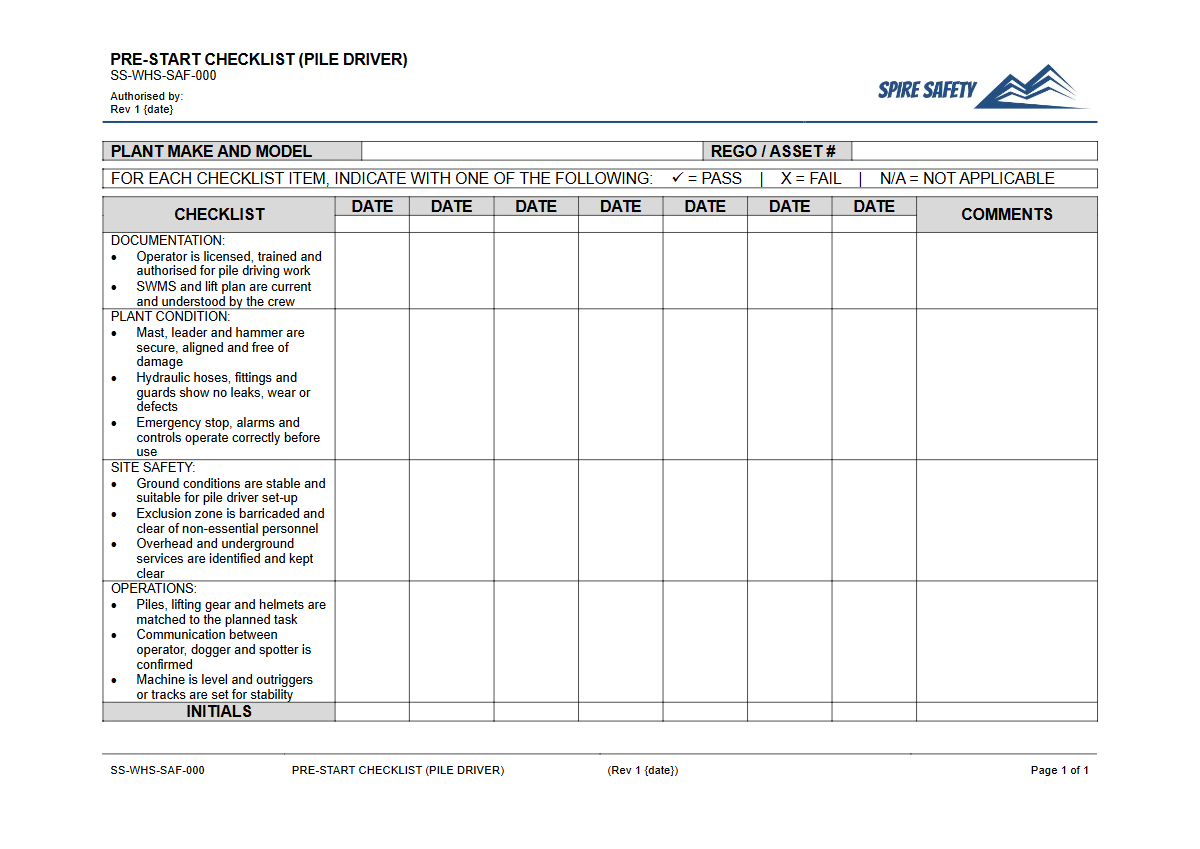
Download our Free Pre-Start Checklist (Pile Driver) Template in DOCX & PDF. A structured starting point for formalising your pre-operational equipment checks.
Free Pre-Start Checklist (Pile Driver) Template
DOCX • 125 KB + PDF
Updated Oct 2026
No signup required
Purpose of the Free Pre-Start Checklist (Pile Driver) Template
Operating a pile driver involves significant risk. A thorough pre-operational inspection is a critical control measure to ensure the equipment is safe to use.
Our Free Pre-Start Checklist (Pile Driver) Template provides a structured framework for operators to inspect the machinery before commencing work, helping to identify mechanical, hydraulic, electrical, or structural faults that could lead to an incident. Using this checklist helps your organisation meet its primary duty of care under WHS legislation by systematically managing risks associated with heavy plant.
This pre-start checklist is designed as a starting point, aligned with Australian WHS principles for high-risk work. It helps formalise the inspection process, ensuring that key components like the hammer, leads, power pack, hoses, and safety guards are checked consistently.
Documenting these checks provides a clear record of the equipment's condition, which is vital for maintenance scheduling and incident investigations. Formalising procedures for high-risk construction tasks is essential; a similar approach can be taken for other site activities using tools like a Safe Work Method Statement (SWMS) for Concrete Truck Operation.
Video walkthrough
How to use the Free Pre-Start Checklist (Pile Driver) Template
This Pre-Start Checklist is available as a fully editable Microsoft Word (DOCX) document and a print-ready PDF. To use it, simply download the file and integrate it into your daily pre-work routine.
The operator should walk around the pile driver and systematically check each item listed, noting its condition as satisfactory or identifying any defects. Any 'Unsatisfactory' item should be detailed in the comments section, and the equipment must not be used until the issue is rectified by a qualified person.
It is crucial to customise this template to suit your specific workplace. We've provided a solid foundation based on common pile driver configurations, but your site, your specific machine (e.g., vibratory, hydraulic hammer, diesel), and your safe work procedures have unique requirements.
Add or remove items to ensure the checklist accurately reflects the equipment being inspected. Integrating this checklist into your broader safety framework is key to demonstrating due diligence and building robust WHS management systems.
When to use this Pre-Start Checklist
A pre-start inspection must be completed before the pile driver is used for the first time on any given shift or workday. It should also be performed if a new operator takes over during a shift, or if the equipment has been idle for an extended period.
The goal is to verify the machine's safety and operational integrity before it is subjected to the stresses of its work task. This daily check can be reinforced with regular safety discussions, such as those facilitated by a Pre-Start Checks and Plant Maintenance Toolbox Talk Template.
Who should use this Pre-Start Checklist
The pre-start inspection should be conducted by the person who will be operating the pile driver. This must be a competent person who has received the necessary training and instruction on how to operate the specific model of pile driver safely and how to identify hazards associated with its use.
Supervisors or maintenance personnel may also use the checklist to verify inspections or audit the condition of the fleet. Findings from the checklist can be discussed and documented using a Free Pre-Start Meeting Template to ensure all team members are aware of the equipment's status.
Competency goes beyond just ticking boxes on a checklist. The operator must understand the 'why' behind each check item.
A key part of managing plant safety involves ensuring operators are not only trained but also verified as competent for the specific equipment they use. You can formalise this process with a tool like our Verification of Competency (Impact Driver) Template, adapting the concept for heavy machinery.
Completed checklists should be signed, dated, and retained as a record of your organisation's safety management activities. These records are essential for demonstrating compliance and can be reviewed during safety audits. Periodically reviewing the effectiveness of your pre-start process is a core part of continuous improvement and can be validated through professional WHS compliance auditing.
Common mistakes
Common mistakes to avoid
- Using a generic checklist that doesn't match the specific pile driver model.
- Performing a 'tick and flick' without physically and visually inspecting each component.
- Failing to immediately tag out and report faulty equipment.
- Operators signing off on a check performed by someone else.
Legal references
Legal considerations
The following legal requirements may be relevant to this type of work.
- Work Health and Safety Act (Harmonised) — Provides the primary duties for protecting workers and other people from work health and safety risks.
- Work Health and Safety Regulations (Harmonised) — Sets out requirements supporting the management of workplace hazards and risks.
The following codes may be relevant to this type of work.
- Managing WHS Risks Code of Practice — Provides practical guidance on identifying hazards, assessing risks and applying effective controls.
- Work Health and Safety Consultation, Cooperation and Coordination Code of Practice — Provides practical guidance on consulting workers and coordinating with other duty holders.
- Managing the Work Environment and Facilities Code of Practice — Provides practical guidance on safe work environments, workplace facilities and related controls.
Did you know
Equipment Failure
According to Safe Work Australia, a significant portion of injuries involving machinery are due to inadequate maintenance, with many incidents being preventable through regular inspection and servicing.
Force Generation
Hydraulic hammer pile drivers can generate immense impact energy, with large models capable of delivering hundreds of kilojoules per blow, highlighting the critical need for structural integrity.
FAQ
Frequently asked questions
01What are the main hazards of pile driving operations?
02Is a pre-start checklist a legal requirement for a pile driver in Australia?
03How often should a pile driver be inspected?
04What should happen if a fault is found during a pre-start check?
Share this resource
Free Pre-Start Checklist (Pile Driver) Template
Browse Categories
How To Use It
- 1Download and open in Word or PDF.
- 2Replace the placeholders with your business details.
- 3Get it reviewed by a WHS specialist before rollout.
Need it customised?
Our WHS consultants can adapt this template to your site, run a gap analysis, or audit what you already have in place.
Book a Free Consultation WHS consulting servicesor call 1300 156 382