
Free Pre-Start Checklist (Pie Warmer) Template
Download our free Pre-Start Checklist for pie warmers. This template helps formalise daily checks to ensure electrical and food safety. Download yours now.
Free Pre-Start Checklist (Pie Warmer) Template
DOCX • 125 KB + PDF
Updated Oct 2026
No signup required
Purpose of the Free Pre-Start Checklist (Pie Warmer) Template
Pie warmers are common appliances in many Australian workplaces, from construction site lunchrooms to cafes and canteens. Despite their simple appearance, they pose significant electrical, thermal, and food safety hazards if not properly maintained.
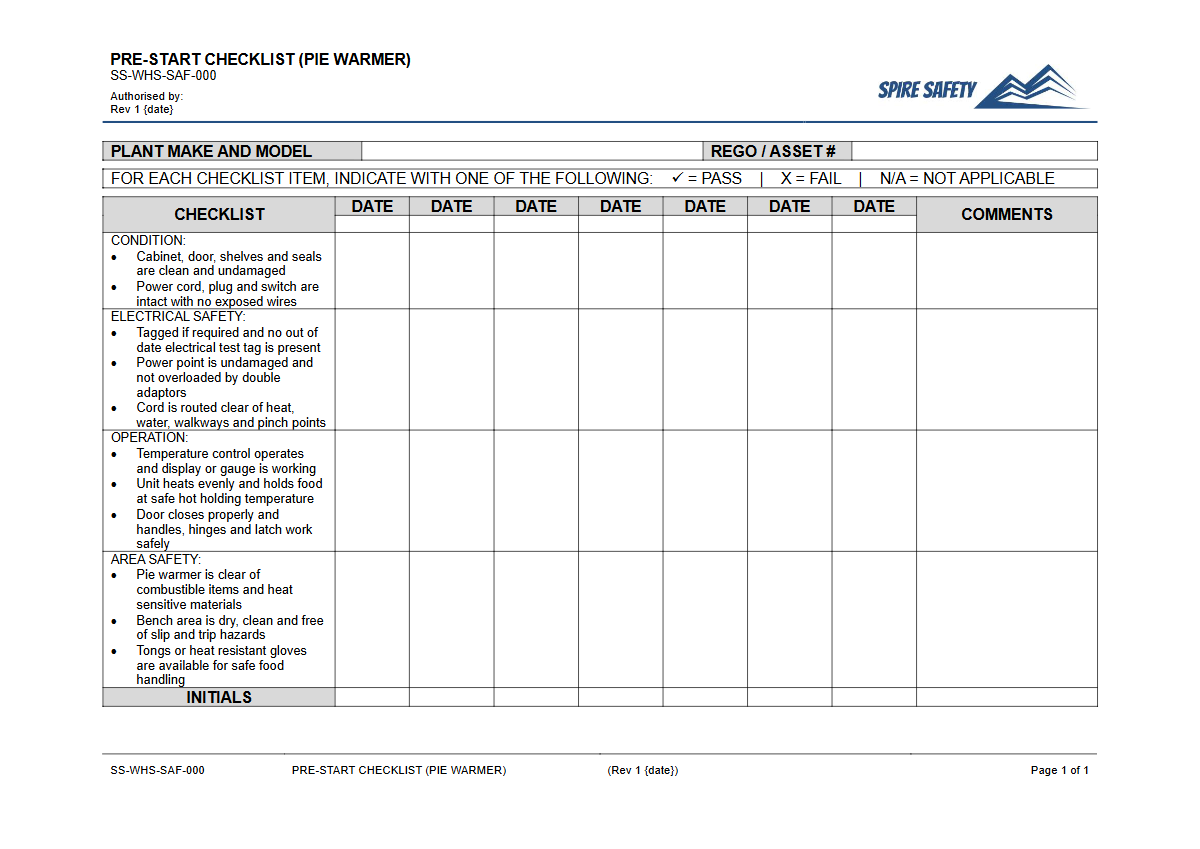
Our Free Pre-Start Checklist (Pie Warmer) Template provides a structured starting point for formalising daily safety inspections. Using this checklist helps workers identify potential faults such as damaged power cords, faulty thermostats, or broken door seals before they lead to electric shock, burns, or foodborne illness.
It's a practical tool for any Person Conducting a Business or Undertaking (PCBU) to demonstrate due diligence in ensuring workplace equipment is safe for use.
Regular, documented checks are a fundamental part of a proactive safety culture. They transform safety from an assumption into a verifiable activity, helping to prevent incidents before they occur.
Integrating these checks is a key component of any effective WHS management system, ensuring that safety responsibilities are clear and accountability is maintained. This checklist serves as tangible evidence that safety procedures are being followed, which can be invaluable during safety consultations or incident investigations.
Video walkthrough
How to use the Free Pre-Start Checklist (Pie Warmer) Template
This template is available for immediate download in both DOCX and PDF formats. The DOCX version is fully editable, allowing you to tailor it to your specific operational needs.
The PDF is ideal for quick printing and immediate use.
Customisation is Essential
This document is a template, not a finished procedure. To make it effective, you must customise it for your specific workplace and the pie warmer models you use.
We have provided a solid foundation, but it is your responsibility to ensure the final document reflects your unique environment and risks. Consider adding:
- Your company name and logo.
- Specific location or asset numbers for each pie warmer.
- Checks relevant to the specific model (e.g., specific indicator lights, water trays for humidity models).
- Emergency contact details for maintenance personnel.
- A section for recording corrective actions taken.
Once customised, the checklist should be integrated into your daily opening procedures. The findings can be discussed as needed during safety meetings, which can be documented using a pre-start meeting template to ensure all team members are aware of equipment status.
When to use it
This pre-start checklist should be completed at the beginning of each day or shift before the pie warmer is first operated. This simple, two-minute check ensures the appliance is safe before being loaded with food and heated.
It should also be used after the unit has been moved or after any maintenance has been performed. Regular checks are vital for identifying wear and tear that occurs over time.
A great way to reinforce this habit is by delivering a short, focused Pre-Start Checks and Plant Maintenance Toolbox Talk to all relevant staff.
Who should use it
The checklist is designed for use by any worker tasked with operating the pie warmer. This could include kitchen hands, café staff, construction workers, or office administrators. Designating responsibility to the operator empowers them to take ownership of their immediate safety. Supervisors and managers should also be familiar with the checklist to ensure its consistent and correct use. These records are also important evidence of procedural compliance during internal or external WHS compliance audits. For other small equipment, you might find our pre-start checklist for 3D printers a useful reference for comparison. You can browse our entire free WHS resources library for more templates and tools to support your safety program.
Common mistakes
Common mistakes to avoid
- Using the pie warmer even after identifying a fault during the check.
- Failing to report defects or to 'tag out' faulty equipment to prevent others from using it.
- Pencil-whipping the form without physically inspecting each item.
- Neglecting to customise the template for the specific pie warmer model in use.
Legal references
Legal considerations
The following legal requirements may be relevant to this type of work.
- Work Health and Safety Act (Harmonised) — Provides the primary duties for protecting workers and other people from work health and safety risks.
- Work Health and Safety Regulations (Harmonised) — Sets out requirements supporting the management of workplace hazards and risks.
The following codes may be relevant to this type of work.
- Managing WHS Risks Code of Practice — Provides practical guidance on identifying hazards, assessing risks and applying effective controls.
- Work Health and Safety Consultation, Cooperation and Coordination Code of Practice — Provides practical guidance on consulting workers and coordinating with other duty holders.
- Managing the Work Environment and Facilities Code of Practice — Provides practical guidance on safe work environments, workplace facilities and related controls.
Did you know
Electrical Safety
Faulty or damaged electrical appliances are a leading cause of workplace fires and electric shocks in Australia. Regular inspection is one of the simplest and most effective controls to prevent these incidents.
Food Safety Zone
To prevent the growth of harmful bacteria, hot food must be kept above 60°C. A functioning thermostat and accurate temperature gauge on a pie warmer are critical for food safety, not just food quality.
FAQ
Frequently asked questions
01What should be checked on a pie warmer before use?
02How often should a pie warmer be inspected?
03Is a pre-start checklist a legal requirement for a pie warmer?
04Can this template be used for other heated food displays?
Share this resource
Free Pre-Start Checklist (Pie Warmer) Template
Browse Categories
How To Use It
- 1Download and open in Word or PDF.
- 2Replace the placeholders with your business details.
- 3Get it reviewed by a WHS specialist before rollout.
Need it customised?
Our WHS consultants can adapt this template to your site, run a gap analysis, or audit what you already have in place.
Book a Free Consultation WHS consulting servicesor call 1300 156 382