
Free Pre-Start Checklist (Flatbed) Template
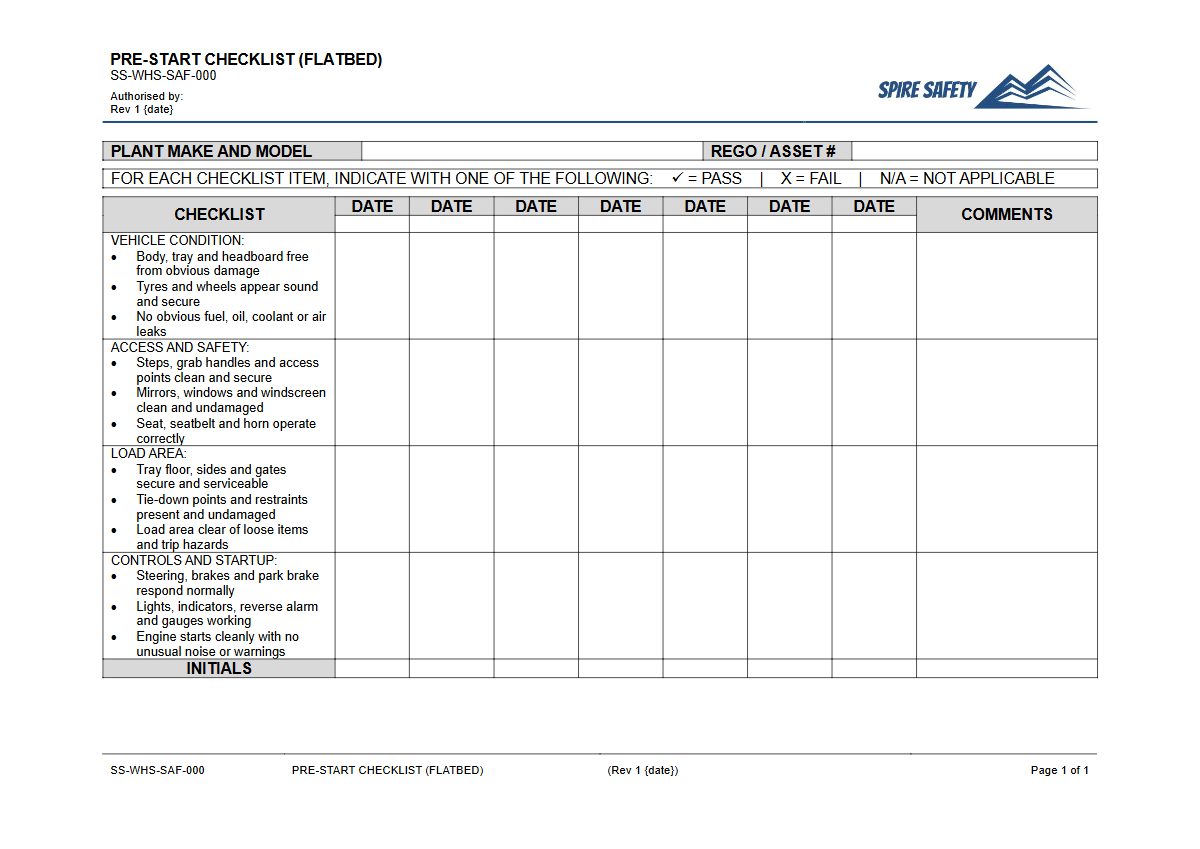
Download our Free Pre-Start Checklist (Flatbed) Template (DOCX & PDF). This structured checklist helps formalise vehicle inspections and manage WHS risks.
Free Pre-Start Checklist (Flatbed) Template
DOCX • 125 KB + PDF
Updated Oct 2026
No signup required
Purpose of the Free Pre-Start Checklist (Flatbed) Template
Operating a flatbed truck, whether in transport, logistics, or construction, involves significant safety risks if the vehicle is not properly maintained. A systematic pre-start inspection is a critical control measure to identify potential faults before they lead to an incident.
This Free Pre-Start Checklist (Flatbed) Template provides a structured framework for operators to conduct thorough daily checks, ensuring the vehicle is safe for use. Integrating such procedures is a fundamental aspect of proactive safety management, helping your organisation meet its duty of care under WHS legislation.
It serves as a practical tool for identifying mechanical issues, fluid leaks, tyre damage, or problems with load restraint points before the vehicle leaves the yard.
Using a standardised checklist ensures consistency across all operators and shifts. It creates a formal record that the inspection has been completed, which is vital for accountability and due diligence.
A documented pre-start process demonstrates a commitment to safety and forms a key part of effective WHS management systems. It helps move your organisation from a reactive to a proactive safety culture by catching small issues before they become major failures.
Video walkthrough
How to use the Free Pre-Start Checklist (Flatbed) Template
This template is designed to be a comprehensive starting point for creating a site-specific checklist. Download the DOCX version to customise the fields to match the exact make and model of the flatbed trucks in your fleet.
You may need to add or remove items based on specific features, such as integrated cranes, tail lifts, or specialised load restraint systems. The goal is to create a document that is practical and relevant for your operators.
Important: This document is a template and must be customised to your specific equipment, operations and workplace. We are not responsible for the outcomes if you fail to adapt it.
Ensure you consult with operators, mechanics, and supervisors during the customisation process to capture all critical inspection points. Once finalised, train all operators on how to use the checklist correctly, including the process for reporting and rectifying defects. Similar principles of customisation and training apply to all heavy equipment, such as that covered by a pre-start checklist for a forwarder.
When to use it
A pre-start check should be conducted before the flatbed truck is used for the first time on any shift. This ensures that the vehicle's condition hasn't changed overnight due to damage, tampering, or a developing fault.
It should become a non-negotiable daily routine for every operator. The check should also be performed after any significant event, such as a near miss or if the vehicle has been operated in particularly harsh conditions (e.g., on unsealed, corrugated roads).
This checklist is for operational readiness, not a substitute for scheduled periodic maintenance or servicing by a qualified mechanic.
The completed checklists should be collected and reviewed regularly by a supervisor or manager. This review process helps identify recurring faults that may indicate a need for more intensive maintenance or additional operator training.
Storing these records is also crucial for demonstrating compliance during a WHS compliance auditing process, providing tangible evidence of your safety procedures in action.
Who should use it
This checklist is designed for use by competent and licensed operators who are authorised to drive the flatbed truck. The person conducting the check must be familiar with the vehicle and understand the importance of each item on the list.
They must be empowered to ground the vehicle if a safety-critical fault is discovered. Supervisors and safety officers should also be familiar with the checklist to effectively oversee its implementation and review completed records.
Ultimately, anyone involved in the operation and management of a vehicle fleet has a role to play. While operators perform the check, managers must provide the resources, training, and systems to support the process.
This same principle of defined roles and responsibilities applies to all plant operation, including equipment like that detailed in our bin lifter pre-start checklist. You can find more templates for various types of plant and equipment in our free WHS resources library to build out your safety program.
Common mistakes
Common mistakes to avoid
- Operator 'pencil-whipping' the form without physically checking the items.
- Failing to adapt the generic template to the specific make and model of the flatbed.
- Not having a clear 'tag out' and reporting process for when defects are found.
- Inadequate training for operators on what they are looking for during the inspection.
Legal references
Legal considerations
The following legal requirements may be relevant to this type of work.
- Work Health and Safety Act (Harmonised) — Provides the primary duties for protecting workers and other people from work health and safety risks.
- Work Health and Safety Regulations (Harmonised) — Sets out requirements supporting the management of workplace hazards and risks.
The following codes may be relevant to this type of work.
- Managing WHS Risks Code of Practice — Provides practical guidance on identifying hazards, assessing risks and applying effective controls.
- Work Health and Safety Consultation, Cooperation and Coordination Code of Practice — Provides practical guidance on consulting workers and coordinating with other duty holders.
- Managing the Work Environment and Facilities Code of Practice — Provides practical guidance on safe work environments, workplace facilities and related controls.
Did you know
Heavy Vehicle Statistics
According to the National Heavy Vehicle Regulator (NHVR), mechanical failure is a contributing factor in a significant number of heavy vehicle incidents. Consistent pre-start checks are one of the most effective ways to identify and mitigate these mechanical risks.
FAQ
Frequently asked questions
01Why is a daily pre-start check for a flatbed truck important?
02What should happen if a fault is found during a pre-start check?
03Is this flatbed pre-start checklist a legal document?
04How often should a flatbed pre-start checklist be reviewed and updated?
Share this resource
Free Pre-Start Checklist (Flatbed) Template
Browse Categories
How To Use It
- 1Download and open in Word or PDF.
- 2Replace the placeholders with your business details.
- 3Get it reviewed by a WHS specialist before rollout.
Need it customised?
Our WHS consultants can adapt this template to your site, run a gap analysis, or audit what you already have in place.
Book a Free Consultation WHS consulting servicesor call 1300 156 382