
Free Pre-Start Checklist (Fish Scaler) Template
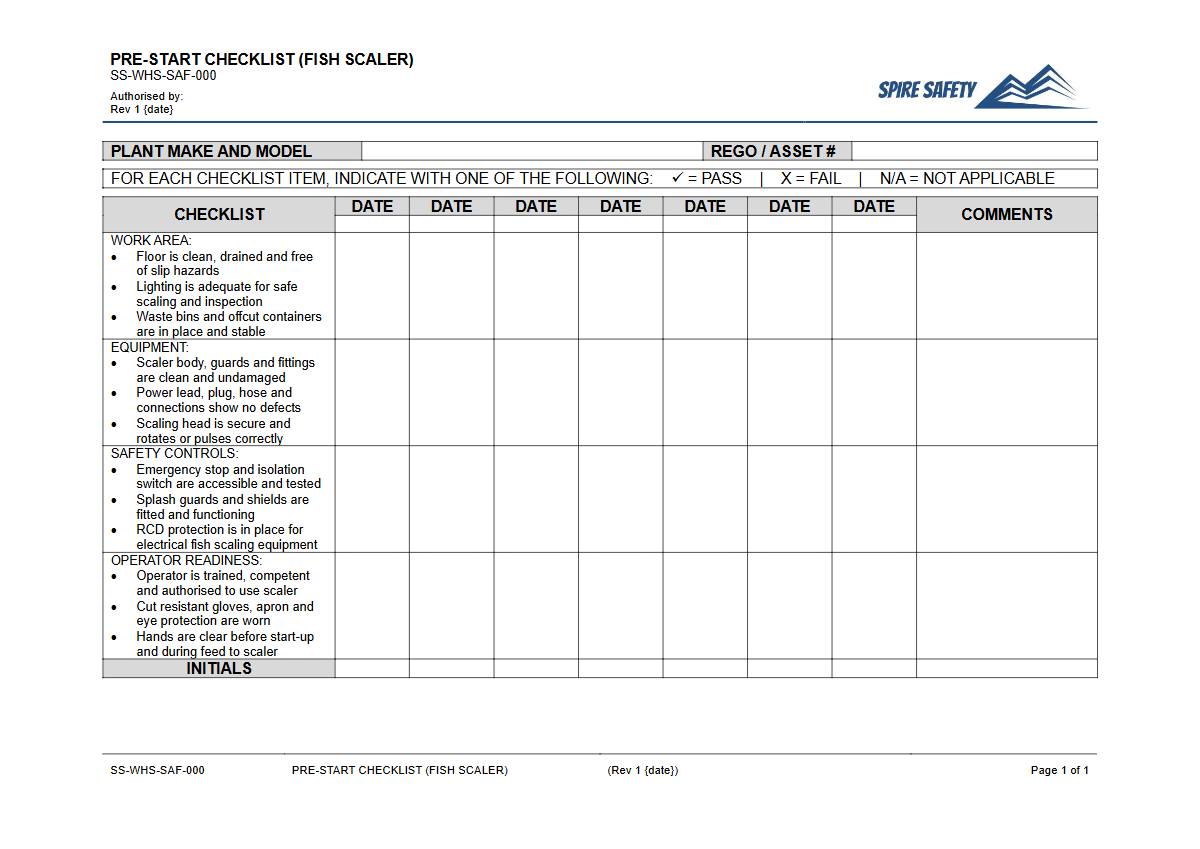
Download our free Pre-Start Checklist for fish scalers. This DOCX & PDF template helps formalise daily equipment checks. Improve your safety systems today.
Free Pre-Start Checklist (Fish Scaler) Template
DOCX • 125 KB + PDF
Updated Oct 2026
No signup required
Purpose of the Free Pre-Start Checklist (Fish Scaler) Template
This Free Pre-Start Checklist (Fish Scaler) Template provides a structured starting point for businesses to formalise their daily equipment safety inspections. Regular, documented checks are a critical part of any proactive safety program, helping to identify potential faults, damage, or wear and tear before the equipment is used.
By catching issues like frayed cords, damaged guards, or dull blades early, you can prevent serious injuries and operational downtime.
Using a standardised checklist ensures that inspections are consistent, regardless of who performs them. It embeds a safety-first mindset and helps demonstrate due diligence in managing workplace hazards associated with powered hand tools.
Integrating this practice is a key topic covered in our Pre-Start Checks and Plant Maintenance Toolbox Talk, which helps teams understand the importance of this daily routine.
Video walkthrough
How to use the Free Pre-Start Checklist (Fish Scaler) Template
Using this template effectively involves a few simple steps. First, download the document in your preferred format (DOCX for easy editing or PDF).
Second, and most importantly, review and customise the checklist to align with the specific make and model of the fish scaler used in your workplace, as well as your operational risks.
Important: This is a template, not a finished document. We cannot guarantee it covers every potential hazard for your specific equipment or work environment.
You MUST customise this checklist to ensure it is relevant and comprehensive for your business. This may involve adding or removing checkpoints based on manufacturer recommendations and a site-specific risk assessment.
Once customised, provide training to all operators on how to properly complete the checklist and what actions to take if a fault is found. A completed checklist serves as a formal record, so it must be stored as part of your overall WHS management system. This creates a valuable data trail for monitoring equipment condition and demonstrating compliance.
Example Customisations:
- Adding a check for specific blade types or attachments.
- Including checks for battery charge and condition if using a cordless model.
- Specifying the location of emergency stops or safety triggers.
- Noting the required Personal Protective Equipment (PPE) such as cut-resistant gloves and safety glasses.
The principles of customising a pre-start checklist for a specific piece of small equipment apply broadly. For instance, the checks required for a fish scaler differ from those in a coffee grinder pre-start checklist, but both require a detailed, equipment-specific approach.
When to use it
A pre-start checklist for a fish scaler should be completed before the equipment is used for the first time each day or at the beginning of each shift. This frequency ensures that any damage or issues that may have occurred overnight, during cleaning, or from previous use are identified before work begins.
It should also be completed after any maintenance or repair work to verify the equipment has been returned to a safe operational state.
Who should use it
The pre-start checklist should be completed by the trained and competent person assigned to operate the fish scaler. The operator is best positioned to notice subtle changes in the equipment's performance or condition.
Supervisors or managers should also be involved in the process by periodically reviewing completed checklists to spot recurring issues, verify the checks are being done correctly, and ensure that faulty equipment is being reported and repaired in a timely manner. Regular WHS compliance audits can help confirm that these procedures are being followed effectively across the organisation.
By implementing this simple but effective tool, you formalise a key aspect of plant safety management. While this template focuses on fish scalers, we offer many other specific templates in our free WHS resources library to help you manage risks across your entire operation.
Common mistakes
Common mistakes to avoid
- Failing to customise the template for the specific make and model of the fish scaler.
- Operators 'pencil-whipping' the checklist without physically inspecting each item.
- Not immediately removing faulty equipment from service and applying a 'Do Not Use' tag.
- Poor record-keeping, making it difficult to track recurring faults or prove due diligence.
Legal references
Legal considerations
The following legal requirements may be relevant to this type of work.
- Work Health and Safety Act (Harmonised) — Provides the primary duties for protecting workers and other people from work health and safety risks.
- Work Health and Safety Regulations (Harmonised) — Sets out requirements supporting the management of workplace hazards and risks.
The following codes may be relevant to this type of work.
- Managing WHS Risks Code of Practice — Provides practical guidance on identifying hazards, assessing risks and applying effective controls.
- Work Health and Safety Consultation, Cooperation and Coordination Code of Practice — Provides practical guidance on consulting workers and coordinating with other duty holders.
- Managing the Work Environment and Facilities Code of Practice — Provides practical guidance on safe work environments, workplace facilities and related controls.
Did you know
Ergonomic Risks
Repetitive use of powered hand tools like fish scalers can lead to musculoskeletal disorders (MSDs). Regular breaks, job rotation, and proper technique are as important as equipment safety.
Electrical Safety in Wet Areas
Portable electrical equipment used in wet environments, common in food processing, poses a heightened risk of electric shock. Using a safety switch or residual current device (RCD) is a critical control measure.
FAQ
Frequently asked questions
01What should be included in a fish scaler pre-start checklist?
02How often should a pre-start check be done on a fish scaler?
03Are pre-start checklists a legal requirement in Australia?
04Who is responsible for completing the fish scaler pre-start check?
Share this resource
Free Pre-Start Checklist (Fish Scaler) Template
Browse Categories
How To Use It
- 1Download and open in Word or PDF.
- 2Replace the placeholders with your business details.
- 3Get it reviewed by a WHS specialist before rollout.
Need it customised?
Our WHS consultants can adapt this template to your site, run a gap analysis, or audit what you already have in place.
Book a Free Consultation WHS consulting servicesor call 1300 156 382