
Free Pre-Start Checklist (Fertiliser Spread) Template
Download our free Pre-Start Checklist (Fertiliser Spread) Template. This structured DOCX & PDF resource helps formalise equipment checks. Get yours now.
Free Pre-Start Checklist (Fertiliser Spread) Template
DOCX • 125 KB + PDF
Updated Oct 2026
No signup required
Purpose of the Free Pre-Start Checklist (Fertiliser Spread) Template
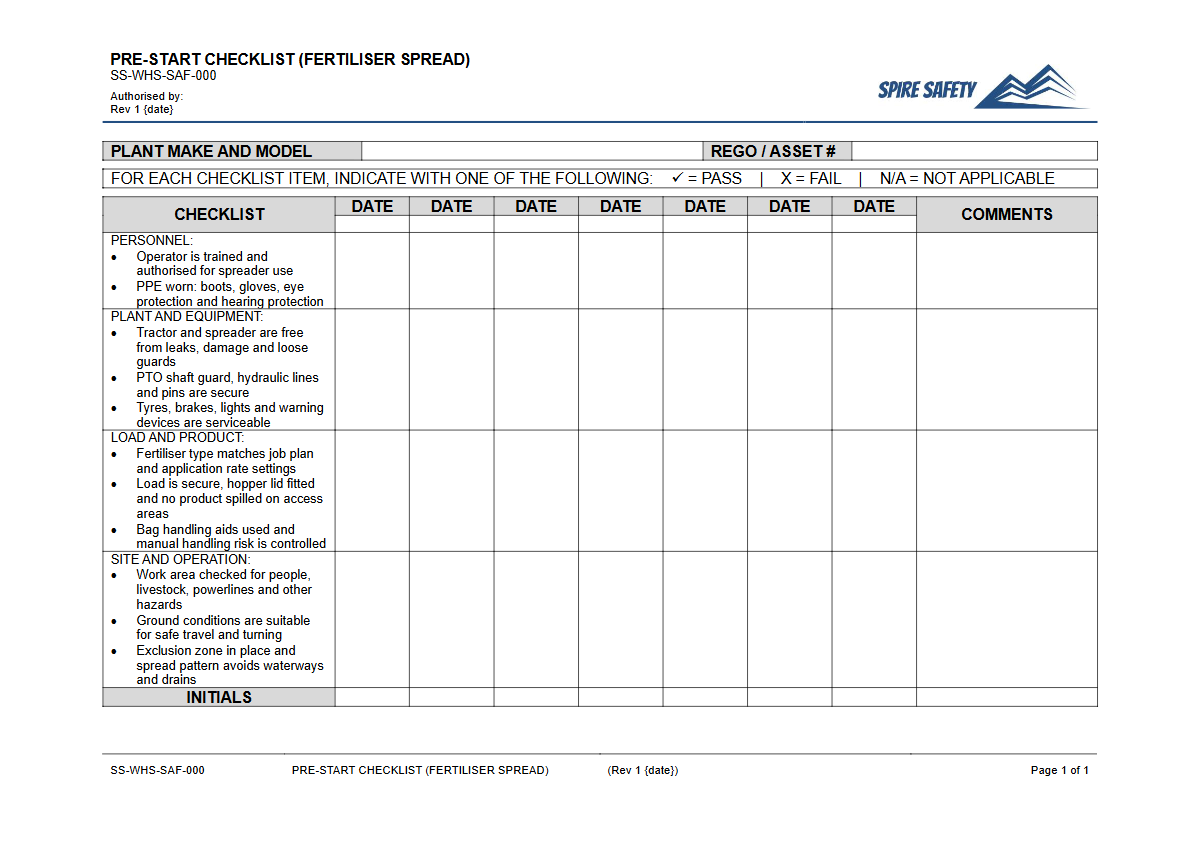
This free Pre-Start Checklist (Fertiliser Spread) Template provides a structured framework for inspecting fertiliser spreading equipment before use. Regularly conducting these checks is a critical part of any workplace health and safety (WHS) program, particularly in agricultural, horticultural, and groundskeeping settings.
The primary goal is to systematically identify any mechanical defects, damage, or missing safety features that could lead to an incident, equipment failure, or operator injury.
By formalising the inspection process, organisations can proactively manage risks associated with mobile plant and machinery. A documented check helps ensure the equipment is fit for purpose and safe to operate, supporting your duty of care obligations. You can reinforce these principles across your team with a pre-start checks and plant maintenance toolbox talk.
Video walkthrough
How to use the Free Pre-Start Checklist (Fertiliser Spread) Template
This resource is provided in both DOCX and PDF formats to suit your operational needs. The checklist is designed as a comprehensive starting point aligned with Australian WHS principles.
To implement it effectively, download the template and integrate it into your daily pre-operational procedures. It is designed to be straightforward for operators to complete at the start of their shift.
Please note: This template provides a solid foundation, but it is not a complete, out-of-the-box solution. We strongly recommend that you customise this document to address the specific makes, models, and configurations of fertiliser spreaders used in your workplace, as well as your unique operational risks and environment. This customisation is a key part of developing effective WHS management systems.
When to use this Pre-Start Checklist
A pre-start inspection should be completed before every use of the fertiliser spreader. This ensures that the equipment's condition has not changed since its last operation. Additionally, a check should be performed:
- At the beginning of each workday or shift.
- After the equipment has undergone maintenance or repairs.
- When hiring or introducing a new piece of spreading equipment to your fleet.
- If the equipment has been idle for an extended period.
Who should use this Pre-Start Checklist
This checklist is primarily intended for the operators of the fertiliser spreading equipment. They are in the best position to conduct a thorough physical inspection before they begin work. Beyond the operator, other personnel have a role:
- Supervisors and Managers: To verify that checks are being completed correctly and to ensure any reported faults are addressed promptly.
- Maintenance Personnel: To use the completed checklists as a tool for diagnosing recurring faults and scheduling preventative maintenance.
- WHS Officers: To review records as part of safety audits and incident investigations.
For organisations looking to ensure their processes are robust and effective, engaging with professional WHS consulting services can provide valuable external insight and verification.
Key Items on a Fertiliser Spreader Checklist
A thorough checklist for a fertiliser spreader should cover several critical safety and operational areas. While our template provides a detailed list, key items for inspection typically include:
- Guards and Shields: Confirm all guards, especially for the Power Take-Off (PTO) shaft and moving parts, are in place and undamaged.
- Tyres and Wheels: Check for correct inflation, excessive wear, and any visible damage.
- Hydraulics: Inspect hoses and connections for leaks, cracks, or signs of abrasion.
- Spreader Mechanism: Ensure spinners, belts, or chains are free from debris and function correctly.
- Structural Integrity: Look for cracks, bends, or significant corrosion on the frame and hopper.
- Controls and Hitches: Verify that all operator controls are functional and that towing hitches and safety chains are secure.
- Warning Devices: Check that lights, indicators, and any audible alarms are working correctly, especially for road-transportable units.
Regularly reviewing completed checklists is also a key activity during WHS compliance audits, providing evidence of your safety procedures in action.
Integrating Checklists into Your Safety System
A pre-start checklist is most effective when it is part of a broader, integrated safety management system. The information gathered should inform your maintenance schedules, risk assessments, and operator training programs. Using similar documentation for all equipment, such as a Pre-Start Checklist for Aerators, creates consistency and reinforces safe work habits across all operations. You can find many more templates like these in our library of free WHS resources to build out your safety toolkit.
Common mistakes
Common mistakes to avoid
- "Pencil-whipping" the checklist without physically inspecting each item.
- Failing to report identified defects or continuing to use unsafe equipment.
- Using a generic checklist that doesn't cover the specific hazards of the model being used.
- Not providing adequate training to operators on what to look for during the inspection.
Legal references
Legal considerations
The following legal requirements may be relevant to this type of work.
- Work Health and Safety Act (Harmonised) — Provides the primary duties for protecting workers and other people from work health and safety risks.
- Work Health and Safety Regulations (Harmonised) — Sets out requirements supporting the management of workplace hazards and risks.
The following codes may be relevant to this type of work.
- Managing WHS Risks Code of Practice — Provides practical guidance on identifying hazards, assessing risks and applying effective controls.
- Work Health and Safety Consultation, Cooperation and Coordination Code of Practice — Provides practical guidance on consulting workers and coordinating with other duty holders.
- Managing the Work Environment and Facilities Code of Practice — Provides practical guidance on safe work environments, workplace facilities and related controls.
Did you know
Mechanical Hazards
The Power Take-Off (PTO) shaft, which connects a tractor to a spreader, can rotate at speeds up to 1,000 RPM. A missing or damaged guard is a major entanglement hazard and a critical item on any checklist.
Chemical Exposure
Beyond mechanical risks, operators can face chemical exposure from fertilisers. A thorough pre-start process should also include verifying that the correct personal protective equipment (PPE) is available and in good condition.
FAQ
Frequently asked questions
01What is the purpose of a pre-start checklist for a fertiliser spreader?
02Is it a legal requirement to use a pre-start checklist in Australia?
03Can I use this template for any type of fertiliser spreader?
04Who is responsible for completing the fertiliser spreader pre-start check?
Share this resource
Free Pre-Start Checklist (Fertiliser Spread) Template
Browse Categories
How To Use It
- 1Download and open in Word or PDF.
- 2Replace the placeholders with your business details.
- 3Get it reviewed by a WHS specialist before rollout.
Need it customised?
Our WHS consultants can adapt this template to your site, run a gap analysis, or audit what you already have in place.
Book a Free Consultation WHS consulting servicesor call 1300 156 382