
Free Position Description (Crane Operator) Template
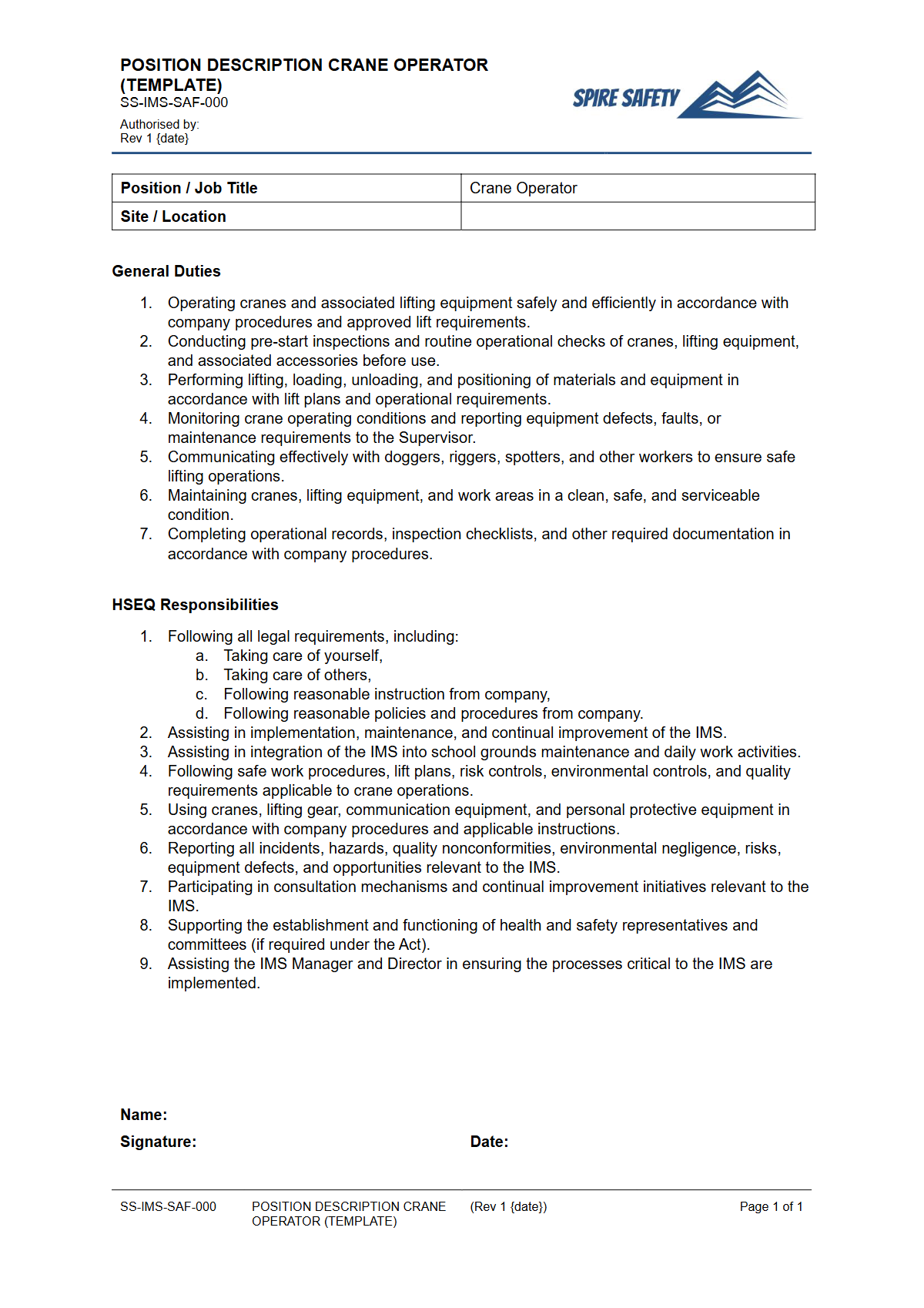
Download our free Position Description (Crane Operator) Template. This structured document helps define roles, responsibilities, and WHS duties.
Free Position Description (Crane Operator) Template
DOCX • 138 KB + PDF
Updated Oct 2026
No signup required
Purpose of the Free Position Description (Crane Operator) Template
A well-drafted Position Description is a foundational tool for managing high-risk roles effectively. This is especially true for Crane Operators, where clarity on responsibilities, qualifications, and safety obligations is critical.
Our Free Position Description (Crane Operator) Template provides a structured starting point for organisations to define the key aspects of this role, helping to attract qualified candidates and set clear performance expectations from day one.
This document is more than just a hiring tool; it's a key component in a robust safety framework. It helps formally document the required competencies and safety duties for the role, providing a clear standard for performance and demonstrating that the business has defined its safety expectations.
A strong Position Description supports the overall structure of your WHS management systems by ensuring roles and responsibilities are clearly articulated.
How to use the Free Position Description (Crane Operator) Template
To get started, simply download the template in your preferred format (DOCX for easy editing or PDF). The document is organised into key sections, including a position summary, primary duties, WHS responsibilities, required qualifications, and desired experience.
You can adapt, add, or remove sections to suit your specific operational needs.
Important: This template is a guide and must be customised for your workplace. We have designed it to be a comprehensive starting point, but every worksite has unique hazards, equipment, and procedures.
You must review and edit this document to reflect the specific types of cranes used, the environment they operate in, and your organisation's safety policies. For example, your daily inspection requirements should be detailed and align with resources like our Free Pre-Start Checklist (Crane Truck) Template to ensure consistency.
When to use a Position Description
A Position Description for a Crane Operator is a versatile document used throughout the employment lifecycle. Its primary use is during the recruitment and selection process to attract suitable candidates and as a benchmark for interviews.
Once an operator is hired, it serves as a crucial part of the onboarding process, clarifying expectations from the outset. It also provides a basis for performance reviews, training needs analysis, and, if necessary, managing performance issues.
In the event of a safety incident, a clear Position Description can also help in investigations by showing what the defined duties and expectations for the role were. The duties within it, such as daily checks, should be a consistent part of operations, similar to using a Free Pre-Start Checklist (Crawler Crane) Template before each shift.
Who should use this template
This resource is designed for any person or organisation responsible for hiring, managing, or ensuring the safety of crane operations. This includes:
- Human Resources (HR) Managers
- Recruitment Consultants
- WHS and Safety Managers
- Project Managers and Site Supervisors
- Business Owners in construction, logistics, manufacturing, and mining
It provides a professional, structured format that helps ensure all key aspects of the role are considered and documented correctly.
Beyond the Template: Ensuring Operator Competence
A Position Description sets the standard, but competence must be verified. Beyond holding the correct High Risk Work Licence, a business must ensure operators are competent on the specific make and model of crane they will be using on site.
This process of confirming skills and knowledge for site-specific equipment is often formalised through a Verification of Competency (VOC). While this PD defines the role, a VOC confirms the operator's practical ability.
You can see how this process works by reviewing our Verification of Competency (Bulldozer) Template, which follows a similar assessment principle.
By pairing a clear Position Description with rigorous competency assessments and consistent daily safety rituals, such as using a Free Pre-Start Checklist (Jib Crane) Template for smaller fixed cranes, your organisation builds a powerful system for managing high-risk work safely. Explore our entire free WHS resources library for more tools to support your safety management system.
Common mistakes
Common mistakes to avoid
- Using a generic PD without customising it for the specific crane type and workplace risks.
- Failing to clearly list the mandatory High Risk Work Licence (HRWL) class required for the job.
- Neglecting to include specific WHS duties, such as conducting pre-start checks or following lift plans.
- Treating the Position Description as a one-off document instead of reviewing it periodically or after an incident.
Legal references
Legal considerations
The following legal requirements may be relevant to this type of work.
- Work Health and Safety Act (Harmonised) — Provides the primary duties for protecting workers and other people from work health and safety risks.
- Work Health and Safety Regulations (Harmonised) — Sets out requirements supporting the management of workplace hazards and risks.
The following codes may be relevant to this type of work.
- Managing WHS Risks Code of Practice — Provides practical guidance on identifying hazards, assessing risks and applying effective controls.
- Work Health and Safety Consultation, Cooperation and Coordination Code of Practice — Provides practical guidance on consulting workers and coordinating with other duty holders.
- Managing the Work Environment and Facilities Code of Practice — Provides practical guidance on safe work environments, workplace facilities and related controls.
Did you know
High-Risk Work
Operating most types of cranes is classified as 'high-risk work' in Australia, requiring a specific High Risk Work Licence (HRWL) issued by a state or territory WHS regulator.
Lift Planning
For complex or critical lifts, a detailed lift plan is often a legal requirement. This plan is a critical safety document that the crane operator must understand and follow precisely to ensure a safe operation.
FAQ
Frequently asked questions
01Does a crane operator need a special licence in Australia?
02What should be included in a crane operator's WHS responsibilities?
03Can I use this template for any type of crane operator?
04How does a Position Description help with WHS compliance?
Share this resource
Free Position Description (Crane Operator) Template
Browse Categories
How To Use It
- 1Download and open in Word or PDF.
- 2Replace the placeholders with your business details.
- 3Get it reviewed by a WHS specialist before rollout.
Need it customised?
Our WHS consultants can adapt this template to your site, run a gap analysis, or audit what you already have in place.
Book a Free Consultation WHS consulting servicesor call 1300 156 382
Related templates
- Free Position Description (Earthmoving Plant Operator) Template
- Free Position Description (Electrician) Template
- Free Position Description (Emergency Warden) Template
- Free Position Description (Environmental Officer) Template
- Free Position Description (Estimator) Template
- Free Position Description (EWP Operator) Template