
Free Position Description (Estimator) Template
Download our free Position Description (Estimator) Template.
Free Position Description (Estimator) Template
DOCX • 135 KB + PDF
Updated Oct 2026
No signup required
Purpose of the Free Position Description (Estimator) Template
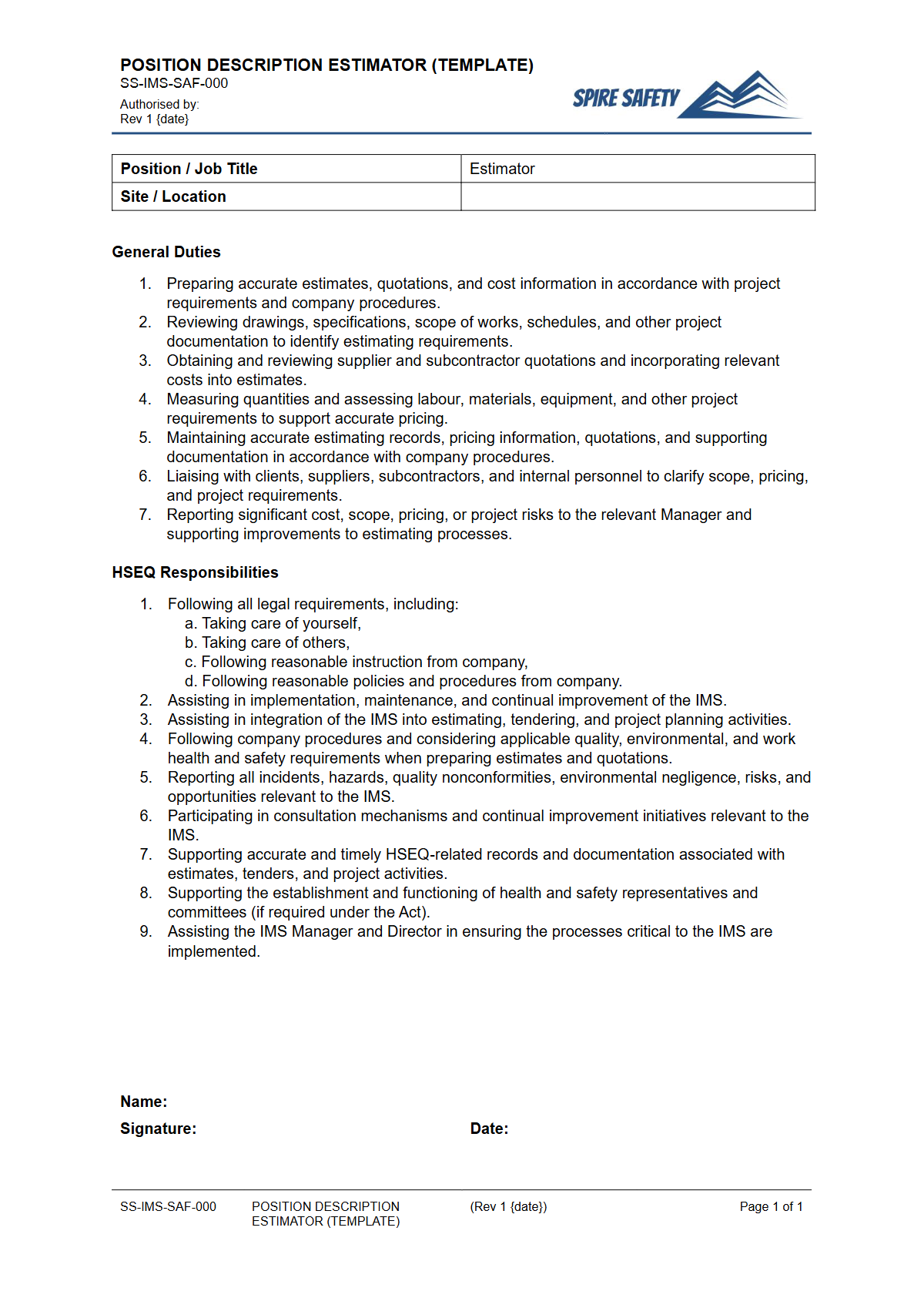
A well-drafted position description is a foundational tool for effective human resources and safety management. This Free Position Description (Estimator) Template provides a structured framework for defining the scope, responsibilities, and safety obligations for estimators in your organisation.
It clarifies expectations for both the employee and management, ensuring that critical project and safety functions are clearly allocated from the outset. By establishing clear duties, this document supports effective recruitment, simplifies performance management, and helps integrate safety considerations into the earliest stages of a project lifecycle.
Using a standardised template ensures consistency across your organisation and forms a critical component of your overall safety framework. A clear position description demonstrates a commitment to due diligence and helps embed safety into your company culture.
It serves as an administrative control that supports the successful implementation of your broader WHS management systems by defining who is responsible for specific safety-related tasks.
How to use the Free Position Description (Estimator) Template
This template is designed for ease of use and customisation. Simply download the DOCX file to edit the document directly, or use the PDF as a reference.
The document is structured to cover all key areas of an estimator's role, from primary purpose and key accountabilities to qualifications and specific Work Health and Safety (WHS) responsibilities. When using our Free Position Description (Estimator) Template, ensure you tailor each section to align with the unique operational environment and specific demands of your business.
Important: This template provides a structured starting point based on Australian WHS principles, but it is not a substitute for professional advice. We strongly recommend you customise it to reflect the specific requirements, hazards, and operational context of your workplace.
Key details such as reporting lines, specific software competencies, and project types must be added to make the document truly effective for your organisation.
When to use it
A detailed position description for an estimator is a versatile document that should be used at multiple points in the employment lifecycle. Its primary use is during the recruitment and selection process to attract suitable candidates and provide them with a clear understanding of the role.
It is also an essential tool for onboarding new employees, serving as a guide during their induction and training. Furthermore, it should be referenced during performance reviews to set clear objectives and evaluate performance against defined responsibilities.
The document is also valuable during organisational restructures or when clarifying roles to prevent gaps or overlaps in responsibility.
Who should use it
This template is designed for a range of personnel involved in hiring, managing, and overseeing staff within an organisation. Key users include:
- Hiring Managers and Department Heads: To define the requirements of the role and ensure they attract candidates with the right skills and experience.
- Human Resources (HR) Professionals: To standardise the recruitment process, ensure fairness, and maintain consistent documentation across the business.
- WHS Managers and Advisors: To ensure that WHS responsibilities are clearly defined, allocated, and communicated to individuals in key project-influencing roles. For expert assistance in defining these safety-specific duties, consider engaging professional WHS consulting services.
- Small Business Owners: For smaller companies without a dedicated HR department, this template provides a professional and structured way to manage recruitment and role definition.
Integrating WHS into the Estimator Role
An estimator's role is critical for influencing project safety from the pre-construction phase. Their calculations directly impact the budget and resources allocated for safety measures, such as the cost of compliant materials, adequate site facilities, high-risk work licenses, and specific safety personnel.
A position description that explicitly outlines these WHS duties ensures the estimator understands their part in mitigating risks before work even begins. This includes responsibilities like identifying potential hazards during the tender process and allowing for the costs of necessary safety controls in their bids.
Formalising these duties makes them a measurable part of job performance.
This document can later serve as a reference point during safety reviews and audits. It provides a clear benchmark against which an employee's adherence to their stated WHS responsibilities can be assessed, contributing to the continuous improvement cycle that underpins effective safety management.
Regular reviews of role-based safety performance are a key activity within formal WHS compliance auditing programs.
For organisations aiming for the highest standards of occupational health and safety, integrating role-specific responsibilities aligns with frameworks like AS/NZS ISO 45001. A clear position description is a practical tool that supports the 'Leadership and worker participation' clause by defining roles and responsibilities throughout the organisation.
If your business is pursuing certification, our ISO 45001 consulting team can provide guidance on embedding these principles into your documentation.
By clearly defining every role, you strengthen your safety culture and operational efficiency. Feel free to browse our complete free WHS resources library for more templates and tools to support your business.
Common mistakes
Common mistakes to avoid
- Using a generic template without customising it to the specific industry, project types, and workplace hazards.
- Failing to clearly articulate and assign specific WHS responsibilities, leaving them vague or implied.
- Forgetting to include key behavioural competencies like attention to detail, communication, and analytical skills.
- Not regularly reviewing and updating the position description to reflect changes in the role, technology, or legislation.
Legal references
Legal considerations
The following legal requirements may be relevant to this type of work.
- Work Health and Safety Act (Harmonised) — Provides the primary duties for protecting workers and other people from work health and safety risks.
- Work Health and Safety Regulations (Harmonised) — Sets out requirements supporting the management of workplace hazards and risks.
The following codes may be relevant to this type of work.
- Managing WHS Risks Code of Practice — Provides practical guidance on identifying hazards, assessing risks and applying effective controls.
- Work Health and Safety Consultation, Cooperation and Coordination Code of Practice — Provides practical guidance on consulting workers and coordinating with other duty holders.
- Managing the Work Environment and Facilities Code of Practice — Provides practical guidance on safe work environments, workplace facilities and related controls.
Did you know
Proactive Safety
Studies show that the majority of a project's lifecycle costs, including those for safety and risk mitigation, are determined during the initial design and planning phases. An estimator's work is therefore one of the earliest and most critical inputs for a safe project outcome.
FAQ
Frequently asked questions
01What are the key WHS responsibilities for an Estimator?
02Why is a formal position description important for an Estimator role?
03Can this template be used for a Senior Estimator role?
04How does an Estimator's role impact a company's safety performance?
Share this resource
Free Position Description (Estimator) Template
Browse Categories
How To Use It
- 1Download and open in Word or PDF.
- 2Replace the placeholders with your business details.
- 3Get it reviewed by a WHS specialist before rollout.
Need it customised?
Our WHS consultants can adapt this template to your site, run a gap analysis, or audit what you already have in place.
Book a Free Consultation WHS consulting servicesor call 1300 156 382
Related templates
- Free Position Description (EWP Operator) Template
- Free Position Description (Excavator Operator) Template
- Free Position Description (Farm Manager) Template
- Free Position Description (First Aid Officer) Template
- Free Position Description (Fleet Manager) Template
- Free Position Description (Foreperson) Template