
Free Position Description (Excavator Operator) Template
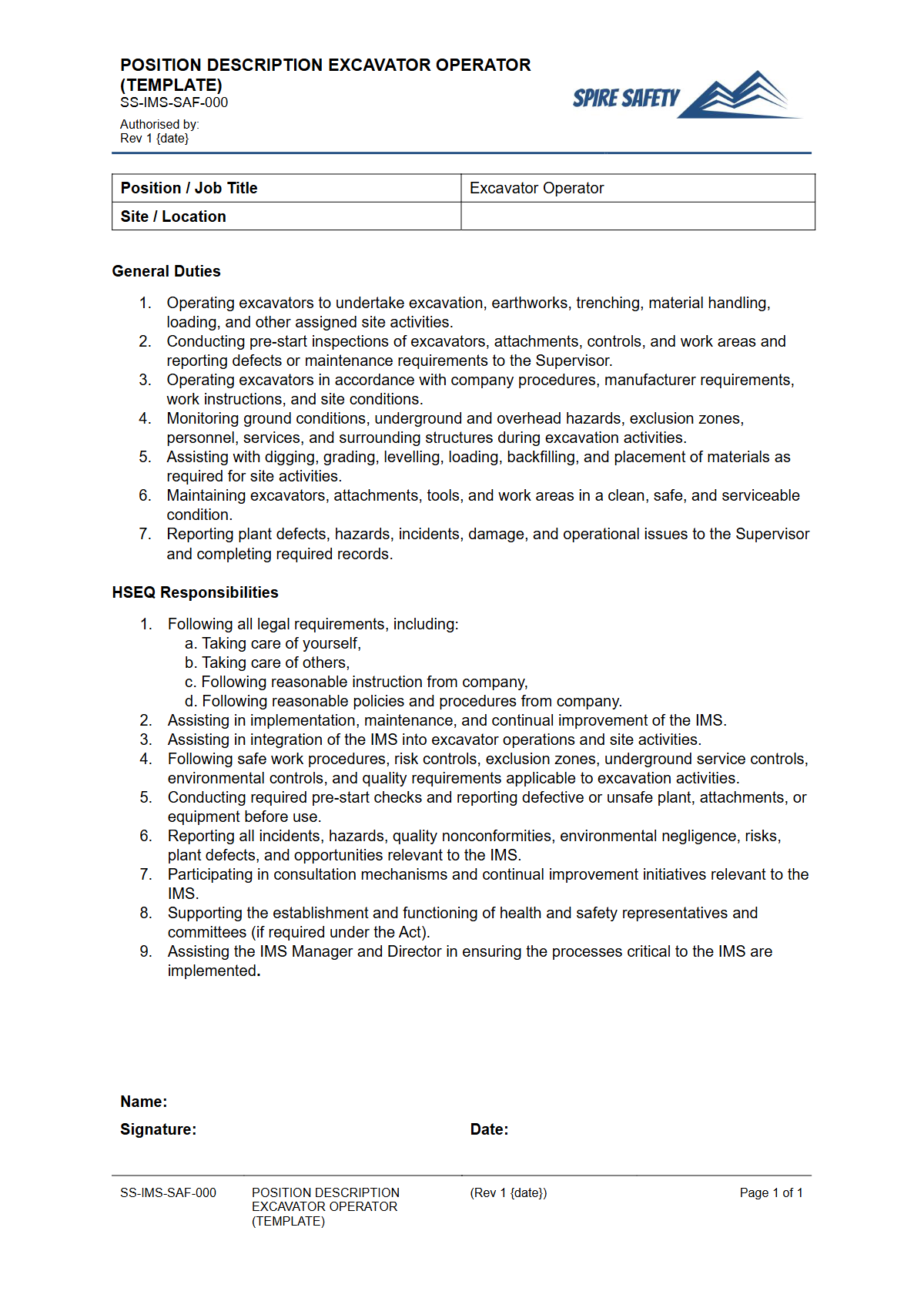
Download our free Position Description (Excavator Operator) Template. This DOCX & PDF resource helps define key roles, responsibilities, and WHS duties.
Free Position Description (Excavator Operator) Template
DOCX • 136 KB + PDF
Updated Oct 2026
No signup required
Purpose of the Free Position Description (Excavator Operator) Template
Defining the role of an excavator operator is critical for safety and operational efficiency on any Australian worksite. This high-risk role demands clarity around duties, qualifications, and safety obligations.
Our Free Position Description (Excavator Operator) Template provides a structured starting point for organisations to clearly articulate these requirements. Using a well-drafted Position Description ensures that both the employer and employee understand the expectations, from operational tasks to key WHS accountabilities. It formalises the competencies required for the role, which can be formally assessed using tools like our free Excavator VOC (Verification of Competency) Template.
A detailed Position Description serves as a foundational document within your safety framework. It helps in the risk management process by ensuring that only individuals with the specified skills and qualifications are assigned to operate machinery.
This document can also be a key piece of evidence in demonstrating due diligence during a WHS compliance audit, showing that your organisation has a systematic process for defining roles and responsibilities.
How to use the Free Position Description (Excavator Operator) Template
This resource is available as a DOCX file for easy editing and a PDF for quick reference. The template is designed to be comprehensive but must be tailored to your specific operational context.
It includes sections covering the primary purpose of the role, key responsibilities, qualifications, experience, and specific WHS duties, such as conducting pre-start checks and adhering to safe work procedures.
Important: This template is a guide only. It is crucial that you customise this document to align with your specific machinery, site conditions, projects, and organisational structure.
We are not lawyers, and this does not constitute legal advice; the PD must be integrated into your company's broader WHS management systems to be effective.
When to use a Position Description
A Position Description for an excavator operator is a versatile document used throughout the employment lifecycle. Its primary use is during the recruitment and hiring process to attract suitable candidates and provide a clear basis for interviews.
It is also an essential tool for onboarding new operators, ensuring they understand their role from day one. Beyond hiring, it should be used for performance reviews, identifying training needs, and defining career progression pathways. In the unfortunate event of a workplace incident, a clear PD helps investigators understand the defined roles and responsibilities, which was a factor in a recent case where an excavator incident led to a $450,000 fine.
Who should use this document
This template is designed for use by anyone involved in the management of human resources and workplace safety in the construction, civil, and mining industries. This typically includes:
- Human Resources (HR) Managers
- WHS Advisors and Officers
- Construction and Site Managers
- Project Managers
- Business Owners and Directors
It helps these stakeholders establish clear, consistent, and documented expectations for plant operators. For organisations with a diverse fleet of earthmoving equipment, the principles in this template can be adapted for other roles, though specific competency documents like our Verification of Competency (Bulldozer) Template will also be necessary.
For complex sites or operations, engaging with WHS consulting services can help ensure your role descriptions are robust and fit for purpose. You can find many more helpful documents in our free WHS resources library to support your safety management activities.
Common mistakes
Common mistakes to avoid
- Using a generic template without customising it for specific machine models, attachments, and site hazards.
- Failing to clearly list specific WHS duties, such as conducting pre-start checks, adhering to exclusion zones, and reporting defects.
- Not regularly reviewing and updating the PD as roles, machinery, or work practices evolve.
- Treating the document as a one-time hiring tool instead of an active part of performance management and competency verification.
Legal references
Legal considerations
The following legal requirements may be relevant to this type of work.
- Work Health and Safety Act (Harmonised) — Provides the primary duties for protecting workers and other people from work health and safety risks.
- Work Health and Safety Regulations (Harmonised) — Sets out requirements supporting the management of workplace hazards and risks.
The following codes may be relevant to this type of work.
- Managing WHS Risks Code of Practice — Provides practical guidance on identifying hazards, assessing risks and applying effective controls.
- Work Health and Safety Consultation, Cooperation and Coordination Code of Practice — Provides practical guidance on consulting workers and coordinating with other duty holders.
- Managing the Work Environment and Facilities Code of Practice — Provides practical guidance on safe work environments, workplace facilities and related controls.
Did you know
High-Risk Work Licence
In Australia, operating an excavator is considered high-risk work. A specific licence (Class LE) is required for excavators capable of swinging a boom 360 degrees with a lifting capacity of 3 tonnes or more.
Operator Blind Spots
Excavators have large blind spots, especially to the rear and right-hand side of the cabin. Many serious incidents occur when ground workers enter these blind spots undetected by the operator.
FAQ
Frequently asked questions
01What qualifications does an excavator operator need in Australia?
02Is a Position Description a legal requirement for an excavator operator?
03How does a Position Description differ from a Safe Work Method Statement (SWMS)?
04Can I use this template for other plant operators?
Share this resource
Free Position Description (Excavator Operator) Template
Browse Categories
How To Use It
- 1Download and open in Word or PDF.
- 2Replace the placeholders with your business details.
- 3Get it reviewed by a WHS specialist before rollout.
Need it customised?
Our WHS consultants can adapt this template to your site, run a gap analysis, or audit what you already have in place.
Book a Free Consultation WHS consulting servicesor call 1300 156 382
Related templates
- Free Position Description (Farm Manager) Template
- Free Position Description (First Aid Officer) Template
- Free Position Description (Fleet Manager) Template
- Free Position Description (Foreperson) Template
- Free Position Description (Forestry Worker) Template
- Free Position Description (Forklift Operator) Template