
Free Position Description (EWP Operator) Template
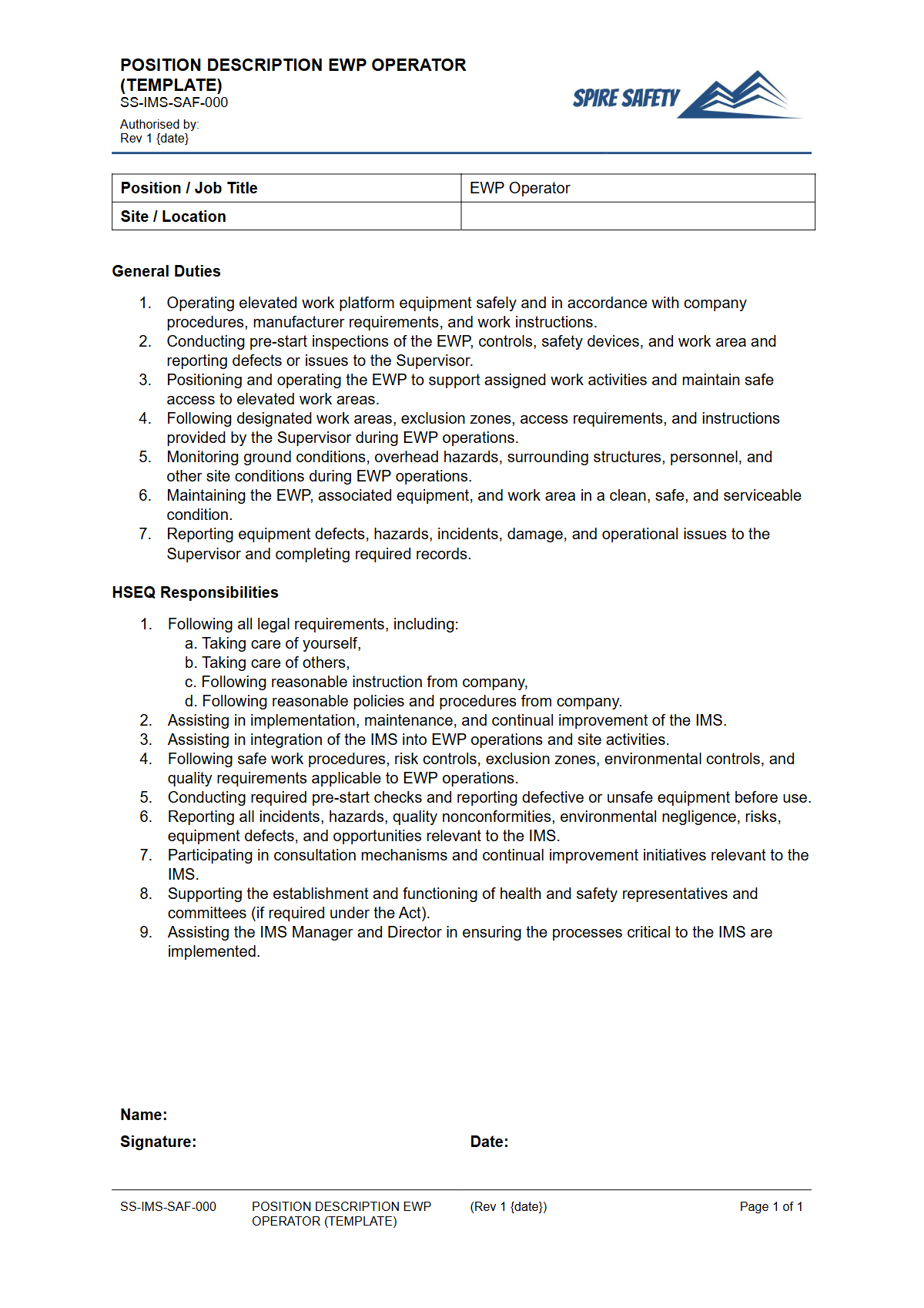
Clearly define the roles and responsibilities of an Elevating Work Platform operator. Download our free Position Description (EWP Operator) template.
Free Position Description (EWP Operator) Template
DOCX • 136 KB + PDF
Updated Oct 2026
No signup required
Purpose of the Free Position Description (EWP Operator) Template
Defining roles and responsibilities is a cornerstone of a safe and efficient workplace. This is especially true for high-risk activities like operating an Elevating Work Platform (EWP).
Our free Position Description (EWP Operator) template provides a structured starting point for organisations to clearly outline the duties, qualifications, and safety expectations for this critical role. A well-drafted Position Description (PD) helps ensure that operators understand their obligations, from conducting pre-start checks to following safe work procedures, minimising risks associated with working at height.
Using a detailed PD helps integrate safety into your operational fabric. It establishes clear performance standards and accountabilities, which are vital for managing high-risk work.
Beyond just hiring, this document serves as a reference for training, performance management, and competency assessments. Similar to how a Verification of Competency (Rough Terrain Forklift) confirms practical skill, a PD defines the foundational role that skill is built upon, ensuring every operator knows what is expected of them before they even turn a key.
What is included in the template?
This Position Description template is a comprehensive DOCX document that you can adapt for your business. It covers key areas including:
- Position summary and objectives
- Key responsibilities and duties (operational, safety, and maintenance)
- Essential qualifications, including High Risk Work Licence (HRWL) requirements
- Skills, knowledge, and experience
- Key performance indicators (KPIs)
- Reporting relationships
How to use the Free Position Description (EWP Operator) Template
To get started, simply download the template in your preferred format (DOCX for easy editing or PDF for reference). The document is designed to be a flexible framework, not a final, off-the-shelf solution.
You must review and customise it to reflect the specific hazards, equipment, and operational context of your workplace. This includes adding details about the types of EWPs used (e.g., scissor lifts, boom lifts), site-specific rules, and any unique environmental conditions.
Important: This is a template that provides a strong foundation. We strongly recommend that you customise it to align with your specific machinery, site procedures, and existing safety management system.
If you require assistance tailoring documents or developing your safety framework, our expert WHS consulting team can provide tailored support to ensure your documentation is robust and practical for your business needs.
When to use it
A formal Position Description for an EWP Operator should be used throughout the employment lifecycle. It is an essential tool during the recruitment and selection process to attract qualified candidates and set clear expectations from the outset.
Once an employee is onboarded, the PD serves as a guide for induction and training, and as a benchmark for ongoing performance reviews and identifying further training needs.
It also plays a crucial role in incident investigations. Should an incident occur, the PD helps to review whether the operator was acting within their defined scope of responsibilities and had the required training and authority.
For organisations managing a diverse range of plant, having distinct PDs for each role is critical, just as you would use a specific Verification of Competency (Bulldozer) Template for dozer operators.
Who should use it
This template is designed for use by anyone involved in managing personnel and workplace safety. This typically includes:
- Human Resources (HR) Managers: For creating consistent and clear job advertisements, contracts, and performance management frameworks.
- WHS/HSE Managers and Advisors: To ensure safety responsibilities and competency requirements are formally documented and integrated into employee roles.
- Operations and Site Managers: To clarify operational duties, supervise workers effectively, and ensure tasks are assigned to competent individuals.
- Business Owners and Directors: To establish a clear organisational structure and demonstrate due diligence in managing high-risk work.
Ultimately, this PD forms a critical part of your overall WHS management systems, helping to formalise roles and ensure that safety is a shared responsibility, understood by everyone from the ground up. It helps bridge the gap between policy and practice.
Beyond the initial PD, ongoing safety diligence requires regular checks and balances. Using a position description in conjunction with practical assessments ensures a holistic approach to competency.
For related roles involving mobile equipment, a document like a Verification of Competency (Walkie Stacker) can be used to confirm hands-on skills, complementing the responsibilities outlined in the PD.
The effectiveness of your safety documentation, including this PD, should be reviewed periodically. Regular reviews as part of your internal processes or through formal WHS compliance auditing ensure your systems remain effective and aligned with current standards and operational realities. You can find more templates and tools to support your safety processes in our free WHS resources library.
Common mistakes
Common mistakes to avoid
- Using a generic PD without adding site-specific procedures and EWP-specific details.
- Failing to clearly specify the High Risk Work Licence (WP class) requirement for boom-type EWPs over 11m.
- Neglecting to include responsibilities for daily pre-start checks and fault reporting.
- Not using the Position Description as a tool for ongoing performance reviews and identifying training needs.
Legal references
Legal considerations
The following legal requirements may be relevant to this type of work.
- Work Health and Safety Act (Harmonised) — Provides the primary duties for protecting workers and other people from work health and safety risks.
- Work Health and Safety Regulations (Harmonised) — Sets out requirements supporting the management of workplace hazards and risks.
The following codes may be relevant to this type of work.
- Managing WHS Risks Code of Practice — Provides practical guidance on identifying hazards, assessing risks and applying effective controls.
- Work Health and Safety Consultation, Cooperation and Coordination Code of Practice — Provides practical guidance on consulting workers and coordinating with other duty holders.
- Managing the Work Environment and Facilities Code of Practice — Provides practical guidance on safe work environments, workplace facilities and related controls.
Did you know
EWP Categories
Elevating Work Platforms are broadly categorised into scissor lifts (which move vertically) and boom lifts (which have telescopic or articulated arms for outreach). The High Risk Work Licence only applies to boom-type EWPs with a reach of 11 metres or more.
Fall Risks
According to Safe Work Australia, falls from height are a leading cause of workplace fatalities and serious injuries. Proper EWP operator training and clear role definition are critical controls for preventing these incidents.
FAQ
Frequently asked questions
01What is an EWP operator's main responsibility?
02Is a specific licence required to operate an EWP in Australia?
03How does a Position Description improve safety for EWP operations?
04Can I use this template for all types of EWPs?
Share this resource
Free Position Description (EWP Operator) Template
Browse Categories
How To Use It
- 1Download and open in Word or PDF.
- 2Replace the placeholders with your business details.
- 3Get it reviewed by a WHS specialist before rollout.
Need it customised?
Our WHS consultants can adapt this template to your site, run a gap analysis, or audit what you already have in place.
Book a Free Consultation WHS consulting servicesor call 1300 156 382
Related templates
- Free Position Description (Excavator Operator) Template
- Free Position Description (Farm Manager) Template
- Free Position Description (First Aid Officer) Template
- Free Position Description (Fleet Manager) Template
- Free Position Description (Foreperson) Template
- Free Position Description (Forestry Worker) Template