
Free Position Description (Earthmoving Plant Operator) Template
Clearly define roles, responsibilities, and qualifications for your team with our free Position Description (Earthmoving Plant Operator) template.
Free Position Description (Earthmoving Plant Operator) Template
DOCX • 136 KB + PDF
Updated Oct 2026
No signup required
Purpose of the Free Position Description (Earthmoving Plant Operator) Template
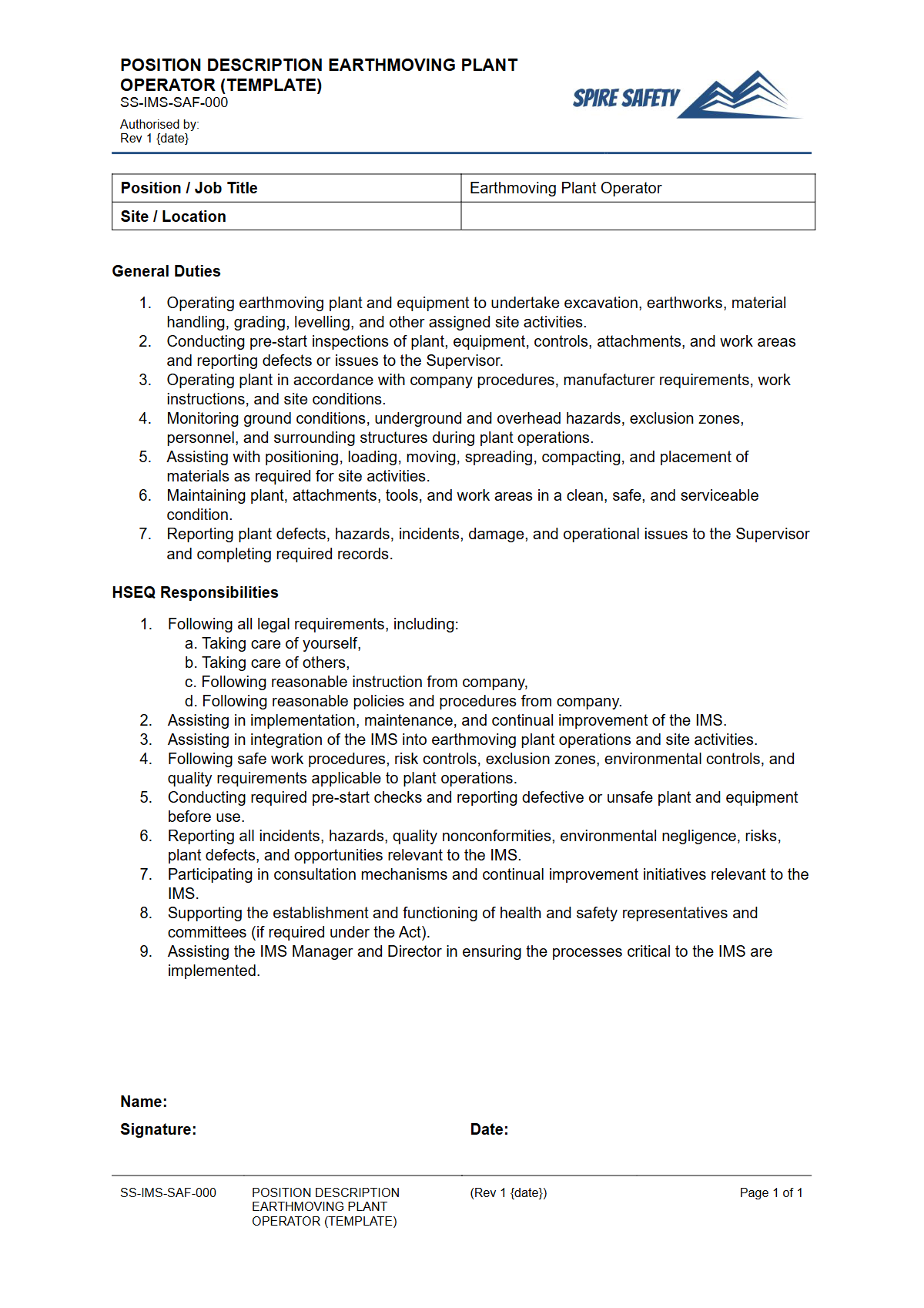
A well-crafted position description is fundamental for ensuring clarity and safety in high-risk roles. Our Free Position Description (Earthmoving Plant Operator) Template provides a comprehensive framework for detailing the responsibilities, qualifications, and safety obligations for operators of machinery like excavators, loaders, dozers, and graders.
By clearly defining expectations from the outset, you improve recruitment outcomes, streamline performance management, and strengthen your overall safety culture. This document serves as a structured starting point, designed to be adapted to the specific plant and operational context of your worksite.
It helps you meet your duty of care by ensuring every operator understands the full scope of their role, including critical safety functions, reporting lines, and required competencies.
How to use the Free Position Description (Earthmoving Plant Operator) Template
Download the template in either DOCX for easy editing or PDF for straightforward distribution. The key to its effectiveness is customisation.
Please note: This is a template only. We have provided a solid foundation, but you must review and edit every section to accurately reflect the specific machinery, tasks, site conditions, and legal obligations of your organisation. For example, the responsibilities section should align with the hazards identified in your plant-specific risk assessments. If your operators use loaders, reviewing and adapting our free Front End Loader Risk Assessment Template can help inform the specific duties you list.
Ensure all required High Risk Work Licences, competencies, and site-specific procedures are included and accurately described to create a role-specific and useful document.
Key Components of the Position Description
This template is structured to cover all essential aspects of an Earthmoving Plant Operator's role. Key sections include:
- Position Summary: A high-level overview of the role’s primary purpose and its contribution to the team and project goals.
- Key Responsibilities: Details the core operational duties, such as operating specific plant, conducting routine checks, and adhering to project plans. This includes tasks like daily inspections, which can be formalised using a free Pre-Start Checklist (Bucket Attachment) Template to ensure equipment is fit for purpose before operation.
- WHS Responsibilities: Outlines the safety-critical functions, including participating in risk assessments, reporting hazards and incidents, using personal protective equipment (PPE), and following all established safety procedures and policies.
- Qualifications and Experience: Specifies the mandatory and desired qualifications. This includes relevant High Risk Work Licences, industry experience (e.g., civil construction, mining), and any necessary Verifications of Competency (VOCs).
- Key Relationships: Defines the reporting lines and key internal and external stakeholders the operator will interact with, such as Site Supervisors, other operators, and maintenance personnel.
Integrating the PD into Your Safety System
A position description is not a standalone document; it is a vital component of integrated WHS management systems. It connects human resources processes like recruitment and onboarding directly to operational safety requirements. The document should be a living tool, referenced during toolbox talks, safety training sessions, and performance reviews.
Regular reviews of the PD, perhaps as part of your WHS compliance auditing schedule, ensure it remains current with changing legislation, technology, site conditions, and company procedures. An up-to-date PD demonstrates a proactive approach to defining and managing safety-critical roles within your organisation.
When to Use This Position Description
This template is designed for use throughout the employment lifecycle. Its primary application is during the recruitment and selection process to attract suitable candidates and provide them with a clear understanding of the role.
It is also an essential onboarding tool for new hires. Furthermore, it serves as a benchmark for ongoing performance management and the identification of training gaps.
If an operator requires competency verification on new or different equipment, the PD helps define the scope of that assessment, which can be formally recorded using a specific tool like a Verification of Competency (Water Cart) template. It also provides a valuable reference point during incident investigations to review whether roles and responsibilities were clearly understood.
Who Should Use This Position Description
This template is designed for Human Resources Managers, WHS Advisors, Site Supervisors, and Operations Managers within the construction, mining, agriculture, and civil infrastructure sectors. Essentially, anyone responsible for hiring, managing, or ensuring the competency of earthmoving plant operators will find it valuable. Beyond formal licenses, demonstrating ongoing skill is critical, and this PD helps set the standard for what needs to be assessed. You can formalise this assessment process using a resource like our Verification of Competency (Mini Excavator) Template. Using a standardised PD format across the business provides consistency and clarity for all team members. For more tools to support your safety framework, browse our complete free WHS resources library.
Common mistakes
Common mistakes to avoid
- Using a generic PD without customising it for specific plant, attachments, and site conditions.
- Focusing only on operational tasks and neglecting to clearly define WHS responsibilities like hazard reporting.
- Failing to review and update the PD after an incident or when new equipment or procedures are introduced.
- Treating the PD as a 'set and forget' document instead of using it for performance management and training analysis.
Legal references
Legal considerations
The following legal requirements may be relevant to this type of work.
- Work Health and Safety Act (Harmonised) — Provides the primary duties for protecting workers and other people from work health and safety risks.
- Work Health and Safety Regulations (Harmonised) — Sets out requirements supporting the management of workplace hazards and risks.
The following codes may be relevant to this type of work.
- Managing WHS Risks Code of Practice — Provides practical guidance on identifying hazards, assessing risks and applying effective controls.
- Work Health and Safety Consultation, Cooperation and Coordination Code of Practice — Provides practical guidance on consulting workers and coordinating with other duty holders.
- Managing the Work Environment and Facilities Code of Practice — Provides practical guidance on safe work environments, workplace facilities and related controls.
Did you know
A Leading Cause of Incidents
According to Safe Work Australia, incidents involving vehicles, including mobile plant, are consistently one of the leading causes of workplace fatalities and serious injuries in the country.
Technology in the Cabin
Modern earthmoving equipment often incorporates advanced technologies like GPS, telematics, and semi-autonomous functions, evolving the skill set required for operators beyond just manual control and machine feel.
FAQ
Frequently asked questions
01What qualifications are essential for an Earthmoving Plant Operator in Australia?
02How often should a Position Description be reviewed?
03Can this template be used for any type of earthmoving plant?
04What is the difference between a Position Description and a Safe Work Method Statement (SWMS)?
Share this resource
Free Position Description (Earthmoving Plant Operator) Template
Browse Categories
How To Use It
- 1Download and open in Word or PDF.
- 2Replace the placeholders with your business details.
- 3Get it reviewed by a WHS specialist before rollout.
Need it customised?
Our WHS consultants can adapt this template to your site, run a gap analysis, or audit what you already have in place.
Book a Free Consultation WHS consulting servicesor call 1300 156 382
Related templates
- Free Position Description (Electrician) Template
- Free Position Description (Emergency Warden) Template
- Free Position Description (Environmental Officer) Template
- Free Position Description (Estimator) Template
- Free Position Description (EWP Operator) Template
- Free Position Description (Excavator Operator) Template