
Free Position Description (Childcare Worker) Template
Download our Free Position Description (Childcare Worker) Template. This structured starting point helps you define roles, responsibilities, and safety duties.
Free Position Description (Childcare Worker) Template
DOCX • 137 KB + PDF
Updated Oct 2026
No signup required
Purpose of the Free Position Description (Childcare Worker) Template
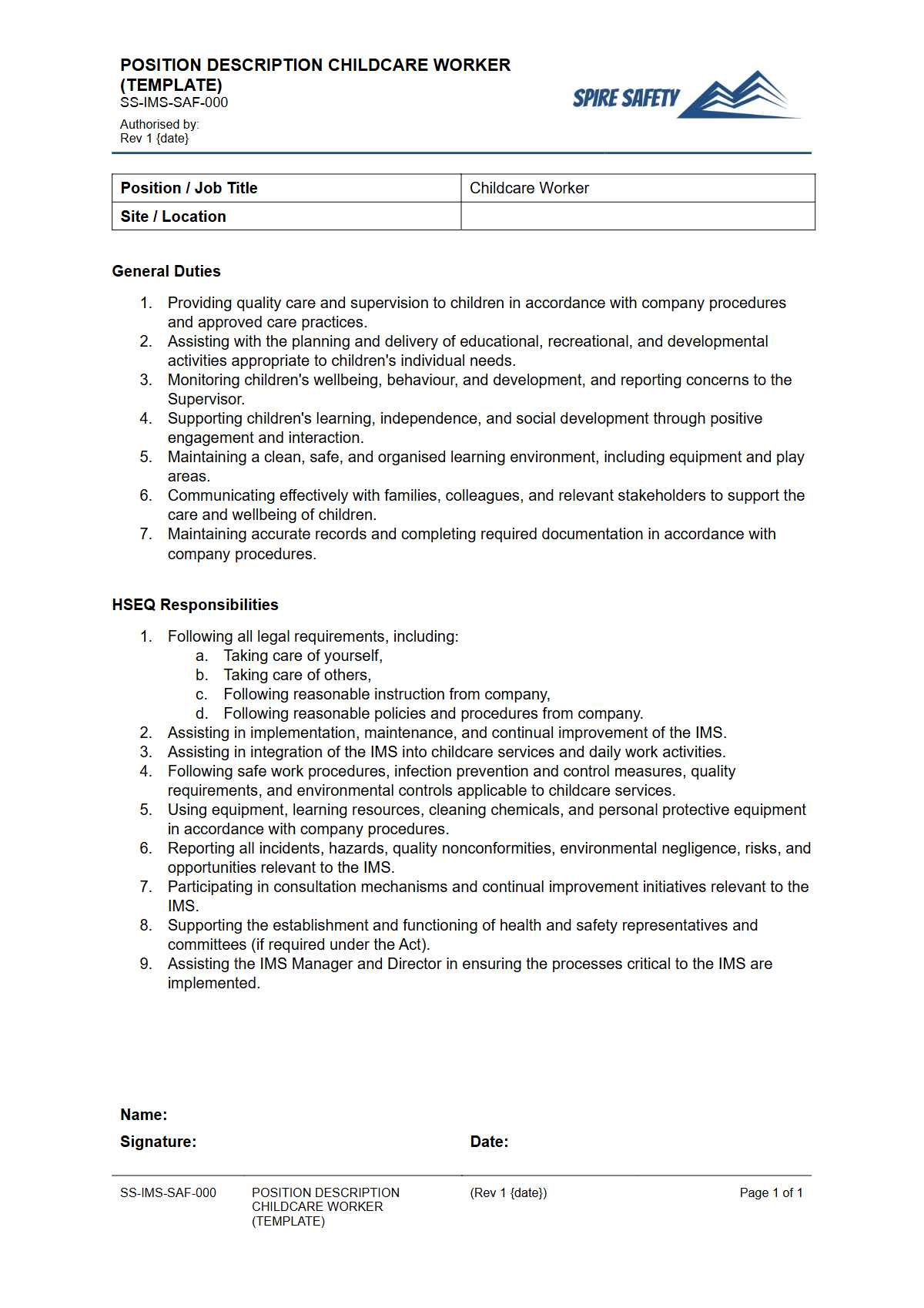
Defining roles clearly is fundamental to a safe and effective childcare centre. Our Free Position Description (Childcare Worker) Template provides a structured foundation for outlining the duties, responsibilities, and qualifications for your staff.
A well-drafted Position Description (PD) serves as a critical tool for communicating expectations, managing performance, and embedding Work Health and Safety (WHS) into every role from the outset. This template is designed to help you articulate the specific requirements of a childcare position, ensuring candidates and employees understand their contribution to maintaining a safe learning environment.
Using this template helps you formalise the role’s scope, covering everything from daily tasks and interactions with children to mandatory reporting and emergency procedures. It prompts you to consider the essential qualifications, skills, and attributes needed, ensuring you recruit the right people.
By integrating specific WHS duties, you demonstrate a commitment to safety and meet your obligations as a Person Conducting a Business or Undertaking (PCBU). It is helpful to be familiar with the key WHS definitions when customising this document to your workplace.
How to use the Free Position Description (Childcare Worker) Template
This template is provided in both DOCX and PDF formats for your convenience. Download the DOCX file to edit and tailor the content directly.
The document is structured with key sections like 'Position Purpose,' 'Key Responsibilities,' 'Selection Criteria,' and 'WHS Responsibilities' to guide you. Fill in the details specific to your centre, the particular role (e.g., assistant, educator, room leader), and your state or territory's regulatory framework.
Important: This is a template only and must be customised to your specific workplace. We recommend a competent person reviews the document to ensure it reflects your unique operational needs, identified hazards, and control measures.
A Position Description should be a living document, reviewed regularly and integrated into your broader WHS management system to remain effective.
When to use it
A Position Description is a versatile document used throughout the employment lifecycle. Its primary use is during the recruitment and selection process to attract suitable candidates and provide them with a clear understanding of the role.
It should be provided to applicants and used as a benchmark for shortlisting and interviewing. It is also an essential tool for onboarding new staff, forming the basis of their induction and training.
Furthermore, the PD serves as a foundational document for performance reviews, goal setting, and identifying professional development needs.
Who should use it
This resource is designed for managers and operators within the Australian early childhood education and care sector. This includes:
- Centre Directors and Managers
- Human Resources (HR) Professionals
- Recruitment Coordinators
- Small Business Owners operating childcare facilities
Anyone responsible for hiring, managing staff, and ensuring WHS compliance in a childcare setting will find this template a valuable starting point. It provides a professional, structured approach to role definition that supports both operational and safety objectives.
Periodically conducting a WHS compliance audit can help ensure your position descriptions and other system documents remain aligned with current legislation and practice.
Integrating WHS into the Role
Childcare work involves unique physical and psychosocial risks, including manual handling (lifting children and equipment), exposure to illnesses, and managing challenging behaviours. This PD template includes a dedicated section for WHS responsibilities to ensure these are formally recognised.
You should detail worker duties such as following hygiene protocols, reporting hazards, participating in emergency drills, and contributing to risk assessments. This focus on safety is also relevant for managing worker fatigue and well-being, ensuring staff can perform their duties safely.
Properly defining these duties helps workers understand their obligations and empowers them to actively participate in creating a safe workplace for themselves, their colleagues, and the children. If you require further guidance on embedding WHS into your operational documents, consider seeking expert WHS consulting support. For more ready-to-use templates and guides, explore our extensive free WHS resources library.
Common mistakes
Common mistakes to avoid
- Using a generic template without customising it to the centre's specific environment and hazards.
- Forgetting to include specific Work Health and Safety (WHS) responsibilities.
- Failing to update the Position Description as the role, regulations, or workplace evolves.
- Making the list of duties too vague or, conversely, too restrictive, hindering flexibility.
Legal references
Legal considerations
The following legal requirements may be relevant to this type of work.
- Work Health and Safety Act (Harmonised) — Provides the primary duties for protecting workers and other people from work health and safety risks.
- Work Health and Safety Regulations (Harmonised) — Sets out requirements supporting the management of workplace hazards and risks.
The following codes may be relevant to this type of work.
- Managing WHS Risks Code of Practice — Provides practical guidance on identifying hazards, assessing risks and applying effective controls.
- Work Health and Safety Consultation, Cooperation and Coordination Code of Practice — Provides practical guidance on consulting workers and coordinating with other duty holders.
- Managing the Work Environment and Facilities Code of Practice — Provides practical guidance on safe work environments, workplace facilities and related controls.
Did you know
Role Clarity
A well-written Position Description can reduce role ambiguity, which is a recognised psychosocial hazard that can contribute to workplace stress.
Legal Foundation
In Australia, a Position Description can be a key document in performance management and workplace disputes, outlining the agreed-upon duties of the role.
FAQ
Frequently asked questions
01Is this Position Description template compliant with Australian regulations?
02What should I include in the 'Key Responsibilities' section for a childcare worker?
03Can I use this template for different levels of childcare staff?
04Why are WHS duties important in a childcare Position Description?
Share this resource
Free Position Description (Childcare Worker) Template
Browse Categories
How To Use It
- 1Download and open in Word or PDF.
- 2Replace the placeholders with your business details.
- 3Get it reviewed by a WHS specialist before rollout.
Need it customised?
Our WHS consultants can adapt this template to your site, run a gap analysis, or audit what you already have in place.
Book a Free Consultation WHS consulting servicesor call 1300 156 382
Related templates
- Free Position Description (Civil Engineer) Template
- Free Position Description (Cleaner) Template
- Free Position Description (Concreter) Template
- Free Position Description (Construction Manager) Template
- Free Position Description (Contracts Administrator) Template
- Free Position Description (Crane Operator) Template