
Free Verification of Competency (Lighting Tower) Template
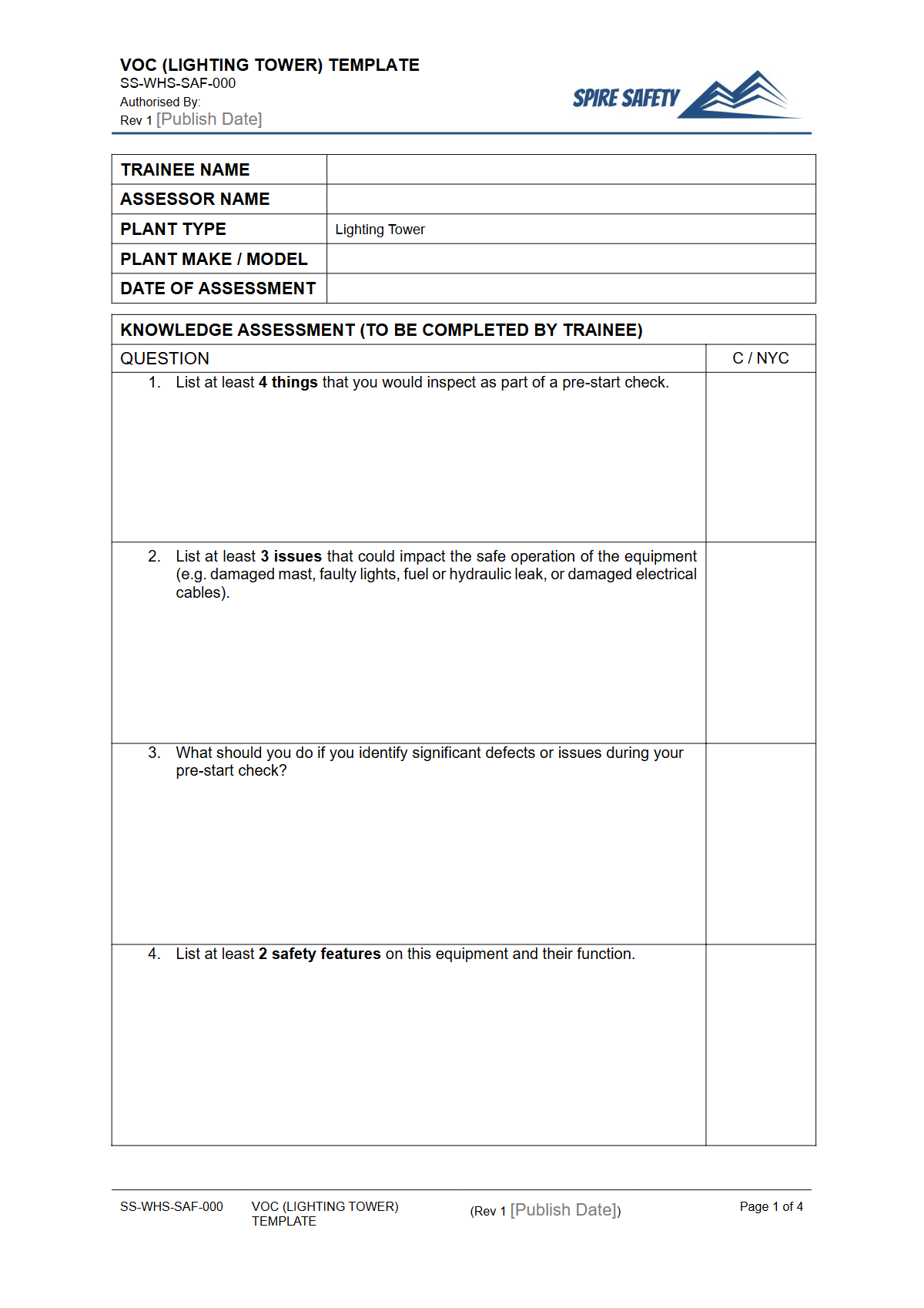
Download our free Verification of Competency (Lighting Tower) template. This structured DOCX & PDF resource helps assess operator skills. Get your template now.
Free Verification of Competency (Lighting Tower) Template
DOCX • 140 KB + PDF
Updated Oct 2026
No signup required
Purpose of the Free Verification of Competency (Lighting Tower) Template
Ensuring workers can safely and effectively operate equipment is a cornerstone of workplace health and safety. This is especially true for mobile plant like lighting towers, which are essential for nighttime and low-light operations but carry inherent risks.
Our Free Verification of Competency (Lighting Tower) Template provides a structured framework for assessing and documenting an operator's ability to use this equipment correctly, aligning with Australian WHS best practices. A VOC is a practical way to confirm that a person's skills and knowledge, whether gained through formal training or on-the-job experience, meet the requirements for safe operation in your specific work environment.
Using a standardised assessment process helps your organisation meet its duty of care. This involves verifying that operators understand pre-start checks, safe positioning, mast extension and retraction, refuelling procedures, and emergency protocols.
Proper verification helps prevent incidents related to equipment instability, electrical hazards, or incorrect manual handling. This process is a key component of robust WHS management systems, demonstrating proactive risk management.
Video walkthrough
How to use the Free Verification of Competency (Lighting Tower) Template
This template is designed for practical, on-site assessment. It combines theoretical questions with direct observation of practical tasks, from initial setup to shutdown.
The process involves an assessor observing an operator and checking off criteria as they are successfully demonstrated. It serves as a clear record that the verification took place and what was covered.
- Download: Choose between the DOCX file for easy editing or the PDF for straightforward printing.
- Customise: Adapt the document to your workplace. Add your company branding and, most importantly, modify the criteria to match the specific models of lighting towers you use and the unique conditions of your site.
- Assess: A competent person, who has in-depth knowledge and experience with lighting towers, should conduct the assessment. They will guide the operator through the required tasks and knowledge questions.
- Document: Complete the form, noting any areas where the operator requires further training. Both the assessor and the operator should sign the completed document. File it as part of the worker's training records. A similar process can be followed using our Verification of Competency (Mini Excavator) Template for other types of mobile plant.
Important: This is a template, not a finished document. We've created it as a strong starting point.
You must customise it to reflect your specific equipment, site hazards, and internal procedures to ensure it is effective for your organisation.
When to conduct a VOC
Verification of Competency is not a one-time event. It should be conducted at various points in a worker's employment to ensure skills remain current and relevant. Key triggers for conducting a lighting tower VOC include:
- Pre-employment: To verify the skills and claims of a new hire.
- New Equipment: When a new make or model of lighting tower is introduced to the workplace.
- Post-incident: After an incident or near-miss involving a lighting tower to identify and close any knowledge gaps.
- Identified Skill Gaps: If a supervisor observes unsafe or incorrect operation.
- Periodic Refreshers: As part of a regular schedule (e.g., every 2-3 years) to ensure skills haven't degraded over time. These scheduled checks can be integrated into your broader safety program, which may also be reviewed during a WHS compliance audit.
On large civil construction projects, you may need to verify competency on a range of equipment. Using specific templates for each, such as a Verification of Competency (Asphalt Paver) Template, ensures that the unique risks of each machine are addressed.
Who should use this template
This resource is designed for anyone responsible for WHS and personnel management on sites where lighting towers are used. This includes:
- WHS Managers and Advisors: To implement a consistent and documented process for skill verification across the organisation.
- Site Supervisors and Foremen: To conduct on-the-ground assessments and ensure their team members are competent to perform their assigned tasks safely.
- Project Managers: To maintain oversight of site safety standards and supports your compliance efforts with principal contractor requirements.
- Trainers and Assessors: As a basis for developing their assessment tools and recording outcomes.
Ultimately, the person conducting the VOC must be competent themselves—meaning they have the skills, knowledge, and experience to judge another person's ability to operate the equipment safely. For more templates covering different equipment, explore our complete free WHS resources library.
Common mistakes
Common mistakes to avoid
- Failing to customise the template for specific site conditions and lighting tower models.
- Using an assessor who is not themselves competent and experienced with the equipment.
- Treating the VOC as a 'tick-and-flick' exercise without genuine observation and questioning.
- Overlooking pre-start checks and safe shutdown procedures in the assessment.
Legal references
Legal considerations
The following legal requirements may be relevant to this type of work.
- Work Health and Safety Act (Harmonised) — Provides the primary duties for protecting workers and other people from work health and safety risks.
- Work Health and Safety Regulations (Harmonised) — Sets out requirements supporting the management of workplace hazards and risks.
The following codes may be relevant to this type of work.
- Managing WHS Risks Code of Practice — Provides practical guidance on identifying hazards, assessing risks and applying effective controls.
- Work Health and Safety Consultation, Cooperation and Coordination Code of Practice — Provides practical guidance on consulting workers and coordinating with other duty holders.
- Managing the Work Environment and Facilities Code of Practice — Provides practical guidance on safe work environments, workplace facilities and related controls.
Did you know
Energy Efficiency
Modern LED lighting towers can be up to 40% more fuel-efficient than older metal halide models, significantly reducing both operational costs and carbon emissions on-site.
Stability is Key
Many lighting tower incidents are caused by instability. Proper deployment of outriggers on level, firm ground is the most critical step in preventing the tower from tipping over, especially in windy conditions.
FAQ
Frequently asked questions
01What is a Verification of Competency (VOC) for a lighting tower?
02How often should a lighting tower VOC be completed?
03Is a special licence required to operate a lighting tower in Australia?
04Can I use this template for different brands of lighting towers?
Share this resource
Free Verification of Competency (Lighting Tower) Template
Browse Categories
How To Use It
- 1Download and open in Word or PDF.
- 2Replace the placeholders with your business details.
- 3Get it reviewed by a WHS specialist before rollout.
Need it customised?
Our WHS consultants can adapt this template to your site, run a gap analysis, or audit what you already have in place.
Book a Free Consultation WHS consulting servicesor call 1300 156 382
Related templates
- Free Verification of Competency (Log Splitter) Template
- Free Verification of Competency (Manual Pallet Jack) Template
- Free Verification of Competency (Material Hoist) Template
- Free Verification of Competency (Mobile Crane) Template
- Free Verification of Competency (Mulcher Attachment) Template
- Free Verification of Competency (Order Picker) Template